
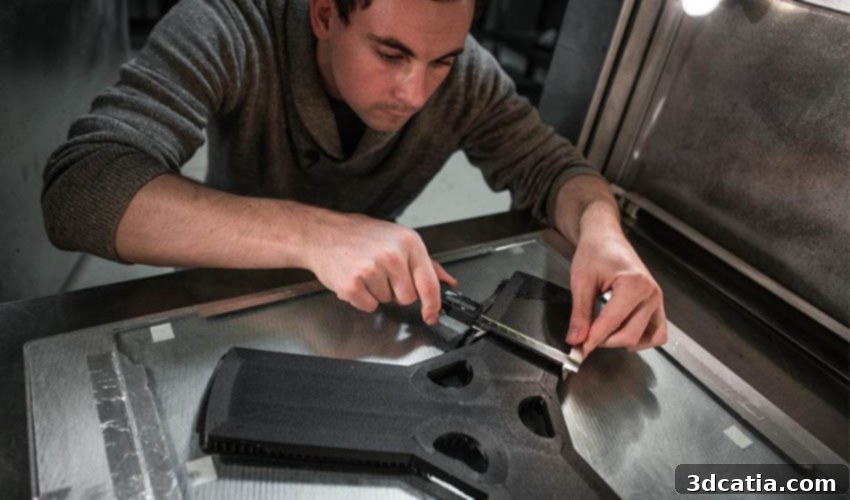
Essentium Expands Global Reach and Open Ecosystem for Industrial Additive Manufacturing
Essentium Inc., a leading innovator in industrial-scale additive manufacturing solutions, has recently announced a series of strategic business expansion initiatives. These moves come in direct response to the escalating global market demand for the company’s advanced additive manufacturing platform, which is revolutionizing how industries approach production. At the core of Essentium’s offering is its High Speed Extrusion (HSE) 180 S 3D printing platform, a system specifically engineered to facilitate true industrial production at scale. This powerful platform leverages Essentium’s proprietary FlashFuse technology, an innovation that fundamentally changes the dynamics of 3D printing.
The HSE 180 S 3D printing platform distinguishes itself from conventional Fused Deposition Modeling (FDM) solutions by offering unparalleled speed, reportedly operating up to 10 times faster than many existing FDM technologies on the market. This significant increase in print speed translates directly into higher throughput, reduced production cycles, and ultimately, a more cost-effective manufacturing process for businesses. However, speed is not the only advantage. Essentium’s innovative FlashFuse technology addresses one of the most persistent challenges in FDM 3D printing: the Z-strength issue. Traditional FDM parts often suffer from anisotropy, meaning they are weaker along the Z-axis (between layers) than in the X-Y plane. FlashFuse technology overcomes this by intelligently fusing individual layers of the printed part together *inside* the 3D printer as the components are being built. This in-situ fusion process results in a part that is remarkably stronger and more isotropic, closely mimicking the mechanical properties of injection-molded parts.
The implications of FlashFuse are profound for industrial applications. By dramatically improving Z-strength, it enables the production of truly functional, end-use parts that can withstand demanding environments. Furthermore, this advanced fusing mechanism significantly reduces, or in many cases eliminates, the need for extensive post-processing steps. This not only saves time and labor but also streamlines the overall additive manufacturing workflow. Another key benefit of FlashFuse is its versatility; it is compatible with a broad spectrum of thermoplastic materials, providing manufacturers with greater flexibility and material choice to meet diverse application requirements. This combination of speed, strength, and material flexibility positions Essentium’s HSE platform as a critical tool for companies looking to integrate additive manufacturing into their production lines for high-performance applications.
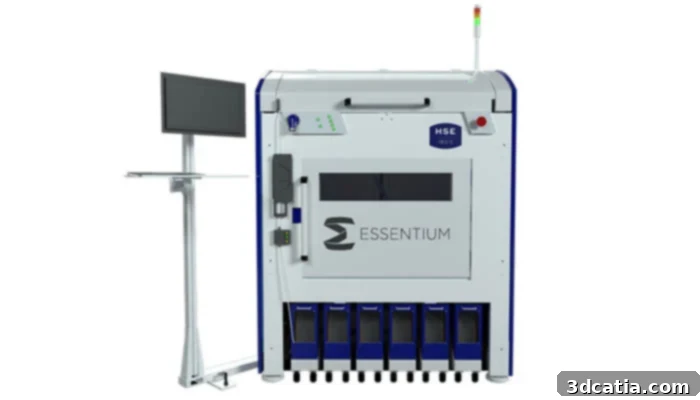
The HSE 180 S 3D printing platform from Essentium | Image via Essentium
Central to Essentium’s latest business expansion initiatives is a strong commitment to fostering an open ecosystem within the industrial extrusion additive market. This strategic approach involves close collaboration with industry leaders such as BASF 3D Printing Solutions and Materialise NV. Unlike many proprietary additive manufacturing systems that lock customers into specific hardware, software, and material choices, Essentium, alongside its partners, aims to provide unparalleled flexibility. The goal is to empower customers with greater control over their innovation processes, offering them an expansive choice of materials and the ability to achieve industrial-scale production at unprecedented economics. These key partnerships, which have been active since November 2018, are dedicated to elevating industrial additive manufacturing to its next evolutionary stage, breaking down traditional barriers to adoption.
The decision to champion an open ecosystem stems from a deep understanding of market needs. A survey previously conducted by Essentium revealed that scalability remained the primary limiting factor preventing broader adoption and more widespread use of 3D printing technologies across various industries. By offering an open platform, Essentium directly addresses this pain point, enabling manufacturers to integrate Essentium’s solutions seamlessly into their existing workflows and leverage a wider array of materials and software tools without the constraints of vendor lock-in. BASF 3D Printing Solutions contributes its vast expertise in material science, bringing a diverse portfolio of high-performance filaments, while Materialise NV provides critical software solutions and ecosystem integration, ensuring optimal performance and compatibility. This collaborative effort is designed to democratize access to advanced additive manufacturing capabilities, allowing businesses of all sizes to innovate more freely and efficiently.
Blake Teipel, CEO and Co-Founder of Essentium, articulated the strategic rationale behind this business decision, stating: “When you remove the roadblocks to innovation, you enable customer success. There are no better proof points than an expanding pipeline and growing customer demand to illustrate how much the manufacturing market is responding to open ecosystems and the freedom to innovate on their own terms.” This sentiment underscores Essentium’s core philosophy: that true progress in manufacturing comes from empowering customers, not restricting them. By providing tools and systems that allow businesses to experiment, customize, and scale on their own terms, Essentium is accelerating the pace of innovation within the additive manufacturing sector. The market’s positive reception, evidenced by increased demand, validates this customer-centric approach.
In line with its commitment to an open and versatile platform, Essentium has also significantly expanded its material portfolio, introducing seven new materials this year alone. Among these new additions are advanced thermoplastics like TPU 80A-Z and TPU 90A-FR. These specific materials are tailored to meet the rigorous demands of critical sectors such as the Electronics Manufacturing Services (EMS) and aerospace markets. TPU 80A-Z, for instance, offers superior flexibility and durability, making it ideal for applications requiring impact resistance and elasticity, commonly found in protective casings, seals, and flexible components within electronics. TPU 90A-FR, on the other hand, boasts flame-retardant properties, which are absolutely essential for aerospace applications where safety and compliance with stringent fire performance standards are paramount.
The continuous development and introduction of such high-performance materials underscore Essentium’s dedication to providing a comprehensive solution for industrial additive manufacturing. By proposing an open-system to its customers, the company offers a compelling alternative to the restrictive, closed platforms that have traditionally dominated the market. In a closed system, customers are typically “locked in” to a manufacturer’s specific hardware, software, and proprietary materials, limiting their ability to innovate and optimize. Essentium’s open approach, conversely, fosters greater innovation and material choice, directly leading to an increase in demand for the versatile HSE 180 S platform and a corresponding surge in materials consumption. This indicates that manufacturers are actively seeking the freedom and performance Essentium provides.
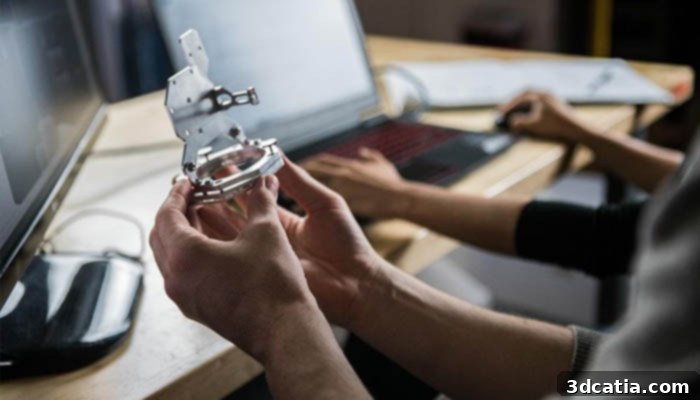
Image via Essentium, showcasing global operations
Beyond technological and ecosystem advancements, Essentium is also significantly expanding its international operations to cater to a growing global demand for its industrial solutions. This strategic global expansion is marked by key leadership appointments designed to bolster regional presence and support. Recently, Essentium appointed Benoit Valin as General Manager for Asia Pacific, a region experiencing rapid industrial growth and increasing adoption of advanced manufacturing technologies. Concurrently, Cyprien Decouty has been appointed as Channel Sales Manager for Europe, Middle East, and Africa (EMEA). These appointments are crucial for strengthening Essentium’s footprint in these vital markets, ensuring that customers worldwide have access to local expertise and support for implementing Essentium’s high-speed extrusion solutions.
Cyprien Decouty elaborated on the immense potential he sees in his new role and the EMEA market: “Additive manufacturing represents a strategic opportunity to help upgrade EMEA’s industrial base and fuel the growth of the manufacturing sector. I’m thrilled to be working with Essentium to help customers realize new opportunities and transform their manufacturing floors.” His statement highlights the transformative power of additive manufacturing in regions actively seeking to modernize their industrial infrastructure. The ability to produce parts faster, stronger, and more cost-effectively through industrial 3D printing enables companies in EMEA and Asia Pacific to enhance their competitiveness, accelerate product development cycles, and implement more resilient supply chains. This global strategic alignment ensures Essentium is well-positioned to meet the evolving needs of the manufacturing industry on an international scale, driving forward the adoption of truly industrial-grade additive manufacturing across continents.
Essentium’s ongoing commitment to innovation, coupled with its strategic partnerships and global expansion efforts, positions the company as a pivotal player in the future of manufacturing. By continually pushing the boundaries of what’s possible with high-speed extrusion and fostering an open, customer-centric ecosystem, Essentium is not just responding to market demand but actively shaping the landscape of industrial additive manufacturing. Its solutions offer manufacturers the speed, strength, material versatility, and freedom necessary to transition from prototyping to full-scale production, unlocking new opportunities for digital manufacturing and industrial transformation worldwide. The company’s vision for scalable, accessible, and high-performance 3D printing is clearly resonating across various industries, signaling a significant shift towards more flexible and efficient production methodologies.