
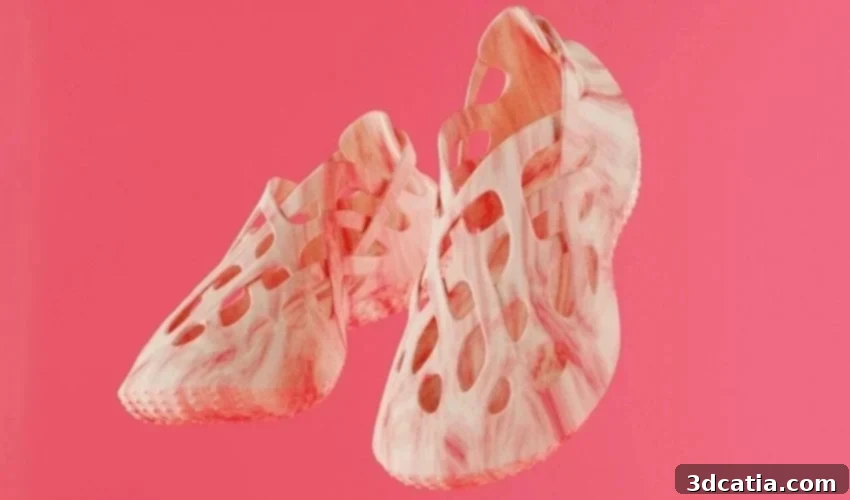
Earth Moc: Revolutionizing Sustainable Footwear with 3D Printing and Biomimicry
The footwear industry is experiencing a profound transformation, largely driven by the rapid advancements in additive manufacturing. In recent years, the proliferation of 3D printed shoes has not only caught the attention of designers and manufacturers but also ignited a new wave of innovation. This surge in interest culminated in significant events, such as the 3D Printing Shoe Design Contest organized by leading 3D printer manufacturer Sintratec earlier this year. This competition aimed to spotlight and celebrate the most groundbreaking designs in 3D printed footwear, fostering a creative environment where technology meets practical application. It was within this innovative spirit that the Earth Moc shoe emerged, a creation that beautifully blends cutting-edge technology with thoughtful design principles.
Conceived by talented designer Daniel Shirley, the Earth Moc is far more than just another pair of shoes; it represents a forward-thinking approach to comfort, flexibility, and environmental responsibility. Designed with the active individual in mind, particularly hikers and backpackers, it offers robust support while maintaining an exceptionally lightweight and comfortable feel. Shirley’s vision was clear: to craft a recovery shoe that could be comfortably worn after strenuous outdoor activities, yet versatile enough for light hiking. As Daniel Shirley himself articulated, “The idea was to create a recovery shoe that you could wear after hiking or backpacking, that is light and comfortable, but with which you could also potentially do some light hiking with as well.” This dual functionality makes the Earth Moc a compelling solution for outdoor enthusiasts seeking both relaxation and readiness for their next adventure.
Innovative Design Inspired by Nature
The Earth Moc immediately distinguishes itself through its visually striking and entirely 3D printed design. Its aesthetic is deeply rooted in nature, featuring intricate patterns and shapes that evoke the organic complexity of roots and vines. This unusual geometry and unique design are a testament to the boundless possibilities unlocked by additive manufacturing. Traditional manufacturing methods often struggle with such complex, interwoven structures, but 3D printing excels at producing them with remarkable precision. This not only results in an eye-catching appearance but also contributes to the shoe’s functional benefits, such as breathability and adaptive support.
In the development of the Earth Moc, Daniel Shirley made a conscious choice to utilize only flexible Thermoplastic Elastomer (TPE) material. This mono-material approach is crucial for both performance and sustainability. TPE is celebrated for its excellent elasticity, softness, and durability, properties that are paramount for footwear designed to offer maximum comfort and flexibility. The project team emphasized that this material choice was deliberate, aimed at maximizing the shoe’s comfort profile and ensuring it could withstand the rigors of outdoor use while conforming seamlessly to the foot’s natural movements. The selection of TPE also plays a vital role in the shoe’s commitment to a circular economy, simplifying the recycling process due to its single-material composition.
For the actual fabrication of the Earth Moc, Daniel Shirley leveraged the capabilities of the Sintratec S2 machine. This particular 3D printer is renowned for its Selective Laser Sintering (SLS) technology, a powerful additive manufacturing process that meets the specialized needs of intricate applications. The Sintratec S2’s precision and ability to work with flexible materials like TPE were instrumental in bringing the Earth Moc’s complex, nature-inspired design to life, ensuring both structural integrity and desired material properties.
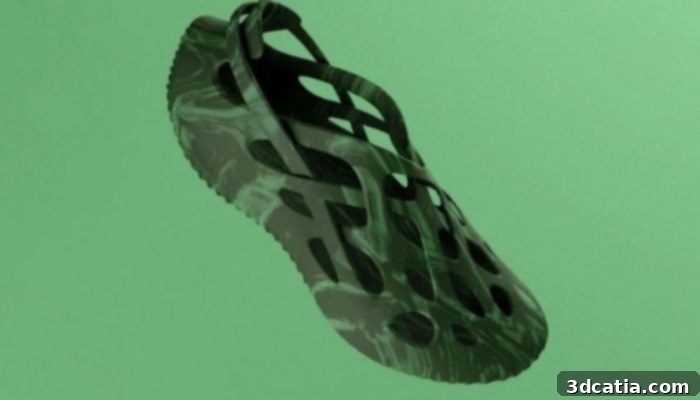
Photo Credits: Daniel Shirley
The Transformative Advantages of 3D Printing in Footwear
Enabling Complex Geometries and Rapid Prototyping
The inherent strengths of the SLS process, as facilitated by machines like the Sintratec S2, offer unparalleled advantages in footwear design. This technology empowers designers like Daniel Shirley to create shoes with extraordinarily complex shapes and intricate internal structures that would be virtually impossible or prohibitively expensive to produce with conventional manufacturing techniques. The Earth Moc’s organic, root-like design is a prime example of such geometric freedom, where form not only follows function but also mirrors natural efficiency.
Beyond aesthetic complexity, Daniel Shirley highlighted another critical benefit: the ability to quickly create prototypes. Rapid prototyping significantly streamlines the design and development cycle, allowing designers to iterate on their ideas at an accelerated pace. Shirley noted that this capability greatly simplified the manufacturing process for the Earth Moc. By quickly producing physical models, he could easily identify and test the precise characteristics of the TPE material, ensuring optimal comfort, flexibility, and durability. This iterative process allows for continuous refinement, leading to a superior final product that perfectly meets its intended purpose. It also drastically reduces the time and cost associated with traditional mold-making and sample production.
Pioneering a Circular Economy Through Biomimicry
Developing the Earth Moc was a journey spanning more than a year, driven by a profound ambition beyond just creating a functional shoe. Daniel Shirley envisions the Earth Moc as a catalyst for democratizing the circular economy, especially within the often resource-intensive footwear industry. This vision is primarily realized through two core principles embedded in the shoe’s design: its mono-material construction and its foundation in biomimicry. By using a single type of flexible TPE, the Earth Moc simplifies end-of-life recycling, paving the way for a more sustainable product lifecycle where materials can be recovered and reused, minimizing waste and resource depletion.
Biomimicry, the innovative approach of imitating nature’s designs and processes to solve human problems, is evident throughout the Earth Moc. The shoe’s organic, root-like structure is not merely decorative; it’s a functional design inspired by the efficiency and strength found in natural systems. This approach not only lends the shoe its distinctive aesthetic but also contributes to its comfort, support, and material efficiency. By learning from nature’s proven solutions, the Earth Moc embodies a design philosophy that is inherently sustainable and optimized for performance.
As additive manufacturing continues to gain traction and popularity within the footwear industry, its ecological benefits become increasingly apparent. Compared to traditional mass production, 3D printing can significantly reduce material waste by building objects layer by layer, only using material where it’s needed. It also opens doors for localized production, potentially shortening supply chains and reducing transportation emissions. Projects like the Earth Moc serve as powerful demonstrations of how 3D printing can align technological advancement with environmental stewardship, creating products that are not only innovative and high-performing but also kind to the planet.
The Future of Personalized and Sustainable Footwear
While the Earth Moc represents a significant leap forward in sustainable and performance-oriented footwear design, enthusiasts eager to purchase such an innovative shoe will need to exercise patience. Currently, projects of this caliber, which push the boundaries of materials, design, and manufacturing processes, are often in the conceptual or advanced prototyping stage. This period is crucial for further research, testing, and scaling up production to meet potential demand while maintaining the high standards of quality and sustainability. The journey from concept to consumer product involves meticulous engineering, material science breakthroughs, and establishing efficient production workflows.
The eventual widespread adoption of 3D printed footwear like the Earth Moc holds immense promise. It heralds a future where shoes can be truly personalized, custom-fitted to individual foot anatomies, and even printed on-demand closer to the consumer, further reducing environmental impact. Imagine a world where shoes are not just mass-produced commodities but tailored creations that perfectly match individual needs, preferences, and ethical considerations. This level of customization and sustainability is the ultimate goal, and projects like Daniel Shirley’s Earth Moc are pioneering the path to that exciting future. The video below offers a deeper dive into the vision and development behind this remarkable 3D printed shoe.
What are your thoughts on the innovative Earth Moc shoe by designer Daniel Shirley? Share your opinions and insights by leaving a comment below or by engaging with us on our LinkedIn, Facebook, and Twitter pages! For those who want to stay at the forefront of additive manufacturing news, don’t forget to sign up for our free weekly Newsletter here, delivering the latest 3D printing news straight to your inbox! You can also explore all our compelling videos and interviews on our dedicated YouTube channel.
Cover Photo Credits: Daniel Shirley