

Dubai’s Maritime Future: Unveiling the World’s First 3D Printed Electric Abra
The United Arab Emirates consistently stands at the forefront of technological innovation, with Dubai, its most dynamic city, serving as a vibrant hub for groundbreaking projects. In recent years, 3D printing technology has been extensively integrated across various sectors, from construction to infrastructure, marking Dubai’s commitment to becoming a global smart city. This pioneering spirit continues to reshape urban landscapes and public services. Building on this momentum, the Dubai’s Roads and Transport Authority (RTA) has proudly announced the trial operation of what it hails as the world’s first electric, 3D printed abra. This landmark achievement not only highlights the UAE’s dedication to sustainable and advanced solutions but also sets a new benchmark for maritime transport globally.
This development comes on the heels of another remarkable feat last September, when a 3D printed water taxi made headlines in Abu Dhabi for breaking world records. These advancements unequivocally demonstrate the escalating importance and capabilities of additive manufacturing within the maritime sector across the UAE. The integration of 3D printing into shipbuilding is proving to be a game-changer, offering unprecedented efficiency, design flexibility, and cost-effectiveness. What makes this latest project particularly compelling is its ingenious blend of deep-rooted tradition with cutting-edge modern shipbuilding techniques, creating a bridge between Dubai’s rich heritage and its ambitious future.
Embracing Tradition: The Enduring Legacy of the Abra
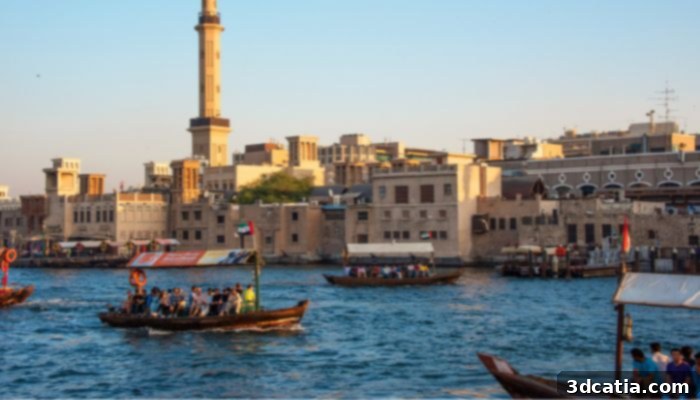
Traditional wooden abras on the Dubai Creek (photo credits: By Phil6007 – Own work, CC BY-SA 4.0)
An abra, a name synonymous with Dubai’s identity, is a traditional wooden boat that has served as a vital mode of transport for centuries. These iconic vessels gracefully ferry passengers across the historic Dubai Creek, a natural saltwater waterway that breathes life into the city. Ranging from 600 to 3940 feet (approximately 200 to 1200 meters) in width, the creek stretches from a natural port in Dubai all the way to the Persian Gulf, a distance of 8.1 miles (13 km). Abras are more than just boats; they are cultural symbols, connecting the vibrant districts of Deira and Bur Dubai and representing the oldest form of public transport in the city. Their rhythmic journeys across the creek offer a glimpse into Dubai’s past, contrasting sharply with the dazzling modernity of its towering skyscrapers. Preserving the essence of the abra while infusing it with futuristic technology is a testament to Dubai’s respect for its heritage, coupled with its drive for innovation.
A Vision for Sustainable Urban Mobility
By introducing a 3D printed electric abra, Dubai’s government officials are not merely marrying tradition with modernity; they are proactively seeking to significantly enhance maritime transport services throughout the city. This initiative aligns perfectly with Dubai’s broader vision for a smart, sustainable, and efficient urban environment. His Excellency Mattar Al Tayer, Director General and Chairman of the Board of Executive Directors of the RTA, articulated the strategic importance of this project: “The trial operation of the electric abra manufactured using 3D printing technology, along with the improvement of traditional abra stations project, is part of RTA’s master plan to enhance the marine transport services, a vital mobility means in Dubai, adding much value to the maritime transport sector.” This statement underscores the RTA’s comprehensive approach to modernizing its public transport network, with marine transport playing a crucial role in connecting communities and supporting the city’s growth. The electric abra represents a tangible step towards achieving carbon neutrality goals and setting new standards for eco-friendly public transportation.
Making a 3D Printed Abra: An Engineering Marvel
The creation of this pioneering 3D printed abra is a collaborative triumph involving leading companies in their respective fields. Manufactured by Al Seer Marine Company in Abu Dhabi – the same innovative entity responsible for last year’s record-breaking 3D printed water taxi – the project also benefited from the expertise of global partners like Mitsubishi, which supplied critical materials, and Siemens, which oversaw the intricate programming and calibration of the advanced 3D printers. This multi-sectoral collaboration highlights the complexity and ambition behind bringing such a project to fruition.
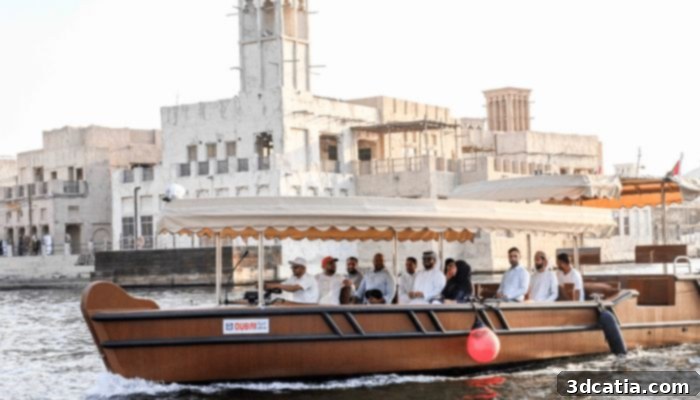
The 3D printed abra can transport up to 20 passengers (photo credits: RTA)
Although meticulously designed and built to faithfully retain the traditional abra’s beloved identity and aesthetic, the integration of 3D printing technology brings a host of transformational benefits. This advanced manufacturing method is projected to dramatically reduce abra manufacturing time by an astounding 90%, significantly slash manufacturing costs by 30%, and cut ongoing operation and maintenance expenses by 30%. These efficiencies are not merely economic; they are also integral to the RTA’s overarching environmental sustainability strategy for maritime transport. By minimizing waste, reducing production timelines, and lowering energy consumption throughout the lifecycle of the vessel, the 3D printed electric abra embodies a holistic approach to sustainable development. Additive manufacturing’s ability to create complex geometries with less material waste and its potential for on-demand parts production further contribute to a greener and more agile shipbuilding process, paving the way for a new era of marine innovation.
Advanced Features and Specifications
Beyond its manufacturing process, the 3D printed abra boasts several remarkable technical attributes that set it apart. Al Tayer elaborated on these cutting-edge features, noting, “The newly manufactured abra features numerous technical attributes, including the longest monocoque structure created using 3D printing technology, measuring 11 meters in length and 3.1 meters in width. It has an electric propulsion system powered by two 10-kilowatt motors and lithium batteries.” The monocoque structure, renowned for its strength, rigidity, and lightweight properties, signifies a leap forward in marine design, enhancing both safety and efficiency. The adoption of an electric propulsion system, powered by robust lithium batteries and twin 10-kilowatt motors, ensures silent, zero-emission operation, drastically reducing the environmental footprint compared to traditional fuel-powered vessels. This not only aligns with Dubai’s environmental goals but also promises a quieter and more pleasant experience for the up to 20 passengers it can comfortably transport across the Dubai Creek, thereby enhancing urban livability and promoting sustainable tourism.
A Glimpse into the Future of Urban Mobility
The trial operation of the 3D printed electric abra is just one facet of the RTA’s ambitious plans for enhancing Dubai’s marine transport infrastructure. Alongside this innovative venture, the RTA is actively working to improve the traditional abra stations, which currently serve over 14 million passengers annually. While it has not been explicitly stated whether additive manufacturing will be utilized for these station upgrades, the underlying principles of sustainability, efficiency, and lower operational costs remain paramount, as reiterated in a press release from the RTA. This dual approach – innovating with new vessels while optimizing existing infrastructure – showcases a forward-thinking strategy for urban mobility.
Concluding his remarks, Al Tayer outlined the next steps for this pioneering project: “The abra will be operated at the Sheikh Zayed Road Marine Transport Station on the TR6 line on a trial base. During this operation phase, the performance of the abra will be monitored and compared with the current 20-passenger fiberglass abras.” This meticulous evaluation phase is crucial to assess the real-world performance, efficiency, and passenger experience of the 3D printed electric abra, ensuring that it not only meets but exceeds expectations for sustainable and modern public transport. The outcomes of this trial will undoubtedly inform future policy and deployment strategies for advanced maritime solutions in Dubai and potentially serve as a model for cities worldwide seeking to integrate smart technologies into their urban fabric. Further insights into this groundbreaking project can be found on the UAE’s official news office HERE.
What are your thoughts on this groundbreaking 3D printed electric abra and its potential to transform urban maritime transport? We’d love to hear your perspective! Let us know in a comment below or connect with us on our LinkedIn, Facebook, and Twitter pages! For the latest updates and exclusive insights into the world of additive manufacturing, don’t forget to sign up for our free weekly newsletter here, delivered straight to your inbox. You can also explore all our compelling videos and interviews on our YouTube channel.