
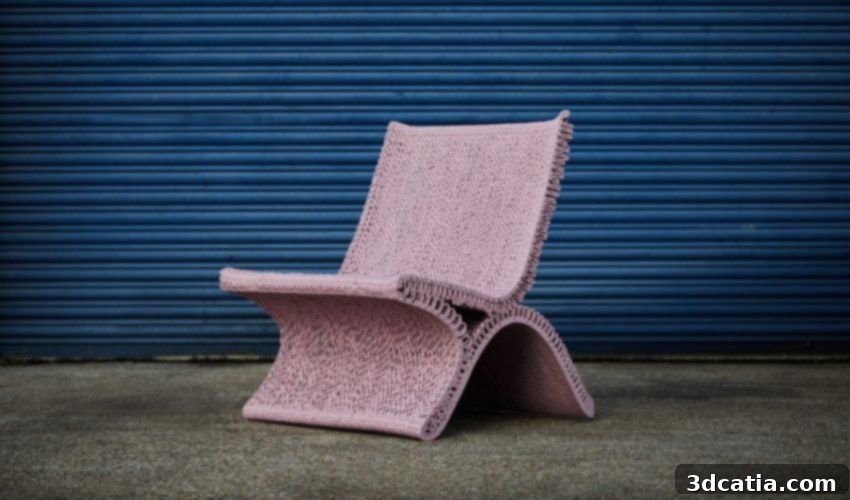
Revolutionizing Sustainable Design: Gareth Neal and The New Raw’s ‘Digitally Woven’ Recycled Plastic Innovations
The convergence of art, design, and cutting-edge 3D printing technology consistently sparks a unique blend of excitement and anticipation, prompting us to marvel at where form gracefully meets function, or where vision brilliantly materializes into reality. Indeed, the transformative role of 3D printing within the global design landscape has evolved dramatically, establishing itself as a formidable force and making several audacious statements along its pioneering journey. At the forefront of these significant advancements is the pressing concept of sustainability, which has been seamlessly integrated into countless innovative projects worldwide. These initiatives are rigorously focused on achieving zero waste objectives and fostering comprehensive reusability across various industries. Adding their names to this esteemed list of innovators are British designer Gareth Neal and the acclaimed Dutch design studio The New Raw. Their recent collaboration has culminated in a groundbreaking series of 3D printed objects meticulously crafted from extensively recycled plastics, pushing the boundaries of what is possible in eco-conscious design.
The Intersection of Innovation and Sustainability in Additive Manufacturing
In an era increasingly defined by environmental consciousness, the quest for truly sustainable manufacturing methods has become paramount. Additive manufacturing, commonly known as 3D printing, offers unprecedented opportunities to redefine production processes, minimize waste, and harness the potential of recycled materials. Traditional manufacturing often generates significant waste through subtractive methods, where material is removed from a larger block. In contrast, 3D printing builds objects layer by layer, only using the material that is absolutely necessary, thereby drastically reducing material consumption and scrap. This inherent efficiency positions 3D printing as a cornerstone for developing a more circular economy, where resources are kept in use for as long as possible, extracting the maximum value from them whilst in use, then recovering and regenerating products and materials at the end of each service life. The partnership between Gareth Neal and The New Raw exemplifies this philosophy, not merely by utilizing recycled plastic, but by pushing the boundaries of how effectively these materials can be re-employed in high-design applications, demonstrating a profound commitment to environmental stewardship through innovative design practices.
Unveiling the ‘Digitally Woven’ Series: A Paradigm Shift in Recycled Plastics
The collaborative series, aptly named ‘Digitally Woven,’ stands out as a remarkable achievement, primarily for two pivotal reasons that redefine what’s achievable with recycled materials and advanced manufacturing techniques. Firstly, the series boldly leverages ‘thrice-recycled’ plastic as its primary material. This choice powerfully underscores the profound reusability and commercial viability of materials salvaged from waste streams, challenging conventional notions about the lifecycle limitations of plastics. It demonstrates a clear pathway towards a more sustainable future where materials are not merely used once but can undergo multiple cycles of reclamation and transformation into valuable new products. Secondly, and perhaps even more ingeniously, the material is extruded in a series of intricately interlocking loops, a stark departure from the standard stacked layers of filament typically observed in most 3D printing processes. This unique extrusion method is not merely an aesthetic choice; it is a critical engineering decision with profound implications for material integrity and structural performance.
The rationale behind this innovative looping construction might not be immediately apparent, but it addresses a fundamental challenge inherent in the recycling process. While the concept of continually using and reusing materials is undeniably noble and crucial for environmental preservation, it frequently presents significant risks. The repeated thermal and mechanical stresses involved in reclamation and reprocessing can cause the molecular structure of plastics to break down over time, leading to a progressive loss of strength, rigidity, and overall material integrity. This degradation often limits the number of times a plastic can be effectively recycled without compromising the quality and durability of the resulting product. However, the ingenious creators of the ‘Digitally Woven’ series were able to masterfully circumvent this pervasive risk thanks to their profoundly innovative design style. The intricately interconnected layout of the loops, combined with the carefully calibrated thickness of the extruded material, enables the final structure to retain exceptional strength and resilience. Furthermore, this intelligent method of construction significantly contributes to lowering the overall amount of material required to complete each project, enhancing the series’ eco-friendly credentials by reducing both raw material input and potential waste.
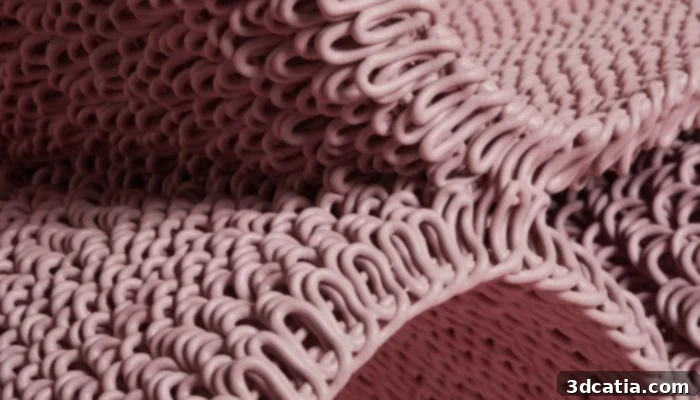
The fully 3D printed design resembles the loops on a knit or woven object.
Bridging Traditional Craft and Digital Fabrication for Enhanced Resilience
The deliberate choice of this looping construction is deeply rooted in a thoughtful design philosophy. The collaborative team explicitly aimed to explore and reinterpret traditional crafting methods, such as weaving and knitting, through the versatile medium of 3D printing. This artistic and technical exploration sought to draw parallels between the intricate, interconnected nature of textile production and the possibilities of digital fabrication. A significant advantage stemming from the unique structure of the ‘woven’ print lies in its ability to gracefully accommodate minor imperfections. The designers envisioned that any small irregularities or variances in the print, which would typically be considered flaws in conventional manufacturing, could be inherently supported and subtly obscured by the overarching, robust structure of the interconnected loops. This innovative approach allows the printed object to inherently absorb and integrate minor anomalies, transforming potential weaknesses into features of its unique aesthetic and structural integrity. Consequently, this method offers substantial benefits in terms of efficiency and sustainability: the production process saves valuable time and drastically reduces material waste because any slight imperfections or even misprints are not necessarily failures but are instead continuously reinforced and supported by the inherent strength and forgiving nature of the surrounding structural network.
Gareth Neal himself provides insightful commentary on the genesis and groundbreaking nature of this project, highlighting the collaborative spirit that fueled its success. “At the time of starting the project, The New Raw was printing in a very traditional style with layered prints that had come from putting 3D models through slicer tools. They asked me to look into how we could consider using their technology to capture craft techniques that they had started to explore to disguise the misprints,” Explains Neal, detailing the initial challenge and the innovative pivot. His words underscore the studio’s desire to move beyond conventional layered additive manufacturing, seeking a method that could not only incorporate but also celebrate the nuances of handcrafted aesthetics. Neal continues, emphasizing the profound impact of their discovery: “The open weave structures were a totally new breakthrough and are really quite special in that they create structurally strong, lightweight objects using half the normal material use. I learned so much [and] it has also reinforced how important the close relationship is between artists and manufacturers. If a manufacturer is open to experimentation, a designer or a maker really can introduce new approaches to traditional methods.” This statement encapsulates the essence of the ‘Digitally Woven’ series: a testament to pioneering material efficiency, where objects achieve superior strength and lightness with significantly reduced material consumption. More profoundly, Neal’s reflection highlights the indispensable synergy between creative vision and manufacturing capability. It illustrates that true innovation often blossoms at the intersection of artistic inquiry and the willingness of industrial partners to embrace experimentation and departure from established norms, fostering a fertile ground for redefining traditional practices through modern means.
The Future of Eco-Conscious Design and Digital Fabrication
The ‘Digitally Woven’ series made its highly anticipated public debut at the prestigious London Design Festival, specifically showcased within the Material Matters fair. This platform provided the ideal setting for an international audience to witness the groundbreaking confluence of sustainable materials, advanced 3D printing techniques, and timeless craft aesthetics. The positive reception at such a significant design event further validated the innovative direction taken by Gareth Neal and The New Raw. Since its successful unveiling, both designers have continued to meticulously develop and expand the ‘Digitally Woven’ line, iterating on the initial concepts and exploring new possibilities for this unique manufacturing approach. Simultaneously, they remain dedicated to pursuing their individual new projects, each contributing uniquely to the evolving landscape of contemporary design and sustainable practices. For enthusiasts and design professionals eager to delve deeper into the pioneering work of these artists, more information on Gareth Neal or The New Raw can be found by visiting their respective websites, which offer comprehensive insights into their latest products, designs, and ongoing research.
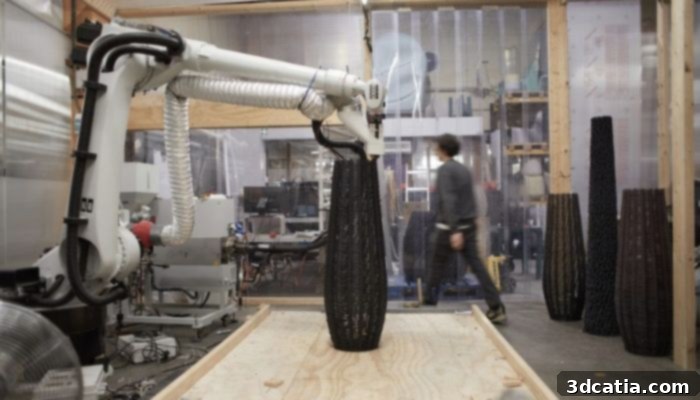
The robotic arm-assisted 3D printer from The New Raw.
What are your thoughts on the groundbreaking ‘Digitally Woven’ series and its implications for the future of sustainable design and 3D printing? We invite you to share your perspectives and engage in the conversation by leaving a comment below or by connecting with us on our vibrant social media platforms, including LinkedIn, Facebook, and Twitter! Furthermore, to ensure you never miss out on the very latest advancements and news in the dynamic world of additive manufacturing, don’t forget to sign up for our complimentary weekly Newsletter here, delivering cutting-edge 3D printing insights directly to your inbox. For a visual exploration of innovative 3D printing projects and technologies, you can also discover all our engaging videos on our dedicated YouTube channel.
*All Photo Credits: James Champion