
Revolutionizing Military Additive Manufacturing: Accelerating 3D Printed Part Qualification with AI and Advanced Monitoring
The future of defense technology is being shaped by groundbreaking advancements in additive manufacturing, more commonly known as 3D printing. However, a significant bottleneck in deploying critical 3D-printed components for military applications has been the arduous and time-consuming process of qualifying these parts and accurately predicting their operational lifespan. Traditionally, evaluating a single 3D-printed component and forecasting its durability has been an immense undertaking, requiring a supercomputer to crunch data for an average of 18 months. This lengthy cycle severely limits the agility and responsiveness needed in modern defense strategies.
In a monumental step forward, Texas A&M University recently announced that a dedicated team of its expert faculty members has been awarded a substantial $1.6 million grant. This vital funding is earmarked for the development of a revolutionary system designed to dramatically accelerate this part qualification process. The ambition is nothing short of transformative: researchers at Texas A&M aim to shrink the evaluation period from an astonishing 18 months down to an unprecedented three days, and crucially, to achieve this using a standard laptop. This potential paradigm shift promises to unlock the full potential of additive manufacturing for military use, enabling rapid deployment and innovation on an unprecedented scale.
The financial backing for this pivotal research initiative originates from the U.S. Defense Advanced Research Projects Agency (DARPA), a federal agency responsible for developing emerging technologies for use by the military. The funding was specifically allocated through DARPA’s Structures Uniquely Resolved to Guarantee Endurance (SURGE) program. The SURGE program represents a strategic challenge to the prevailing machine-centric approach to part qualification within the additive manufacturing industry. Instead of focusing on the general capabilities of a specific 3D printer, SURGE advocates for a critical shift toward evaluating the unique characteristics and integrity of individual parts. The program’s overarching goal is to enable truly on-demand, globally distributed production capabilities, allowing for virtually any geometry to be manufactured on any compatible machine, anywhere in the world, while rigorously ensuring these parts meet stringent durability standards under anticipated service conditions. This vision is essential for future military logistics and operational readiness.
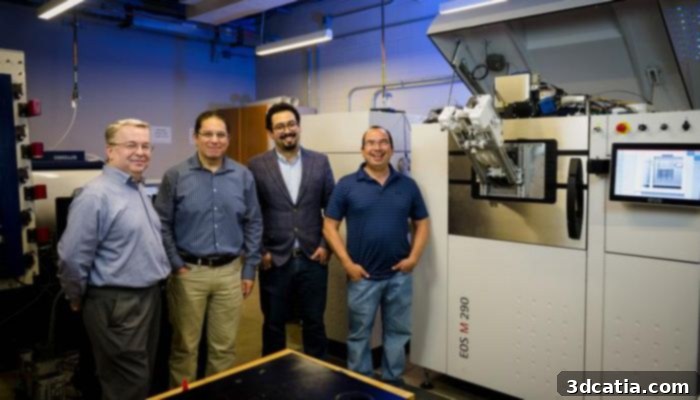
From left to right, members of the Texas A&M team Dr. Ibrahim Karaman, Dr. Alaa Elwany, Dr. Mohsen Taheri Andani and Dr. Raymundo Arroyave, next to a metal 3D printer. Photo Credit: Leon Contreras/Texas A&M Engineering
Achieving the ambitious goal of reducing qualification time is paramount for the broader adoption of additive manufacturing in critical defense applications. By enabling parts to be evaluated and certified in merely three days using a laptop – a stark contrast to the current 18-month supercomputer requirement – the production and deployment cycle for crucial components can be dramatically accelerated. This efficiency gain is not just a matter of convenience; it encourages a more widespread and confident integration of 3D printing into vital military systems. The implications are profound: it could lead to the installation of more 3D printers at various Department of Defense (DoD) bases worldwide, fostering localized production and reducing supply chain vulnerabilities. Furthermore, such an advancement promises millions of dollars in potential savings for the DoD through optimized manufacturing processes, reduced downtime, and faster iteration cycles. If the innovative approach developed by the Texas A&M team proves successful and is widely adopted, its impact has the potential to ripple across the entire additive manufacturing industry, setting new benchmarks for efficiency and reliability.
Dr. Mohsen Taheri Andani, a distinguished member of the Texas A&M grant team, eloquently articulated the excitement surrounding this venture: “This is an exciting moment for the additive manufacturing field, a community that increasingly recognizes the urgent need to accelerate the qualification of 3D-printed parts. By integrating in-situ data with the underlying microstructural features formed during printing, the program will bridge expertise in process monitoring, microstructure characterization, and property evaluation – paving the way for faster, more reliable deployment of additive-manufactured parts.” His statement underscores the interdisciplinary nature of the research, combining advanced monitoring techniques with deep material science understanding to create a holistic qualification framework. This integration is crucial for understanding how printing parameters directly influence the final material properties and, subsequently, the lifespan of a component.
How Are the Lifespans of 3D Printed Military Parts Predicted?
Predicting the lifespan of 3D printed parts is an inherently complex challenge, largely due to the variability inherent in the additive manufacturing process. Even when identical parts are printed on the same machine using the same materials and parameters, microscopic defects can vary significantly in their location, size, and type. These defects, which can include porosity, lack of fusion, or residual stresses, are critical indicators of a part’s structural integrity and are primary determinants of when and how a component might fail under operational conditions. To precisely understand how these variable defects influence part durability and performance, the Texas A&M team will embark on a collaborative effort with Addiguru during the initial two-year phase of the grant.
Addiguru is an innovative company renowned for its software solutions that provide advanced in-situ monitoring and real-time issue detection technology for additive manufacturing. Their proprietary system achieves this by processing a rich stream of data continuously collected from optical, thermal, and various machine sensors integrated directly into the 3D printing environment. The partnership with Addiguru is central to the Texas A&M team’s strategy. Together, they aim to develop a sophisticated sensor package specifically designed for seamless installation within commercial additive manufacturing platforms. This package will be capable of meticulously monitoring the printing process as it unfolds, capturing invaluable data about the material deposition, temperature gradients, and potential defect formation in real time.
Once this advanced sensor system is perfected and validated, the researchers will move to the next critical phase: creating an AI-driven, high-resolution defect-detection system. This intelligent system will be engineered to intelligently read, combine, and process vast quantities of data originating from multiple sensor sources simultaneously. The primary objectives here are achieving both exceptional speed and unparalleled accuracy in identifying and characterizing even the most minute defects. By leveraging the power of artificial intelligence and machine learning algorithms, the system will learn to correlate specific sensor readings with known defect types and their potential impact on part performance, thereby enabling rapid and precise predictions of structural integrity and expected lifespan. This fusion of cutting-edge sensing technology with advanced AI promises to be a game-changer for military component qualification.
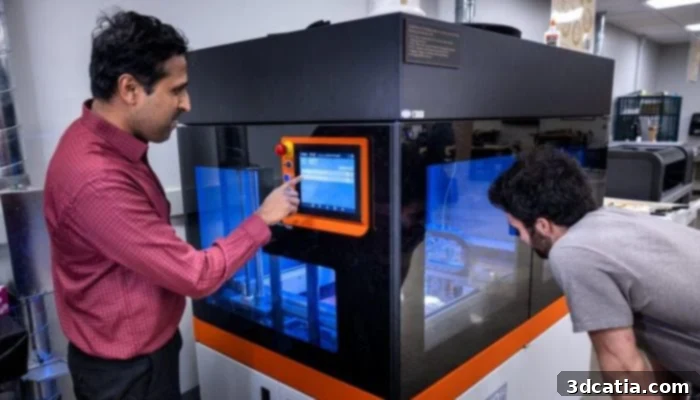
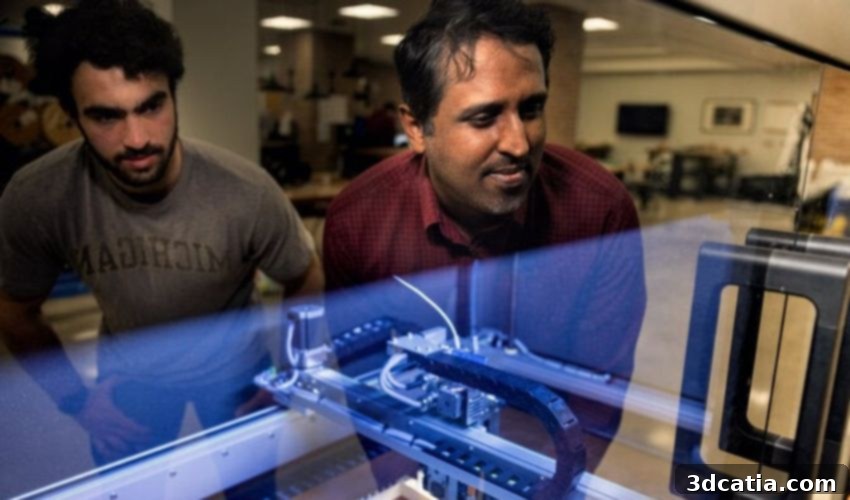
Members of the University of Michigan team, Veera Sundararaghavan ( U-M professor of aerospace engineering and principal investigator of the project) and PhD student Michael Philipchuk, working with a 3D printer. Photo Credits: Marcin Szczepanski/Michigan Engineering
A Grand Collaborative Effort Driving Additive Manufacturing Innovation
The ambitious project spearheaded by Texas A&M University is not an isolated endeavor but rather a key component of a much larger, multi-institutional initiative. The Texas A&M team itself is comprised of four distinguished experts: Dr. Mohsen Taheri Andani, Assistant Professor of Mechanical Engineering; Dr. Raymundo Arróyave, Chevron Professor (II) of Materials Science and Engineering; Dr. Aala Elwany, Professor of Industrial and Systems Engineering; and Dr. Ibrahim Karaman, Chevron Professor and Head of the Department of Materials Science and Engineering. However, their specific $1.6 million grant is nested within a broader, comprehensive four-year grant totaling $10.3 million. This significant funding is shared among a consortium of highly respected collaborators, including the University of Michigan, Auburn University, the University of California, San Diego, and ASTM International. Additionally, critical industry partners such as Addiguru and AlphaStar are integral to the success of this expansive research program.
In mid-April, the University of Michigan announced its leading role in a parallel, yet complementary, four-year project named Predictive Real Time Intelligence for Metal Endurance (PRIME). The PRIME project focuses specifically on advanced predictive modeling. Researchers at the University of Michigan will meticulously document every stage of the laser powder bed fusion (L-PBF) printing process – a common and critical additive manufacturing technique for metals. This detailed documentation will serve as the foundation for creating a precise “digital twin” of each manufactured part. Leveraging the expertise of the 3D printing simulation company AlphaStar, these digital twins will not only replicate the geometry of the physical part but will also meticulously incorporate all identified defects and microstructural variations that occur during the printing process. This digital representation allows for advanced computational analysis.
Following the creation of these digital twins, the University of Michigan team, in close collaboration with partners at the University of California, San Diego, will computationally model the effects of repeated stresses on the parts. This involves simulating various operational loads and environmental conditions to precisely pinpoint where cracks are likely to initiate and propagate. A key aspect of their methodology involves running sophisticated uncertainty quantification models on top of the microstructure models. This allows them to account for the inherent variability in material properties and defect distributions, providing a more robust and statistically sound prediction of the part’s resilience and expected lifetime. By accurately simulating how long it takes for these critical cracks to form and grow under specific stress conditions, the team can predict when a part will ultimately fail. Crucially, these complex computational models will then be rigorously validated with the invaluable assistance of Auburn University. Auburn’s team will conduct extensive physical fatigue testing on the actual 3D-printed parts, stressing them repeatedly until mechanical failure. This empirical validation is essential for ensuring the accuracy and reliability of the predictive models, bridging the gap between theoretical simulation and real-world performance.
Veera Sundararaghavan, Professor of Aerospace Engineering at the University of Michigan and the principal investigator of the PRIME project, highlighted the profound implications of their work in an interview:
“If PRIME takes off, it’s like giving 3D printing a crystal ball—predicting the lifetime of LPBF parts across platforms and turning critical part production into a low-cost, distributed dream.”
These collaborative efforts, encompassing advanced in-situ monitoring, AI-driven defect detection, meticulous digital twinning, and rigorous fatigue testing, are poised to transform the landscape of additive manufacturing. By drastically reducing the time and cost associated with qualifying critical 3D-printed parts, especially for demanding military applications, this research promises to enhance operational readiness, foster innovation, and secure the supply chain for advanced defense components. The ability to quickly and reliably predict the lifespan of these parts will not only benefit the Department of Defense but also establish new industry standards, paving the way for broader adoption of additive manufacturing in sectors such as aerospace, automotive, and medical where high reliability is paramount. This strategic investment by DARPA underlines the critical role that 3D printing will play in future technological superiority and global industrial capabilities.
What are your thoughts on DARPA’s significant investment in accelerating 3D printing qualification for military use? We invite you to share your perspective in a comment below or join the discussion on our LinkedIn or Facebook pages! Furthermore, ensure you don’t miss out on the latest advancements by signing up for our free weekly Newsletter, delivering cutting-edge 3D printing news directly to your inbox. You can also discover all our insightful videos on our YouTube channel. For more dedicated 3D printing news within the aerospace and defense sectors, explore our specialized page HERE.
*Cover Photo Credit: Marcin Szczepanski/Michigan Engineering