
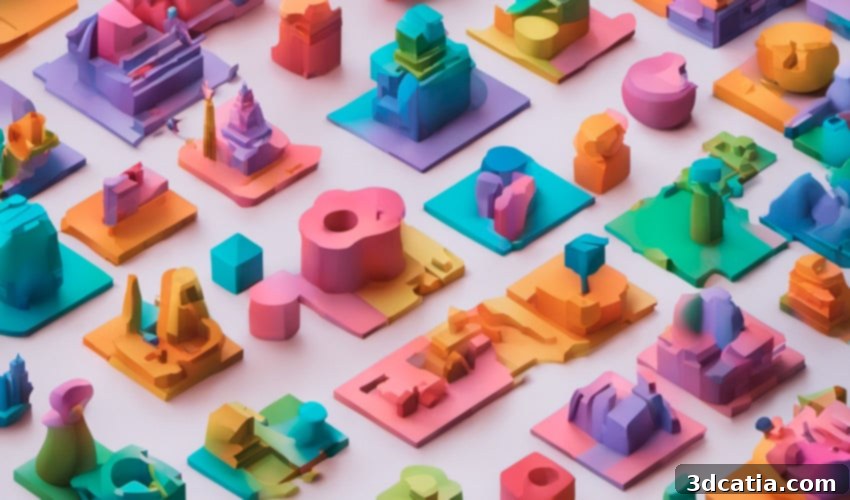
ChatGPT’s Role in 3D Printing Design: Unlocking Generative Modeling and Accessibility
In an era defined by rapid technological advancement, artificial intelligence (AI) has seamlessly integrated into countless facets of our daily lives. From personalized recommendations to sophisticated problem-solving, AI’s accessibility continues to expand, paving the way for innovative applications across diverse industries. Companies worldwide are actively developing advanced AI software tailored for various utilities. Among these, ChatGPT stands out as a prominent example. This advanced AI program, developed by OpenAI, possesses the remarkable ability to understand and respond to human language, answering questions and solving complex problems with human-like nuance. Its underlying architecture is built upon an extensive corpus of text data, enabling it to formulate direct, useful, and contextually relevant answers in mere seconds. Beyond conversational capabilities, one of ChatGPT’s most compelling features is its proficiency in generating code based on specific user requests. This powerful functionality opens up intriguing possibilities for its implementation across numerous sectors, including the dynamic field of 3D printing, particularly for applications such as the design of intricate 3D models.
These transformative technological advances signal a new frontier, with AI unlocking a multitude of novel applications across virtually all industries. Within the realm of additive manufacturing, understanding how AI can be leveraged to generate STL files to streamline and enhance the design process is particularly compelling. ChatGPT facilitates this through a user input mechanism known as a “prompt,” which serves as the instruction provided by the user. As expected, the quality and accuracy of the AI-generated output are directly proportional to the clarity, detail, and specificity of the information embedded within the prompt. Consequently, providing comprehensive context, detailed specifications, and any pertinent additional information significantly elevates the optimality of ChatGPT’s response, especially when the goal is to create precise and functional 3D models. We have delved into the intricacies of this fascinating synergy, exploring how this powerful combination of artificial intelligence and 3D printing technology is executed, transforming traditional design workflows.
An illustrative example of a “prompt” provided to ChatGPT for the creation of a 3D model (photo credits: Raise3D)
ChatGPT and Generative Design for 3D Printing Models
One of the most straightforward and impactful ways to harness ChatGPT in the design of 3D printable models is by formulating a prompt with the explicit instruction to create an STL file. The STL file format is virtually universally adopted in additive manufacturing, serving as the standard for translating 3D models into a format that 3D printers can understand. These files are characterized by generating surface meshes composed of numerous interconnected triangular shapes, which approximate the geometry of a solid object. When generated as ASCII .STL, the format is human-readable, which can be advantageous as it facilitates the interpretation and debugging of ChatGPT’s output if needed. The process of generating an STL file using AI is often iterative and demands a degree of patience. Users will typically need to progressively add more detailed information, constraints, and refinements to the program to guide it towards producing the optimal model. Through a series of attempts and subsequent corrections, the AI will gradually generate a more detailed and accurate mesh, bringing the desired 3D model closer to fruition. It’s crucial to be aware that the program might occasionally pause or halt its generation process, particularly if it encounters a file that becomes excessively large during creation. Should this occur, a simple instruction like “Continue” or “Resume” will typically prompt the software to pick up exactly where it left off, allowing the model generation to proceed uninterrupted.
This direct generation method offers significant advantages, particularly for rapid prototyping and conceptual design. Designers can quickly iterate through various ideas by simply modifying their prompts, exploring shapes and structures that might take much longer to model manually. However, it’s also important to note current limitations. While ChatGPT can create basic to moderately complex geometries, generating highly intricate designs with specific internal structures or precise engineering tolerances still often requires human intervention and specialized CAD software. The AI acts as a powerful assistant, democratizing access to initial design concepts, but expert knowledge remains vital for refinement and validation.
AI-Assisted CAD Scripting: Leveraging ChatGPT for OpenSCAD Designs
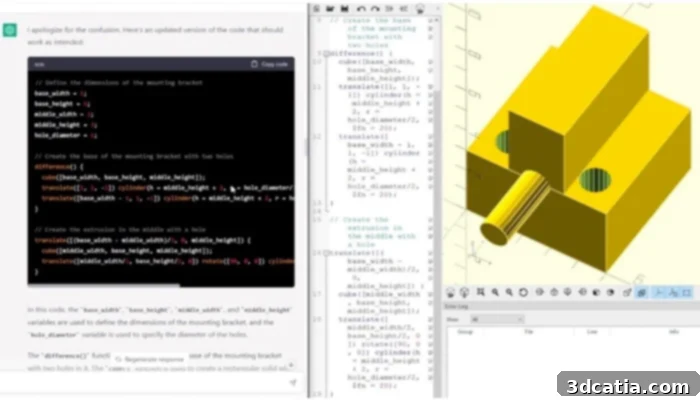
Beyond direct STL generation, another potent application for AI in 3D printing design involves its utility with specific, code-based design programs, such as OpenSCAD. OpenSCAD is a powerful, open-source CAD design tool renowned for its unique approach: it creates 3D models not through direct manipulation, but by interpreting a programming language. While this paradigm offers unparalleled precision, parametric control, and the ability to generate complex, reproducible geometries, the learning curve for mastering its programming language can be steep and time-consuming for novice users or those unfamiliar with coding principles. This is precisely where ChatGPT emerges as an invaluable ally.
Thanks to the AI’s sophisticated ability to write and interpret various programming languages, users can now delegate the arduous programming work to ChatGPT. By clearly articulating the desired 3D model’s features, dimensions, and structural relationships in natural language, one can instruct ChatGPT to generate the specific lines of code required for OpenSCAD. For instance, a user could prompt, “Create an OpenSCAD script for a cylindrical vase with a height of 100mm, a base diameter of 50mm, a top diameter of 70mm, and a wall thickness of 2mm, with a spiral pattern.” ChatGPT would then attempt to produce the corresponding OpenSCAD script, significantly accelerating the design process and making parametric modeling accessible to a much broader audience.
It is crucial to acknowledge, however, that the OpenAI program is still in the relatively early stages of its OpenSCAD programming capability. This necessitates the provision of exceedingly specific and unambiguous instructions to successfully generate a functional and accurate model. The AI’s output will often require careful review, minor adjustments, and sometimes iterative refinement by the user to achieve the desired result. Furthermore, at its current developmental stage, ChatGPT is not yet the optimal choice for responding to requests that demand a high degree of artistic creativity, abstract conceptualization, or novel design innovation without substantial human guidance. While it excels at translating precise parameters into code, truly original or highly aesthetic designs still largely benefit from the human touch. Nonetheless, its ability to translate natural language into executable CAD code marks a significant leap forward in democratizing parametric design and offers immense potential for educational purposes and rapid prototyping.
An example of ChatGPT-generated OpenSCAD code for 3D modeling (Photo Credits: Andrew Sink)
Transforming Accessibility and Innovation in 3D Printing
As we’ve explored, the immense potential of ChatGPT in facilitating the design of models for 3D printing is undeniably vast and continues to grow. This technology effectively lowers the barrier to entry for aspiring designers and beginners who are just embarking on their journey into the world of 3D printing. No longer is comprehensive knowledge of complex CAD software or programming languages an absolute prerequisite for creating tangible 3D objects. Instead, a well-phrased natural language prompt can initiate the design process, allowing users to rapidly prototype ideas and experiment with forms that might otherwise be out of reach.
The benefits extend beyond mere accessibility. ChatGPT can dramatically accelerate the iterative design process, enabling designers to explore multiple variations of a model much more quickly than manual methods. This speed is invaluable in fields requiring rapid prototyping, such as product development or architectural visualization. Furthermore, its ability to handle parametric inputs means designs can be easily modified and customized by simply changing numerical values in the prompt or generated code, offering unprecedented flexibility for bespoke manufacturing and personalized products. For educational purposes, ChatGPT serves as an excellent learning tool, allowing students to see how their textual descriptions translate into 3D geometries or how specific code functions impact a model, thereby bridging the gap between abstract concepts and practical application.
However, it is also important to consider the current limitations and ongoing challenges. While AI can generate designs, the human element of critical thinking, aesthetic judgment, and engineering validation remains indispensable. Complex designs requiring intricate internal structures, precise mechanical fits, or advanced material considerations often necessitate expert human oversight and refinement. Ensuring the generated models are manufacturable, structurally sound, and meet specific performance criteria still requires the discerning eye and experience of a human designer. Moreover, ethical considerations regarding intellectual property for AI-generated designs and potential biases in training data are areas that warrant continuous attention as the technology matures.
With continued development work by OpenAI and other innovators, ChatGPT and similar AI tools are poised to become even more sophisticated and intuitive. We can anticipate future iterations with enhanced creative capabilities, better error handling, and perhaps even seamless integration with leading CAD platforms. The vision of AI serving as an indispensable co-pilot in the design process – empowering designers, reducing learning curves, and fostering unprecedented innovation – is rapidly becoming a reality. In any case, this dynamic field represents a significant frontier in manufacturing technology, and it is one we will undoubtedly continue to watch with great interest as it evolves and reshapes the landscape of 3D printing design.
What are your thoughts on utilizing ChatGPT for designing 3D printing models? We encourage you to share your insights, experiences, or questions in a comment below or join the conversation on our LinkedIn, Facebook, and Twitter pages! Don’t forget to sign up for our free weekly Newsletter here to receive the latest 3D printing news directly to your inbox! You can also find all our compelling videos and tutorials on our YouTube channel.
*Cover Photo Credits: DreamStudio/3Dnatives