
Revolutionizing Metal 3D Printing: The Power of Quasicrystals in Advanced Aluminum Alloys
Metal 3D printing, also known as additive manufacturing for metals, continues to push the boundaries of innovation, particularly in the production of highly reinforced components for demanding sectors like the aerospace and automotive industries. This transformative technology enables the creation of complex geometries and lightweight structures previously unattainable with conventional manufacturing methods. A recent groundbreaking discovery has further illuminated the path for advanced material development within this field: the identification of atomic structures known as quasicrystals within 3D-printed aluminum alloys. This finding holds immense promise for enhancing the mechanical properties of these crucial materials.
Quasicrystals are not your typical atomic arrangements. Unlike conventional crystals, such as those found in common table salt or most metals, which exhibit perfectly regular, repeating atomic patterns, quasicrystals adopt a remarkably different organization. Their structure is ordered but non-periodic, meaning it fills space efficiently without ever reproducing the exact same pattern over large distances. This fascinating characteristic, often described as “organized disorder,” endows quasicrystalline materials with unique and highly desirable mechanical properties, making their discovery in additively manufactured parts particularly significant.
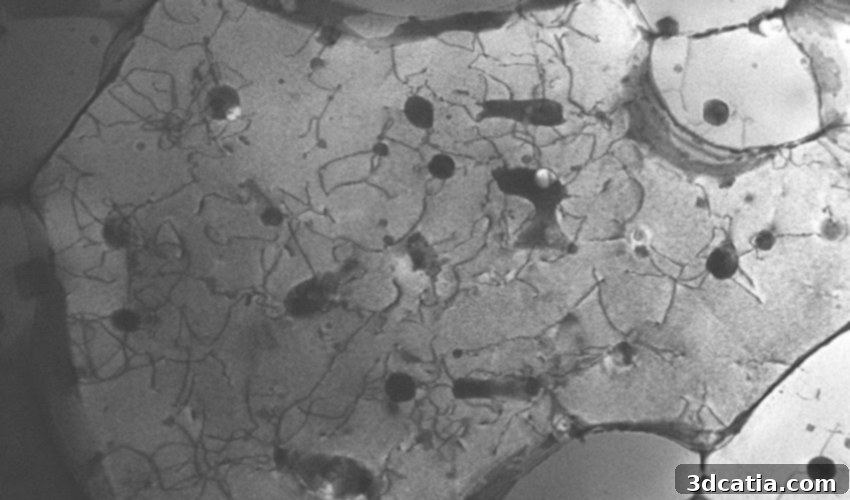
The journey to this discovery began when researcher Andrew Iams was meticulously observing a sample of a newly developed aluminum alloy. What caught his eye was an unusual and intricate organization of atoms that did not conform to the expected crystalline structures. Collaborating with a team of specialized scientists and physicists at the National Institute of Standards and Technology (NIST), Iams was able to confirm that these peculiar formations were indeed quasicrystals. This confirmation was not just an academic curiosity; the team also found compelling evidence that these rare structures were directly contributing to a remarkable enhancement in the alloy’s strength and overall performance.
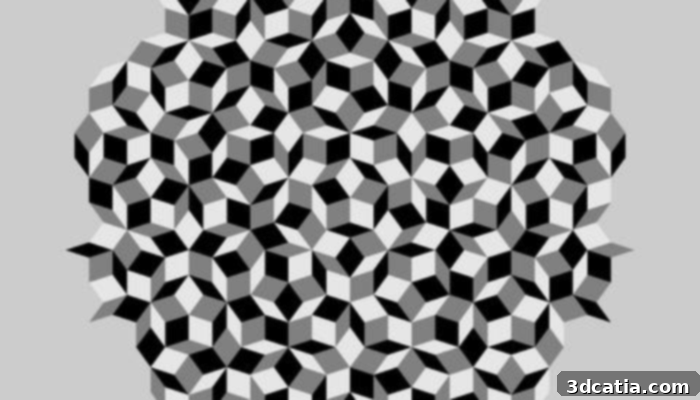
Penrose’s paving pattern is a vivid illustration of the behavior of quasicrystals. Though composed of simple geometric shapes, their assembly creates a complex pattern that never exactly repeats itself, even when extended to a large scale, much like the atomic arrangement in these unique materials.
The Unique World of Quasicrystals: Beyond Traditional Crystal Structures
To truly appreciate the significance of this discovery, it’s essential to understand what makes quasicrystals so distinct. First theorized in the early 1980s and later experimentally confirmed, leading to a Nobel Prize in Chemistry for Dan Shechtman in 2011, quasicrystals represent a departure from the conventional crystallographic paradigm. While traditional crystals possess translational symmetry, meaning their atomic patterns repeat identically at regular intervals, quasicrystals exhibit rotational symmetry that is incompatible with periodicity, such as five-fold symmetry, which cannot exist in a purely repeating lattice.
Despite their non-periodic nature, quasicrystals are far from disordered. They possess a long-range order that governs their atomic arrangement, similar to how the geometric shapes in a Penrose tiling pattern fit together without ever repeating perfectly. This unique structural characteristic gives them a fascinating array of properties, including high hardness, low friction, and exceptional thermal and electrical resistance. The challenge, however, has historically been in intentionally creating and stabilizing these structures, especially within the complex high-temperature environments of metal 3D printing.
Unearthing the Discovery at NIST
The confirmation of quasicrystals within 3D-printed aluminum alloys at NIST marks a pivotal moment. The meticulous work by Andrew Iams and the NIST team involved advanced characterization techniques, likely including sophisticated electron microscopy and X-ray diffraction, to resolve the atomic structure with unprecedented detail. This level of analysis is crucial for understanding how atoms arrange themselves and how these arrangements influence the material’s bulk properties. Their research not only identified these rare structures but also provided compelling evidence that they were directly responsible for bolstering the alloy’s mechanical performance.
The ability to detect and confirm such intricate atomic formations within a material processed by additive manufacturing is a testament to the cutting-edge capabilities available at institutions like NIST. This scientific rigor is paramount, especially when considering the potential applications of these materials in highly sensitive and safety-critical sectors. The findings underscore the importance of fundamental research in advancing the practical applications of new technologies.
Stronger Alloys Thanks to Quasicrystals: A New Approach to Material Design
The immediate implication of this discovery is profound: it opens up an entirely new avenue for designing and engineering reinforced aluminum alloys. By understanding how quasicrystals form and interact within the metallic matrix, researchers can now explore deliberate strategies to incorporate and optimize these unique structures, thereby enhancing the performance of 3D-printed aluminum parts. The NIST team’s work goes beyond mere identification; it provides a foundational understanding of how quasicrystals actively contribute to making the material significantly stronger and more resilient.
The Persistent Challenge of 3D Printing Aluminum
This breakthrough is particularly impactful because aluminum, despite its widespread use and desirable properties like lightness and corrosion resistance, has historically proven to be a difficult metal to master in 3D printing. According to Fan Zhang, a physicist at NIST, the strongest variants of aluminum alloys typically exhibit a frustrating tendency to crack as soon as attempts are made to print them using additive manufacturing processes, rendering them unusable for practical applications. This inherent brittleness under high-temperature processing has severely limited the range of aluminum alloys suitable for 3D printing, especially for high-performance applications where material integrity is non-negotiable.
Part of the core problem lies in the extreme thermal conditions inherent to most metal additive manufacturing techniques, such as selective laser melting (SLM) or electron beam melting (EBM). During these processes, aluminum powder is heated to temperatures well above its melting point, often hundreds or thousands of degrees Celsius. Such intense and localized heating and subsequent rapid cooling can induce severe thermal stresses, lead to undesirable grain growth, promote the formation of hot cracks, and alter the alloy’s microstructure in ways that degrade its mechanical properties. Overcoming these metallurgical challenges has been a central focus of materials science research in additive manufacturing.
A Breakthrough: The Aluminum-Zirconium Alloy of 2017
A significant stride towards addressing these challenges was made in 2017 when scientists successfully developed a special alloy primarily based on aluminum and zirconium. This innovative alloy demonstrated the remarkable capability of being 3D printed without suffering from the dreaded cracking phenomenon that plagued earlier attempts. This achievement was a crucial step forward, opening the door for stronger aluminum parts to be fabricated through additive manufacturing. Intrigued by the unexpected robustness of this particular alloy, NIST made the strategic decision to analyze its structure at the atomic scale, aiming to uncover the fundamental reasons behind its improved printability and strength.
As Fan Zhang explains, gaining a deep understanding of how the atoms organize themselves within such a material is absolutely essential. This atomic-level insight is not just academic; it directly translates to guaranteeing the reliability, consistency, and long-term performance of the material. This is especially critical if the alloy is intended for use in highly sensitive and high-stakes applications, such as military aviation, where material failure can have catastrophic consequences. The NIST team’s investigation into this specific alloy ultimately led them to the exciting discovery of quasicrystals, revealing their pivotal role in the alloy’s superior properties.
How Quasicrystals Fortify Metal: The Mechanism of Strength
Their comprehensive study conclusively revealed that quasicrystals play a key, active role in enhancing the alloy’s performance, particularly its strength and resistance to deformation. In conventional metals, a highly regular and predictable organization of atoms often makes them more susceptible to brittleness and plastic deformation. This is because dislocations – line defects within the crystal structure – can easily move and multiply along well-defined slip planes. This internal slippage is the primary mechanism that causes metals to deform under stress, and if excessive, can lead to fracture.
Quasicrystals, by their very nature, disrupt this regularity. Their non-periodic yet ordered atomic arrangements create complex, impenetrable zones within the material. These zones act as effective barriers, impeding the movement of dislocations and preventing them from propagating easily through the material. Imagine a smooth, open highway versus a dense, winding maze; dislocations move effortlessly on the highway but are constantly blocked and re-routed in the maze. This “dislocation blocking” mechanism requires significantly more energy to deform the material, thereby making it substantially more resistant to internal slippage, deformation, and ultimately, much stronger and harder.
Furthermore, the presence of quasicrystals can also contribute to improved fatigue resistance, as they help to prevent the initiation and growth of microscopic cracks under cyclic loading. This inherent resistance to internal movement and deformation is a game-changer for materials used in high-stress environments, offering a path to components that are not only stronger but also more durable and long-lasting. As Fan Zhang aptly put it, “Now that we have this finding, I think it will open up a new approach to alloy design.” This statement highlights the potential for a paradigm shift in how we conceive and engineer advanced metallic materials for additive manufacturing. You can delve deeper into the NIST research findings HERE.
Paving the Way for Next-Generation Alloy Design
Fan Zhang’s vision of a “new approach to alloy design” is not merely aspirational; it signifies a tangible shift in material science. Instead of relying solely on empirical trial-and-error, scientists can now leverage the principles of quasicrystal formation to intentionally engineer aluminum alloys with tailored properties. This means moving towards custom-designed materials where the precise distribution and characteristics of quasicrystals can be controlled during the 3D printing process to achieve unprecedented combinations of strength, ductility, toughness, and lightness.
The implications for industries are enormous. For aerospace, lighter and stronger aluminum components could lead to significant fuel efficiency gains and enhanced structural integrity for aircraft. In the automotive sector, more robust engine parts, chassis components, and specialized tooling could contribute to improved performance, safety, and durability. Medical implants could benefit from materials that are not only strong but also biocompatible and highly resistant to wear. Defense applications, already mentioned by NIST, demand materials with extreme performance under harsh conditions, making quasicrystal-reinforced alloys incredibly valuable.
This novel design philosophy could also lead to materials with improved fatigue life, better corrosion resistance, and enhanced high-temperature performance, addressing some of the long-standing limitations of traditional aluminum alloys. Beyond just the mechanical advantages, the ability to custom-design alloys through additive manufacturing with quasicrystals could also yield economic and environmental benefits, such as reduced material waste, shorter production cycles, and the creation of lighter end-products that consume less energy.
The Future of Quasicrystals in Additive Manufacturing
The discovery of quasicrystals in 3D-printed aluminum alloys is just the beginning. Future research will undoubtedly focus on optimizing the parameters of additive manufacturing to precisely control the formation, size, and distribution of these strengthening structures. Scientists will likely explore how different processing techniques, laser powers, scan speeds, and powder compositions can influence quasicrystal development. Furthermore, the principles learned from aluminum could be extended to other challenging metal systems, such as titanium alloys or high-performance steels, potentially unlocking similar advancements in their mechanical properties for additive manufacturing.
The journey from laboratory discovery to widespread industrial adoption involves further validation, scaling up production, and developing robust quality control mechanisms. However, this breakthrough clearly signals a transformative era in materials science and metal 3D printing. The ability to harness the “organized disorder” of quasicrystals to engineer superior metallic components promises to accelerate innovation across numerous high-tech industries, making lighter, stronger, and more durable products a reality.
What do you think of the remarkable use of quasicrystals to strengthen metals employed in additive manufacturing? We would love to hear your thoughts! Let us know in a comment below or connect with us on our LinkedIn, Facebook, and Twitter pages! Don’t forget to sign up for our free weekly Newsletter here to get the latest 3D printing news delivered straight to your inbox! You can also find all our insightful videos on our YouTube channel.