
Revolutionizing Additive Manufacturing: EPFL Unveils Bacteria-Powered Biocomposites for a Sustainable Future
The landscape of 3D printing is continuously expanding, pushing the boundaries of what is possible with additive manufacturing. While we’re familiar with diverse materials ranging from advanced polymers and metals to unconventional options like living cells and even chocolate, a recent breakthrough from the École Polytechnique Fédérale de Lausanne (EPFL), also known as the Swiss Federal Institute of Technology Lausanne, introduces an even more extraordinary material: bacteria. In a pioneering project, EPFL researchers have successfully developed and published a method for 3D printing using an innovative ink that incorporates calcium carbonate-producing bacteria. The result is a groundbreaking biocomposite material that boasts remarkable strength, exceptional lightness, and a significantly reduced environmental footprint, opening new avenues for sustainable manufacturing and material science.
This isn’t the first instance where scientific exploration has turned to the natural world for inspiration in developing cutting-edge additive manufacturing solutions. In fact, the concept of biomimicry – the practice of imitating nature’s designs and processes – is a widely adopted and highly effective strategy in 3D printing. It allows for unprecedented optimization of parts, such as the creation of intricate lattice structures that mimic the efficiency and strength of beehives or the robust yet lightweight designs found in bird bones. This EPFL project is deeply rooted in a similar biomimetic philosophy. Researchers meticulously studied nature’s ability to produce composite materials that simultaneously possess seemingly contradictory properties: being light and strong, or porous and rigid. Such combinations are notoriously challenging, if not nearly impossible, to achieve through conventional lab or factory processes. Prime examples from nature include the layered strength of mollusk shells or the intricate, durable structure of bone. The ultimate ambition of this research was to develop materials that not only replicate these desirable natural properties but also uphold a strong commitment to environmental sustainability. With the introduction of this novel 3D printable ink, they have indeed transformed this ambition into a tangible reality.

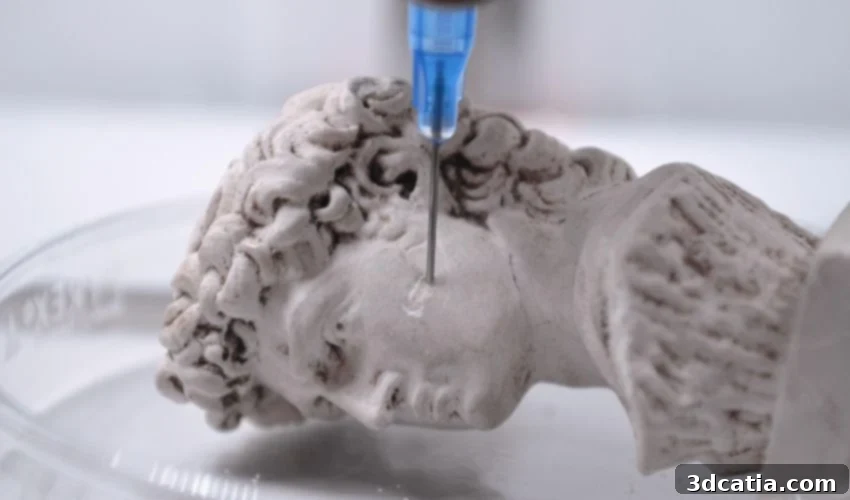
By combining a bacteria-loaded ink (dubbed BactoInk) and advanced 3D printing techniques, EPFL scientists have successfully created a strong, light, and environmentally friendly biocomposite material.
The Genesis of BactoInk: 3D Printing Bacteria for Superior Biocomposites
The detailed methodology and exciting results of this pioneering work were meticulously outlined in their paper, “3D printing of living structural biocomposites,” published in the esteemed journal Materials Today. The researchers, operating from EPFL’s Soft Materials Laboratory, elucidated the intricate process they devised to bring this innovation to life. At the core of their creation lies a specialized 3D printable ink, ingeniously formulated to incorporate the bacterium Sporosarcina pasteurii. The selection of this particular bacterium was far from arbitrary; it possesses a unique and highly advantageous characteristic. When exposed to a solution containing urea, Sporosarcina pasteurii initiates a biological mineralization process, culminating in the production of calcium carbonate (CaCO3). This newly developed ink, aptly named BactoInk, demonstrates remarkable versatility, allowing for the 3D printing of virtually any desired shape or complex geometry. Once printed, the magic truly begins, as the mineralization process unfolds steadily over the course of a few days, transforming the printed structure into a robust biocomposite.
The strategic decision to utilize an ink designed for post-printing mineralization was a clever workaround for several common challenges encountered when 3D printing directly with mineral-based inks. Traditional mineral inks often prove difficult to manage, demanding precise flow conditions and exhibiting tendencies to be overly soft or prone to significant shrinkage after the printing process. Recognizing these inherent limitations, Esther Amstad, who leads the Soft Materials Lab, elucidated their innovative approach: “So, we came up with a simple trick: instead of printing minerals, we printed a polymeric scaffold using our BactoInk, which is then mineralized in a second, separate step. After about four days, the mineralization process triggered by the bacteria in the scaffold leads to a final product with a mineral content of over 90%.” This two-stage process is key to the success of BactoInk. First, the BactoInk, a blend of bacteria and a polymer, is used to print the desired shape as a flexible scaffold. This initial structure provides the necessary form and stability. Following the printing, the scaffold is immersed in a urea-containing solution. It is here that the dormant bacteria within the ink are activated, commencing their biological function of precipitating calcium carbonate within the polymeric matrix. Over approximately four days, this enzymatic reaction thoroughly infuses the structure with mineral, resulting in a final biocomposite that is impressively composed of over 90% mineral content, replicating the hardiness of natural calcium carbonate structures.
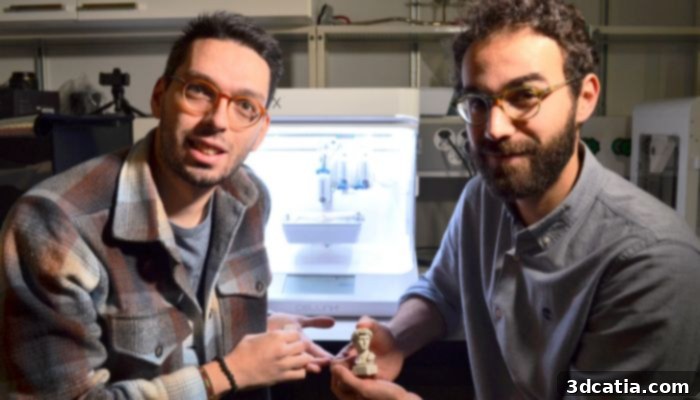
Co-authors and Soft Materials Lab researchers Matteo Hirsch and Lorenzo Lucherini were instrumental in developing the innovative BactoInk and its applications.
The outcome of this meticulous research and development is a uniquely strong, resilient, and highly durable biocomposite material. A significant advantage of this novel approach is its compatibility with standard 3D printing equipment, making the technology potentially accessible for broader adoption without requiring specialized or prohibitively expensive machinery. Furthermore, once the mineralization process is complete, the final products no longer contain living bacteria, ensuring stability and sterility, which is crucial for various applications. The material itself is particularly noteworthy for its exceptional combination of properties: it is not only remarkably strong and surprisingly light, but also inherently porous. Achieving porosity alongside strength and lightness is a complex challenge in additive manufacturing, as these characteristics often conflict with each other in conventional materials. The inherent structure developed through the bacterial mineralization offers this unique triumvirate of properties, mirroring the sophisticated designs found in natural materials like bone, which are both strong and lightweight, yet allow for internal vascularization and nutrient transport.
The EPFL researchers have already envisioned and outlined a compelling array of applications for this versatile material across several diverse fields. One immediate and highly promising application lies in the delicate process of art and architectural restoration. Imagine an ancient sculpture or a historical monument marred by cracks or chips; this innovative ink could be directly injected into the damaged site. The material would then organically grow and mineralize, perfectly fitting and bonding with the existing structure, offering a repair solution that is both precise and aesthetically harmonious, effectively “healing” the artwork. Beyond cultural heritage, the material’s environmentally friendly composition opens up incredibly exciting possibilities for addressing pressing ecological concerns. A particularly impactful application is in the construction of artificial corals. Global climate change and ocean acidification are rapidly degrading natural marine reefs, critical ecosystems for biodiversity. By leveraging BactoInk to create biomimetic coral structures, scientists can aid in the regeneration of damaged marine habitats. The material’s porosity would provide ideal micro-environments for new marine life to settle and flourish, offering a sustainable and biologically compatible solution to restore these vital underwater environments, far superior to inert synthetic alternatives.
The potential impact of BactoInk extends even further. Its unique properties suggest applications in sustainable construction, where lightweight, yet strong and environmentally benign building materials are in high demand. It could also find use in certain medical fields, particularly for bone regeneration or customized biocompatible scaffolds, given its natural mineral composition. Furthermore, the ability to create complex porous structures with high precision could lead to advancements in filtration systems or novel catalysts. As Amstad eloquently concludes, “The versatility of the BactoInk processing, combined with the low environmental impact and excellent mechanical properties of the mineralized materials, opens up many new possibilities for fabricating lightweight, load-bearing composites that are more akin to natural materials than to today’s synthetic composites.” This research marks a pivotal step towards a future where manufacturing processes are not only efficient and advanced but also deeply integrated with natural principles, yielding materials that are both high-performing and inherently sustainable. To delve deeper into the scientific intricacies of this remarkable discovery, the full study is available for review HERE.
What are your thoughts on the groundbreaking work by EPFL researchers, harnessing bacteria-loaded ink and 3D printing to forge these innovative biocomposites? We’d love to hear your insights and perspectives! Share your comments below or engage with us on our LinkedIn, Facebook, and Twitter pages. To stay abreast of the latest advancements and news in the dynamic world of 3D printing, don’t forget to sign up for our free weekly Newsletter here, delivered straight to your inbox! You can also explore all our engaging videos and in-depth content on our dedicated YouTube channel.
*All Photo Credits: Eva Baur/EPFL