
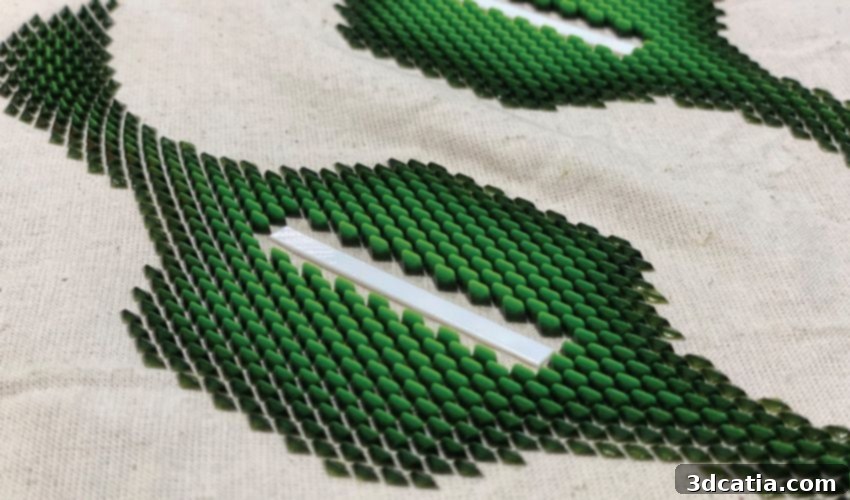
Revolutionizing Luxury Fashion: How 3D Printing Delivers Unprecedented Sustainability and Efficiency
The global fashion industry, long synonymous with rapid trends and high material consumption, is now experiencing a profound transformation, increasingly embracing innovative technologies like additive manufacturing. While the allure of unparalleled design freedom, intricate shapes, and novel material possibilities is a significant draw, the true game-changer lies in 3D printing’s potential to address critical environmental and operational challenges. Sustainability and enhanced process efficiency are no longer secondary considerations but paramount drivers for adopting this advanced production method. This paradigm shift was emphatically underscored by a recent, comprehensive study conducted by the Additive Manufacturer Green Trade Association (AMGTA), revealing groundbreaking environmental benefits.
The AMGTA, a leading advocate for sustainable additive manufacturing practices, has published a detailed report that meticulously outlines the ecological advantages of 3D printing within the fashion sector, with a particular focus on footwear production. This landmark study was a collaborative effort involving Stratasys, a prominent AM technology provider, and Dyloan Bond Factory, an Italian firm renowned for its research and innovation within the fashion industry. The report’s findings are compelling: after a rigorous year-long testing phase, the implementation of additive manufacturing resulted in a substantial reduction in CO2 emissions and significant material savings across the entire supply chain. Below, we delve deeper into the key highlights and profound implications of this pivotal research.
Material Jetting vs. Traditional Luxury Goods Production: A Sustainable Showdown
The Additive Manufacturer Green Trade Association (AMGTA) is dedicated to championing and quantifying the sustainable aspects of additive manufacturing. A core part of its mission involves conducting data-driven studies that unequivocally demonstrate the environmental and operational benefits of this technology. Their latest report, specifically tailored to the fashion industry, is aptly titled “Comparative Analysis: 3D Material Jetting vs Traditional Methods for Designer Luxury Goods.” This document encapsulates the meticulous results of a year-long strategic collaboration between AMGTA, Stratasys, and Dyloan Bond Factory, offering a clear comparison between conventional and advanced manufacturing approaches.
The central use case of the study involved a direct comparison between established traditional production methods, primarily injection molding, and advanced PolyJet 3D printing technology. Utilizing the cutting-edge Stratasys J850™ Fashion TechStyle™ printer, the team aimed to produce 16,000 units of a distinctive logo, destined to be applied to 8,000 pairs of high-end luxury designer shoes. This specific scenario offered a precise framework to measure environmental impact. Sherri Monroe, Executive Director of AMGTA, emphasized the significance of this undertaking: “This collaborative study with Stratasys and Pattern Group, assessing the impact of a print-to-textile process, is our first research undertaking involving polymer. It delivers important data that supports the value of AM to impact one of the most historically polluting industries in the world.” This statement underscores the critical need for sustainable innovation within a sector known for its substantial environmental footprint.
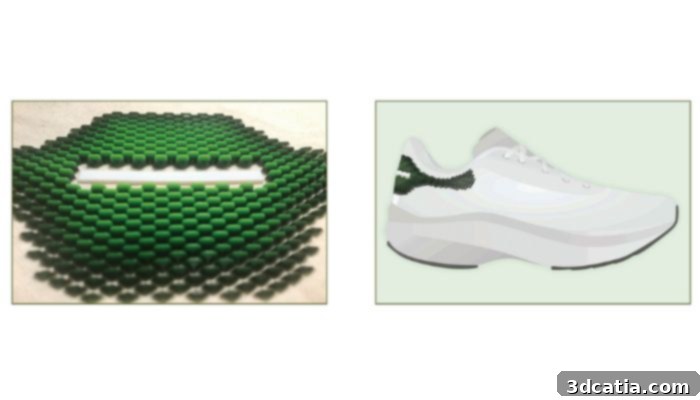
3D printing and logo design application on a shoe, showcasing additive manufacturing in fashion.
After a year of rigorous data collection and meticulous analysis, the study’s results are not merely promising; they are transformative. The additive manufacturing process, particularly through direct printing on fabric, demonstrated a remarkable reduction in CO2 emissions by 24.8 percent when compared to the conventional methods traditionally employed by the customer. To put this into perspective, for the production of 16,000 logos across 8,000 pairs of shoes, 3D printing mitigated nearly one metric ton of CO2 emissions. This substantial environmental gain highlights the power of targeted technological adoption.
Beyond carbon footprint reduction, the study illuminated further critical benefits. Direct 3D printing on fabric led to an impressive 49.9 percent saving in stock material throughout the entire supply chain. This reduction translates directly into minimized inventory, less warehousing space, and significantly streamlined transportation activities, resulting in fewer logistical complexities and associated emissions. Furthermore, the process itself is inherently waterless across the entire production chain, presenting a monumental saving of potentially more than 300,000 liters of water. This is particularly impactful in an industry often criticized for its immense water consumption.
The advantages extended to energy consumption as well. The study revealed that 3D printing significantly reduced energy usage by more than 64 percent. Such a dramatic decrease in power consumption not only lowers operational costs but also lessens reliance on energy grids, thereby reducing the indirect environmental impact. Finally, another pivotal finding underscored the transformative effect on supply chain complexity. By enabling the production of parts in a single, integrated process, 3D printing consolidated supply chain-related technologies from four distinct stages down to just one. This simplification also optimized production and logistical steps, reducing them from a cumbersome twelve to a highly efficient two. This streamlined approach means faster production cycles, reduced lead times, and an overall more agile and resilient manufacturing ecosystem.
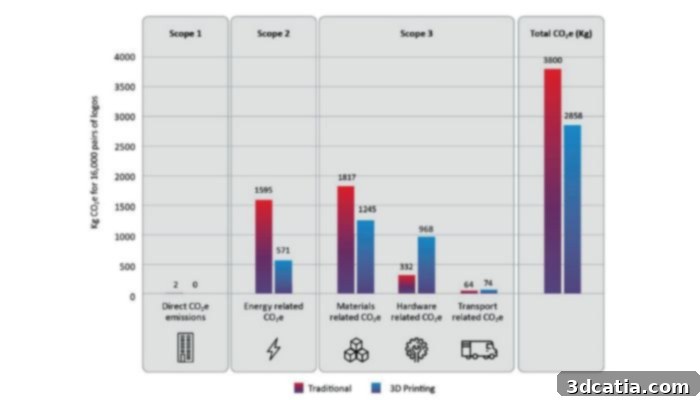
Global Warming Potential comparison between traditional manufacturing and 3D printing for 16,000 logo components, illustrating environmental advantages.
Moving Towards More Sustainable Production in Fashion With 3D Printing
These unequivocally encouraging results certainly lay a robust foundation for the widespread adoption of more sustainable and environmentally conscious production methodologies within the broader fashion and luxury industries. The implications extend far beyond the specific case of footwear logos, pointing to a future where ecological responsibility is woven into the very fabric of high-end manufacturing. Loreto Di Rienzo, Group R&D Director, aptly captured this sentiment, stating, “Producing sustainably is becoming increasingly crucial for designers in the world of luxury.” He further elaborated on the role of technology: “Stratasys’ innovation in 3D printing with the TechStyle™ technology enables us to offer revolutionary capabilities by reducing waste, minimizing reliance on natural resources and optimizing the environmental impact of our entire supply chain. We can affirm and demonstrate that additive technology truly improves our environmental impact while expanding design freedom without compromising the quality of the end result.” This highlights the dual benefit of sustainability and continued high-quality output, a non-negotiable for the luxury market.
The study itself is an integral component of Stratasys’ larger Mindful Manufacturing™ project. Through this visionary initiative, Stratasys actively collaborates with its clients to fundamentally rethink and redesign manufacturing processes, products, and components. The overarching goal is to optimize operations in ways that yield tangible benefits for both humanity and the planet. This commitment to ‘mindful’ production signals a broader industry shift towards responsible innovation, where technological advancement is directly linked to environmental stewardship.
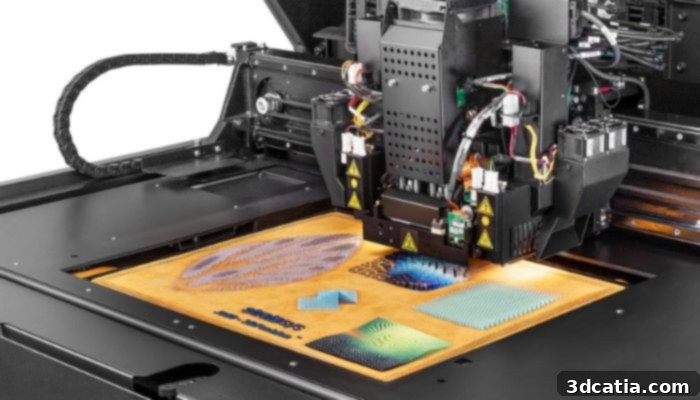
The Stratasys J850TM TechStyleTM 3D printer, a key technology enabling sustainable fashion production.
While this particular study strategically focused on the life cycle analysis of a product logo rather than an entire piece of footwear, its conclusions offer powerful insights into a groundbreaking new methodology for producing various items, intricate details, decorative elements, and essential accessories. The fashion industry frequently manufactures these components in vast quantities, often leading to an excessive and unsustainable use of resources, despite the small individual size of the products. This research undeniably demonstrates that a more sustainable, resource-efficient, and ethically conscious production paradigm is not only achievable but also economically viable. It serves as a compelling proof-of-concept for how additive manufacturing can catalyze a transition towards circular economy principles within the fashion sector, reducing waste and optimizing material flows at every stage. For those interested in a deeper dive into the methodology and detailed findings, the full AMGTA study is readily available: HERE.
What are your thoughts on this pioneering AMGTA study and its profound implications for the fashion and luxury sectors? We invite you to share your perspectives and engage in the conversation by leaving a comment below, or by connecting with us on our LinkedIn, Facebook, and Twitter pages! Don’t miss out on the latest advancements and news in the world of 3D printing; remember to sign up for our free weekly Newsletter here, delivered directly to your inbox. You can also explore our extensive library of videos on our YouTube channel for more insights and demonstrations.
*All photo credits: AMGTA/Stratasys