
Aleph Farms Pioneers Cultivated Meat in Space: A Giant Leap for Sustainable Food Security
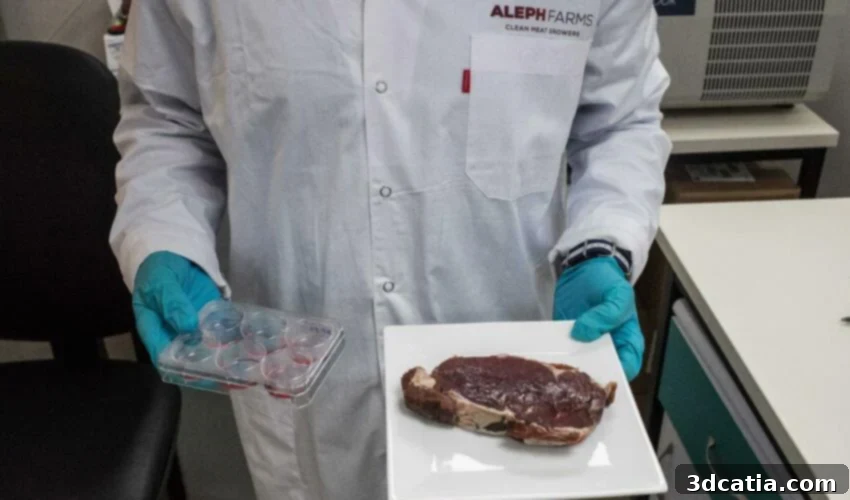
In a groundbreaking move that pushes the boundaries of food production and sustainability, Aleph Farms, an innovative Israeli startup, has achieved a significant milestone in the realm of cultivated meat. The company has successfully developed a sophisticated method to produce real beef steaks directly from animal cells, a process often referred to as cellular agriculture or lab-grown meat. This revolutionary technique meticulously mimics the natural biological process of muscle-regeneration that occurs within a cow’s body, but crucially, it does so under precisely controlled, optimal conditions in a bioreactor environment. This approach allows for the creation of authentic meat without the need for raising and slaughtering animals.
Just recently, Aleph Farms made global headlines by successfully 3D bioprinting meat aboard the International Space Station (ISS). This extraordinary feat, performed far away from Earth’s natural resources, served as a powerful demonstration of the technology’s potential for universal application. The core mission driving Aleph Farms is deeply ambitious yet profoundly vital: to ensure global access to safe, nutritious, and high-quality meat at any time and in any location on Earth, all while utilizing significantly fewer resources than conventional livestock farming. This vision extends beyond our planet, hinting at future possibilities for long-duration space missions and even extraterrestrial settlements.
This pioneering project is not a solo endeavor but a testament to collaborative innovation, backed by several key partners. Among them is 3D Bioprinting Solutions, a renowned laboratory specializing in biotechnological research, which was founded by INVITRO, Russia’s largest private medical company. Further support comes from USA-based entities like Meal Source Technologies and Finless Foods. Together, these organizations pooled their expertise to achieve this scientific marvel. Under the challenging micro-gravity conditions of the ISS, Aleph Farms successfully orchestrated the assembly of small-scale muscle tissue. This was accomplished using a specialized 3D bioprinter, meticulously developed by 3D Bioprinting Solutions, proving the technology’s robustness and adaptability in extreme environments.

A droplet of bioink containing the bovine cells | Credits: 3D Bioprinting Solutions
Didier Toubia, Co-Founder and CEO of Aleph Farms, eloquently articulated the profound implications of their work: “In space, we don’t have 10,000 or 15,000 Liter (3962.58 Gallon) of water available to produce one Kg (2.205 Pound) of beef. This joint experiment marks a significant first step toward achieving our vision to ensure food security for generations to come, while preserving our natural resources.” His statement underscores the critical challenge of resource scarcity, not only in the vacuum of space but increasingly on Earth. Conventional meat production is notoriously resource-intensive, consuming vast amounts of water, land, and feed. The ability to produce meat with minimal resources, as demonstrated by Aleph Farms, offers a compelling solution to these pressing global issues, paving the way for a more sustainable and equitable food system for future generations.
Addressing Global Food Security and Environmental Challenges
The imperative of ensuring food security for future generations cannot be overstated, especially when considering the alarming projections for global population growth. Experts predict that the world population is on track to reach an astonishing 10 billion individuals by the year 2050. This surge in population will inevitably lead to an escalating demand for food, particularly protein sources, placing immense pressure on our already strained agricultural systems. Conventional livestock farming, while a traditional source of protein, presents significant environmental drawbacks that compound this challenge.
It is widely acknowledged that livestock farming is a major contributor to global warming, primarily through its release of methane. Methane is a potent greenhouse gas, far more impactful than carbon dioxide, estimated to be 20 to 30 times more effective at trapping heat in the atmosphere over a 100-year period. The primary source of these emissions from livestock is enteric fermentation – the digestive process in ruminant animals like cattle. Beyond greenhouse gases, the sheer scale of land required for livestock is staggering. Almost 30% of the planet’s ice-free surface is currently utilized for either grazing animals or growing feed crops for them. This extensive land use leads to a cascade of environmental problems.
Indeed, conventional animal agriculture stands as the top global contributor to deforestation, as vast tracts of forests are cleared to create pastures and cultivate feed. It is also a leading cause of land degradation, desertification, and water pollution through agricultural runoff containing excess nutrients and waste. The cumulative impact of these activities on ecosystems, biodiversity, and climate stability is profound and well-documented. A landmark report from the Intergovernmental Panel on Climate Change (IPCC), established by the United Nations and featuring contributions from 107 authors, unequivocally emphasized the integral and substantial contribution of traditional animal farming methods to the ongoing climate crisis. This scientific consensus underscores the urgent need for innovative solutions like cultivated meat to mitigate these severe environmental consequences.
Jonathan Berger, CEO of The Kitchen, a prominent food-tech incubator, further reinforced this perspective, stating, “The mission of providing access to high-quality nutrition anytime, anywhere in a sustainable way is an increasing challenge for all humans.” He highlighted the critical role of innovative ventures: “On Earth or up above, we count on innovators like Aleph Farms to take the initiative to provide solutions to some of the world’s most pressing problems, such as the climate crisis.” Berger’s comments emphasize that the challenges of feeding a growing population sustainably are universal, transcending geographical boundaries and extending even into space. The commitment of companies like Aleph Farms to developing sustainable protein alternatives is crucial for fostering a resilient and environmentally responsible future for humanity.
The Science Behind Cultivated Meat: Beyond Plant-Based Alternatives
Unlike plant-based meat alternatives, which cleverly mimic the taste and texture of meat using various vegetable proteins and ingredients, Aleph Farms’ production method is fundamentally different. It utilizes actual bovine cells to grow real meat, replicating the authentic taste, texture, and visual appearance of conventional beef. This cellular agriculture approach begins with a small, non-invasive sample of various cell types, including fat cells, muscle fibers, and blood vessel cells, harvested from a living animal. These cells are then cultivated in a nutrient-rich environment, where they naturally proliferate and differentiate, much as they would inside the animal’s body.
Once a sufficient quantity of cells has been grown, they are carefully mixed to form a specialized “bioink.” This bioink, essentially a suspension of living cells, serves as the fundamental building block for the bioprinting process. Using advanced 3D bioprinters, these bioinks are precisely layered and structured, allowing the cells to self-organize and mature into complex tissues. This sophisticated process is designed to faithfully preserve the intricate texture, rich flavor, and robust structure characteristic of a classic steak. The result is a piece of meat that is biologically identical to its animal-derived counterpart, offering the same sensory experience without the ethical and environmental drawbacks of traditional farming.
The precision of 3D bioprinting allows for the creation of multi-layered tissue structures, incorporating not just muscle cells but also fat and connective tissues, which are vital for achieving the desired marbling and mouthfeel of a premium cut of meat. This level of control over the composition and architecture of the meat is something unattainable through conventional methods. As the technology continues to advance, cultivated meat promises to become an increasingly important part of our global food system, offering a sustainable, ethical, and resource-efficient solution to meet the world’s growing demand for high-quality protein. Aleph Farms is at the forefront of this revolution, demonstrating that the future of food is not just about alternative ingredients, but about innovative methods that redefine how we produce and consume meat.

The production process of Aleph Farms | Image via Aleph Farms
For more detailed information regarding Aleph Farms’ mission, technology, and progress, you can visit their official website HERE.
What are your thoughts on Aleph Farms’ ambitious mission to revolutionize meat production and enhance food security both on Earth and in space? Do you believe cultivated meat is the answer to our global food and environmental challenges? We invite you to share your perspectives and engage in the conversation by leaving a comment below or joining us on our Facebook and Twitter pages! Additionally, to stay informed about all the latest advancements in 3D printing and cellular agriculture, don’t forget to sign up for our free weekly Newsletter, delivering the most important news directly to your inbox every week!