
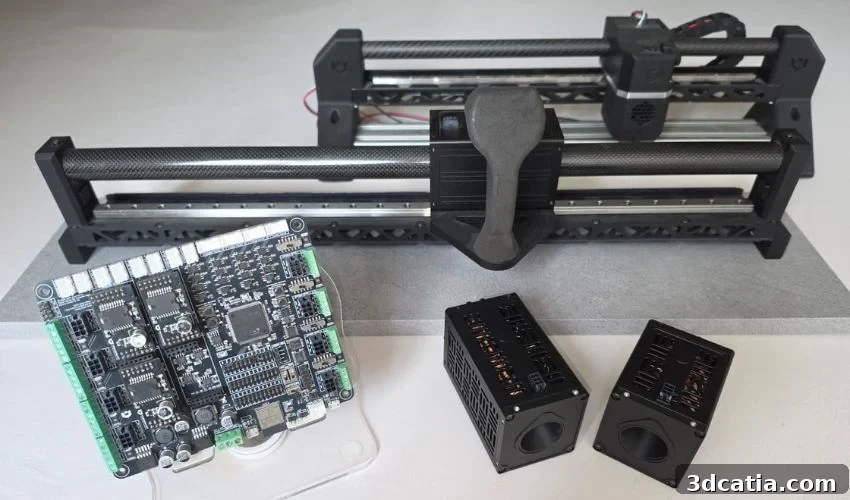
Almost every 3D printer moves its printhead using belts and pulleys — an inexpensive approach that comes with inherent limitations. Belts stretch, vibrate, and lose stiffness over time, which degrades print quality and consistency. For many years, high-performance linear motors have offered a faster and more precise alternative, but their cost has put them beyond the reach of most machine builders. Dutch startup Tesseract Technologies aims to change that with a linear motor system designed from the ground up — hardware, sensors, electronics and firmware — which the company says delivers comparable performance at two to five times better cost-effectiveness than existing options.
The project began as the thesis of founder Timothy Kramer and has already been integrated into real machines such as the FELIX Pro XXL by FELIXprinters. With a commercial launch planned for early 2027, Tesseract’s approach promises to reduce common motion-system problems while enabling new machine architectures. Below, we summarize the key points about what changes when you remove belts, how closed-loop control maintains accurate positioning, and how independent carriages on the same axis can open fresh design possibilities.
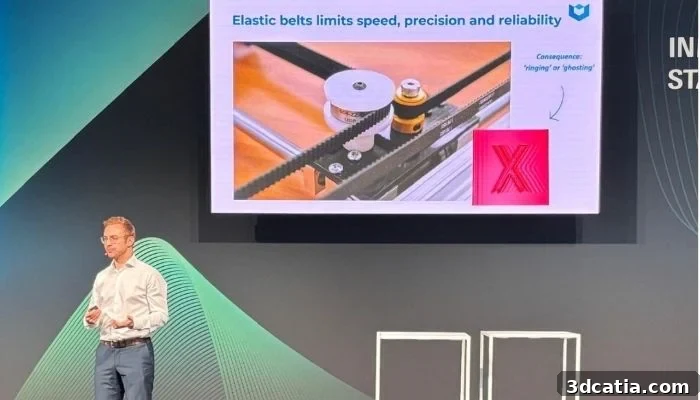
Timothy Kramer, founder of Tesseract, during his presentation at Formnext 2025. The startup was a finalist for the Rookie Award.
3DN: Could you introduce yourself and tell us what led you to found Tesseract Technologies?
My name is Timothy Kramer, founder of Tesseract Technologies. As a student in the 2010s, I was captivated by 3D printing — designing something on a computer and watching it be produced in front of you is empowering. What frustrated me most, though, was print speed and the limitations of conventional motion systems.
In 2017 I discovered linear motors: faster, more accurate, and able to provide constant error correction with minimal maintenance. I wondered why additive manufacturing had not widely adopted them. The main barrier was cost; industrial linear motors are designed for high-end markets. For my thesis I set out to make an affordable linear motor and built a working prototype that by 2020 already outperformed common Cartesian and CoreXY systems. Development has continued since then, refining the motor, sensors and control software to be practical for a broader range of machines.
3DN: What is Tesseract’s mission?
Tesseract’s mission is to democratize linear motor technology so more machine builders can benefit from high-performance motion. We aim to bridge the gap between traditional belt-driven systems and costly industrial linear motors by delivering speed, precision, reliability and closed-loop control at a cost that fits many applications.
By offering a platform that combines optimized motor hardware, readily available electronics and robust firmware, we enable manufacturers to create faster, more dependable machines without over-engineering their motion subsystems. This reduces maintenance and improves throughput for production environments and print farms alike.
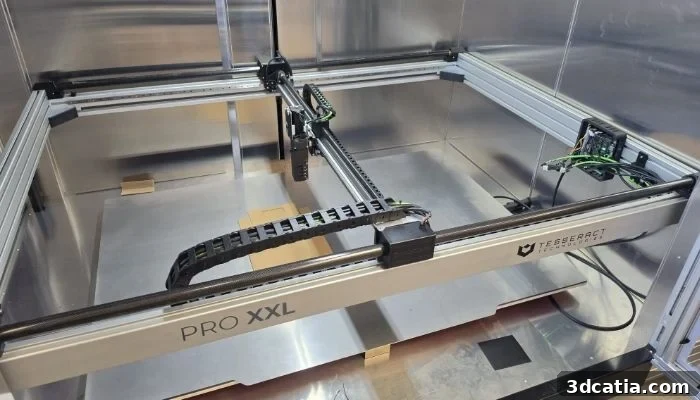
The FELIX Pro XXL from FELIXprinters, equipped with Tesseract’s linear motors
3DN: For those unfamiliar, what does a linear motor offer compared to belts in a 3D printer?
Belt-drive systems rely on a motor that transmits motion through a flexible belt to a carriage. Belts behave like rubber bands: they stretch, vibrate, and change stiffness with temperature and age. On printed parts these effects often appear as:
- faint ripples near corners (ringing),
- softened edges,
- dimensional inaccuracies.
Techniques such as input shaping can mitigate some of these issues, but they are limited and may introduce trade-offs like corner rounding. Heavy printheads or large gantries exacerbate belt stretch because higher forces are required. A linear motor removes the elastic transmission: magnets are embedded in the axis while coils are mounted in the carriage, allowing direct drive without belts or pulleys. The outcome is higher speed without loss of detail, improved repeatability, and more consistent performance over the life of the machine.
For machine builders, that translates to greater productivity and reduced maintenance. For production setups, it means higher uptime and more predictable quality. The benefits become increasingly significant as machine size and moving mass grow — precisely where belt systems reach their limits.
3DN: Industrial linear motors are expensive. What did you rethink to make yours affordable?
We achieve roughly two to five times better cost-effectiveness compared with similar-performance products by rethinking every element: motor geometry, sensor integration, control electronics and firmware. We developed a large database of viable motor topologies and apply optimization to select efficient designs. We combine smart mechanical design with widely available materials and electronics to meet industrial standards while keeping costs down. Built-in diagnostics in the electronics let us analyze and tune performance precisely, which also reduces development time for partners.
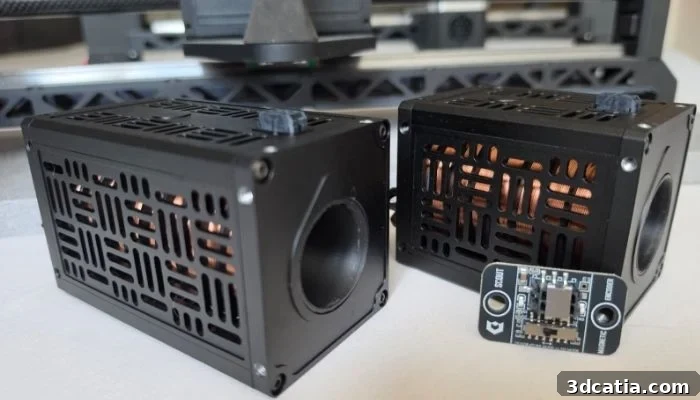
The coil units (forcers) and linear encoder of Tesseract’s system.
3DN: Who is this technology for, and what new machines does it enable?
Linear motors bring improvements in speed, precision, repeatability and maintenance, but their true value is in the ways they change machine design. Because each carriage is measured and corrected continuously in a closed loop, disturbances are corrected immediately — if a head is bumped during printing it returns to the correct position rather than printing with an offset. That reliability matters in production and reduces scrap.
Beyond improving single-head machines, linear motors enable multiple independent carriages to operate on the same axis. This makes it possible for several toolheads or gantries to work on the same part simultaneously, increasing throughput without simply pushing a single head to higher speeds. Removing belts and pulleys also frees up space and routing constraints, allowing motion to be integrated into places where a conventional setup would be impractical. Those possibilities shift design thinking from ‘faster belt drives’ to fundamentally different machine architectures.
3DN: Can you share a pilot project example and what you learned?
One of our main development partners is FELIXprinters. At Formnext 2025 we showed their FELIX Pro XXL running on our linear motors; the machine uses axes of about 1.5 x 1.7 m and features two independent toolheads (IDEX). Working with them taught us how to adapt motors to the machine’s specific mechanical requirements and how powerful embedded electronics are for motor analysis and precise positioning. The biggest lesson was the importance of a mechanically robust machine frame — integrating linear motors works best when the surrounding structure is designed to take full advantage of the motors’ performance.
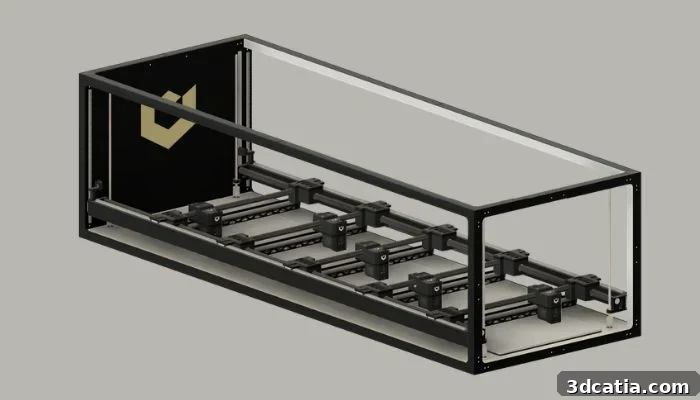
CAD model of a multi-gantry machine.
3DN: What long-term developments excite you most?
We are preparing a strategic partnership with an experienced machine builder and manufacturer to industrialize and scale production, with a market introduction planned for the first quarter of 2027. Looking further ahead, simultaneous multi-toolhead motion is the most exciting development: multiple independent carriages on a single axis enable entirely new machine concepts where several tools collaborate on a part at once. That potential motivates new thinking about workflows, slicing software and machine architectures.
3DN: Final thoughts
Tesseract is open to collaboration with companies across the ecosystem, especially in software and slicing, to make multi-toolhead printing practical for end users. The shift from belts to linear motors is not only about speed and accuracy — it unlocks new ways to build machines that are faster, more reliable and more versatile over their service life.
*All Photo Credits: Tesseract Technologies