
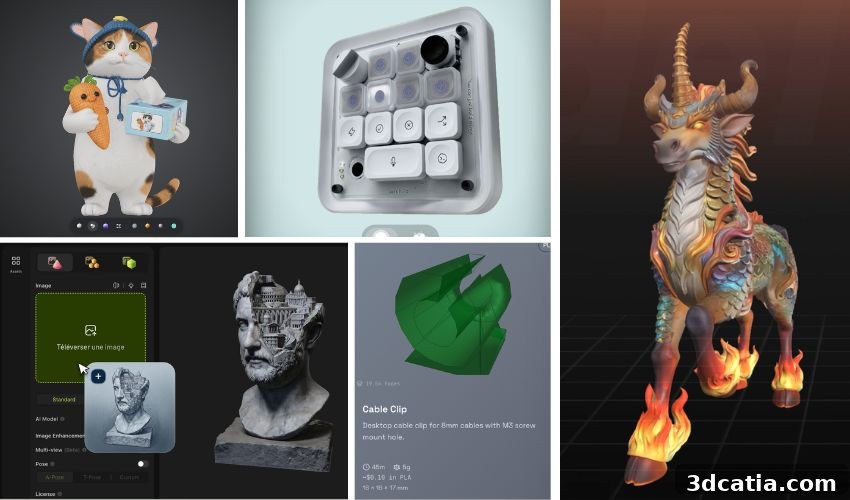
One of the most daunting parts of 3D printing is the software. If you cannot find a ready-made 3D model that fits your needs, you may need to create your own, and designing in 3D can be challenging. With the surge in artificial intelligence, numerous AI-driven 3D model generators have appeared online, making it easier for creators to produce printable models from text, images, and sketches.
Many early generators were developed for games and animation, where geometry only needs to look correct on screen and not necessarily meet physical constraints. Over time, several platforms have adapted their engines specifically for 3D printing, improving mesh cleanliness, watertightness, and print-readiness. Companies now integrate advanced generation engines into workflows to make automated 3D generation more accessible to makers, designers, and product developers.
Below is an overview of six popular AI 3D model generators, summarizing their pricing, model quality and print-readiness, texture and material capabilities, editing and customization features, generation speed, commercial licensing, and platform integrations. Note that generation speed and technical claims (polycount, mesh cleanliness, texture resolution) are taken from each platform’s published information and marketing; they serve as a basis for comparison rather than guaranteed real-world performance.
Fast3D
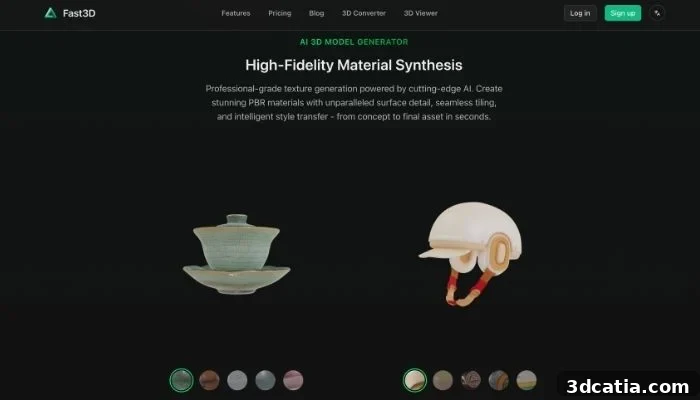
Fast3D is an AI-powered 3D model generator that converts text descriptions or images into textured meshes in seconds. The web application targets creators working in games, AR/VR, product design and 3D printing, with options tailored to different speeds and detail levels.
Pricing and plans
Fast3D uses a credit-based subscription model. The Free plan provides a monthly allowance of credits, basic queue priority and limited downloads. Pro and Max paid plans raise credit limits, concurrent tasks, download allowances and unlock higher quality levels. A top-tier plan offers unlimited credits and tasks through a custom arrangement.
Model and mesh quality / Print-ready
Four quality levels (Fast, Standard, Pro, Ultra) trade speed for geometric detail. Export formats include GLB/GLTF, FBX, OBJ/MTL and STL, making output compatible with game engines, 3D tools and slicers. Outputs focus on visual meshes rather than parametric CAD, so final editing or dimension-specific adjustments are often completed in dedicated 3D software.
Texture and material quality
Fast3D generates PBR material sets emphasizing surface detail, seamless mapping and style transfer options. Higher tiers produce more detailed textures suitable for rendering or visual prototypes.
Editing and customization tools
Inputs include text-to-3D, single-image-to-3D and multi-view reconstruction, with selectable styles. The app does not include full mesh editing, retopology or rigging tools; users typically refine meshes in external 3D editors.
Generation speed
Generation ranges from a few seconds for simple meshes to a few minutes for high-polygon textured models. Background processing allows users to continue working while jobs complete.
Commercial license
Free plan outputs are published under an attribution license, while paid plans grant private ownership and commercial use under the provider’s terms.
Integrations
Fast3D is available as a web app. API access and additional integrations are on the roadmap.
Hi3D
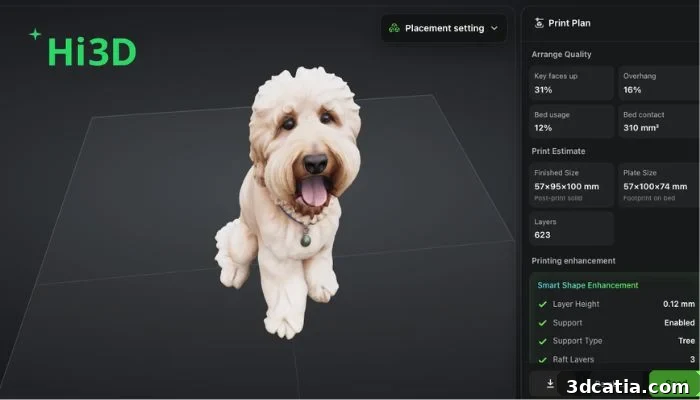
Hi3D is an AI 3D creation platform built specifically with 3D printing in mind. It focuses on producing watertight meshes and automating print preparation, including splitting large models into printable parts and adding assembly features that take nozzle size and material into account.
Credit: Hi3D
Pricing and plans
Hi3D operates on a credit-based model with a lifetime trial credit allocation for free users and multiple paid tiers offering increasing monthly credits, concurrent tasks and storage. Paid plans enable private assets and commercial usage; purchased credit packs provide flexible top-ups that do not expire but require an active subscription to access.
Model and mesh quality / Print-readiness
Hi3D generates high-resolution volumetric meshes with the goal of producing watertight, printable models. Exports include OBJ, GLB, STL, FBX and other common formats. Automated segmentation, connector insertion and tolerance adjustments help ensure printed assemblies fit and function as intended.
Texture and material quality
PBR is optional, with texture outputs scalable up to high resolutions. Stylized texture tools can apply reference image styles to imported models, and vertex-color modes support multi-color printing workflows.
Editing and customization tools
The Hi3D workspace supports text-based prompts, multi-view reconstruction, stylized texturing, split-to-print tooling and build plate optimization. Concept images can be edited before reconstruction, and the platform offers smart orientation and support strategies for different model types.
Generation speed
Geometry generation typically takes a couple of minutes; adding texture increases processing time. Tiered channels provide faster queues for higher subscription levels.
Commercial licensing
Free users must publish outputs publicly under an attribution license, while paid subscribers receive private ownership with commercial rights, along with attribution guidelines for shared or sold content.
Platform integrations
Hi3D provides an API and offers plugins for major tools. Enhanced export formats map color and print settings to slicer profiles, enabling smoother handoffs to slicers and printers.
Meshy
Meshy converts text prompts, photos and sketches into 3D models without prior modeling experience. The platform offers a web app, developer API, official plugins and a community model library. Meshy focuses on accessibility for hobbyists and professionals alike.
Pricing and plans
Meshy uses monthly credits with Free and multiple paid tiers for individuals and teams. Paid tiers unlock higher credits, queue priority, more concurrent tasks and additional features such as multi-view input and community model downloads. Team and enterprise plans add seat-based billing, SSO and higher API throughput.
Model and mesh quality / Print-readiness
Meshy exports STL and 3MF for direct printing, plus common 3D formats for other workflows. Built-in printability checks flag thin walls and non-manifold geometry and offer automatic repair. Smart Topology allows polygon control to balance detail and printability; users should still verify dimensions for parts that must meet precise measurements.
Texture and material quality
The service offers PBR texture sets at multiple resolutions and tools for multi-color printing that integrate with printer-specific multi-material systems.
Editing and customization tools
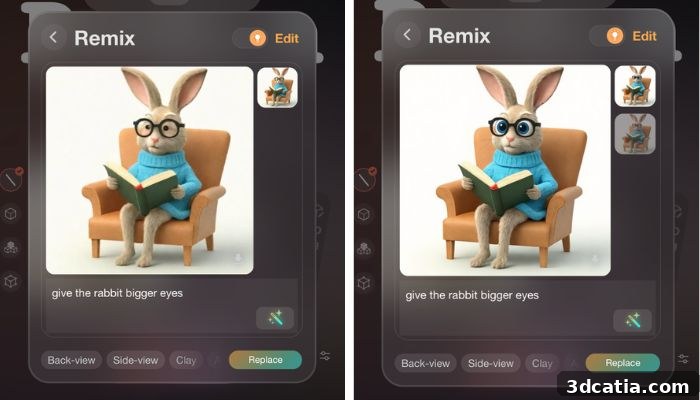
A conversational 3D Agent refines models iteratively, and Auto Split prepares parts for printing, repairs cut surfaces and arranges pieces on the print bed. Auto-rigging and other convenience features are also available to streamline production.
Generation speed
Textured models typically generate in about a minute; untextured geometry can be produced in seconds. Paid tiers provide higher priority and more simultaneous tasks.
Commercial licensing
Free plan models require attribution for commercial use, while paid plans grant full private ownership when usage and source materials comply with copyright rules.
Platform integrations
Meshy supports one-click exports to common slicers and provides plugins for major 3D tools and game engines. A developer API enables scripted pipelines and automation.
Neural4D
Neural4D (N4D) is a web-based platform that reconstructs full volumetric objects from text, images or sketches and aims to deliver editable, production-ready models. The engine focuses on producing closed, watertight geometry suitable for printing and downstream editing.
Pricing and plans
Neural4D uses a credit/subscription system with a free tier and paid plans that provide higher weekly or monthly credit allocations and concurrent task limits. Generations consume credits, and additional credit packs are available for heavy users.
Model and mesh quality / Print-ready
Its reconstruction engine produces closed meshes intended to be print-ready with no holes or common geometric errors. Exports include OBJ, FBX, GLB, USDZ, STL and BLEND. Free users typically receive untextured meshes, while paid plans include full textured model downloads.
Texture and material quality
Neural4D generates native PBR material sets, producing normal, roughness and metallic maps suitable for rendering and texturing workflows in tools like Substance Painter.
Editing and customization tools
The platform supports multimodal input and a conversational refinement system that lets users adjust scale, materials and geometry using natural language. Meshes include standard UVs and are designed for further editing in Blender or other DCC tools. Additional retopology, refinement and rigging features are in development.
Generation speed
Neural4D typically produces a watertight base mesh in about 90 seconds, with full textured models taking a few minutes longer.
Commercial license
Paid subscribers may use generated models commercially, and the provider states it does not claim intellectual property rights over user assets. Free-tier outputs are generally intended for personal or trial use.
Integrations
Neural4D is browser-based with an API for developers and compatibility with engines and tools like Unity, Unreal, WebGL and Blender. Research models and tooling are sometimes shared by the company for developers and researchers.
Rodin (Hyper3D)
Rodin is Hyper3D’s flagship generation model, developed for speed and production-ready output. It offers a mix of rapid geometry generation and high-resolution texturing for studios and producers who need quick iterations.
Pricing and plans
Hyper3D runs Free, Creator, Business and Enterprise tiers, plus a pay-as-you-go option. The Free tier uses a “pay by result” approach where credits are spent only when a result is exported. Creator and Business tiers increase monthly allowances, access to high-resolution textures and higher export and commercial use rights; Enterprise adds on-premise deployment and custom tuning.
Credit: Rodin
Model and mesh quality / Print-readiness
Rodin exports standard formats for printing and production workflows. The engine claims very fast geometry generation and supports high-polygon meshes and quad-based topology in higher tiers, which can simplify cleanup and retopology before printing.
Texture and material quality
Creator and Business plans provide HD and 4K textures plus baked normal maps. Texturing benefits from the provider’s separate texture toolset for custom materials and baking workflows.
Editing and customization tools
Rodin includes a mesh editor, format converter and vector-to-3D tools within its suite, alongside a redo system to regenerate geometry or materials a limited number of times based on plan level.
Generation speed
Published figures indicate geometry can be generated in a few seconds with complete textured models following shortly; real-world times vary with polycount and queue conditions.
Commercial licensing
Free-tier outputs have restricted use; paid subscriptions unlock broader export and usage rights suitable for commercial projects. Always review terms before using generated assets in regulated contexts.
Platform integrations
Rodin offers plugins for major 3D tools and game engines, plus API access for business and enterprise customers to integrate generation into production pipelines.
Tripo AI
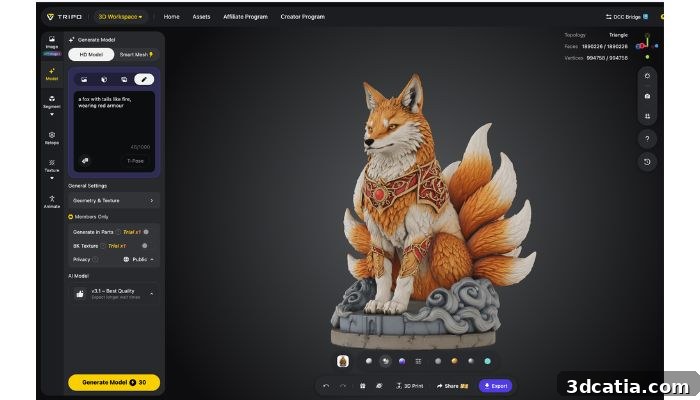
Tripo AI is a foundation-model-based service offering web, API and plugin access, with integrated tooling for producing print-ready parts and animations from AI-generated geometry.
Pricing and plans
Tripo offers Free, Pro, Max and Team plans on a credit basis. Free users receive a small monthly credit allocation and cannot use outputs commercially. Paid plans scale credits, concurrent tasks and unlock private assets and commercial rights. Annual billing often reduces costs significantly across tiers.
Credit: Tripo
Model and mesh quality / Print-readiness
Tripo exports STL, OBJ, FBX, GLB, USD and 3MF for direct use in slicers. Paid tiers provide an Ultra-high mesh quality mode and Smart Mesh options that focus on cleaner, low-polygon topology for printing.
Texture and material quality
The platform produces 4K PBR textures and includes a Magic Brush tool for local texture edits without a full regeneration.
Editing and customization tools
Tripo offers segmentation, retopology, automatic rigging and animation presets within the workspace to streamline prototyping, assembly and motion testing.
Generation speed
Times vary from seconds for low-poly previews to minutes for high-detail textured models. Paid tiers receive priority queueing and dedicated processing for heavy workloads.
Commercial licensing
Commercial rights are restricted on the Free tier and become available starting with paid subscriptions.
Platform integrations
Tripo supplies an official Blender plugin and a developer API for integrating generation and post-processing into studio pipelines.
Have you used an AI 3D model generator? Share your experience in the comments. Subscribe to newsletters or follow your favorite 3D printing communities to stay updated on model generation tools, best practices for print preparation, and workflow integrations that make AI-assisted 3D design more practical for makers and professionals.