
You may not recognize the name curcumin, but you almost certainly know its source: turmeric, the bright yellow spice native to Southeast Asia. Curcumin is the principal bioactive compound in turmeric responsible for its color and many of its properties. Extracted from the Curcuma longa plant, curcumin appears today in dietary supplements, cosmetics, and food coloring. A research team at Hunan University has now demonstrated a promising new application: using curcumin to improve the stability and precision of microscopic ceramic 3D printing.
The Challenge of Light Scattering in Ceramic AM
Ceramic additive manufacturing using vat photopolymerization—commonly implemented with digital light processing (DLP)—relies on curing a liquid resin densely loaded with microscopic ceramic powder. During printing, a projector or light source patterns light onto thin layers of the resin, selectively curing the material to build each layer. However, the ceramic particles inside the resin scatter light in random directions. That stray light can initiate unwanted polymerization in regions outside the intended pattern, creating blurred features, dimensional inaccuracies, and other defects.
Manufacturers typically add industrial dyes to the resin to absorb excess light and reduce scattering effects. While these dyes can help with detail, they work passively—simply blocking or dimming stray photons—and often leave residues that weaken the part after high-temperature firing. This forces a trade-off between achieving fine resolution and preserving the mechanical integrity of the final ceramic component.
Why Curcumin Works
The Hunan University researchers took a different approach. Instead of relying on dyes that only attenuate light, they introduced curcumin into the ceramic resin. At very low concentrations—on the order of 0.01 weight percent—curcumin helps prevent unintended curing by neutralizing the reactive chemical species that cause stray polymerization, while still allowing fast, efficient printing.
| Material Feature | Traditional Chemical Dyes | Curcumin Integration |
| Light Management | Passively dims and blocks stray light | Absorbs specific wavelengths and neutralizes free radicals |
| Feature Resolution | Low to moderate; can clog micro-holes | High; preserves tiny features such as 50‑μm holes |
| Post-Processing | Can leave residue and weaken final structure | Burns away during debinding and sintering, retaining strength |
Active Protection at a Molecular Level
To picture the difference, imagine the printer’s light source as a laser writing a message on a wall while a dense cloud of dust scatters the beam into a broad blur. Traditional dyes are like sunglasses that dim the whole scene, reducing the visibility of the blur but not addressing its cause. Curcumin, by contrast, acts at the molecular level: its natural pigment absorbs the wavelengths associated with scattered light and its chemical structure scavenges free radicals generated when scattered photons interact with the resin.
By neutralizing these free radicals before they can trigger unwanted curing, curcumin keeps the resin from hardening in unintended regions. In the researchers’ laboratory tests, this approach reduced blurring down to 26.1 micrometers and preserved microscopic 50‑micrometer holes that would otherwise clog in standard resins. Crucially, the small amounts of curcumin used do not slow the printing process nor require major changes to existing DLP equipment.
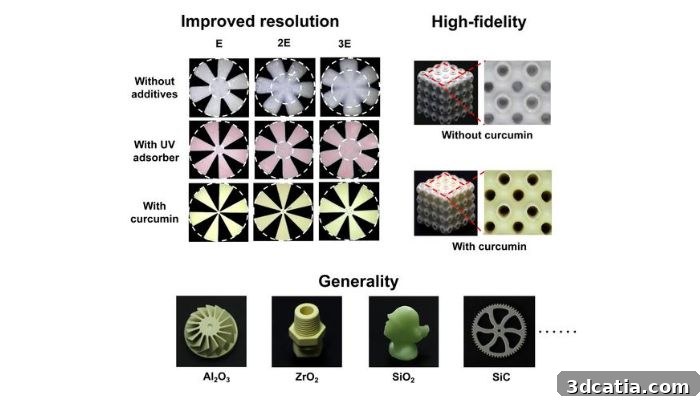
Compared with conventional light absorbers, this strategy substantially enhances the fabrication precision of ceramic components and enables high-fidelity forming of complex structures. (Figure Credit: By Mingyue Cao, Wenxin Wang, Xingyu Yang, Wei Zhu, Xiaolong Zhu, Yinfeng He, Feng Chen and Xiaoxiao Han)
During the debinding and sintering stages—the high-temperature steps used to remove organic components and densify ceramics—the curcumin combusts and is eliminated, leaving a ceramic part with high density and preserved mechanical properties. This contrasts with some synthetic dyes that can leave residues or introduce defects under thermal processing.
Implications for Industry
The practical implications are meaningful for additive manufacturing sectors that require both fine detail and robust mechanical performance. Curcumin-enhanced resins could enable the reliable production of complex ceramic parts for dental restorations, aerospace components, electronic substrates, and medical devices. By reducing the trade-off between resolution and strength, this bio-based solution may help scale ceramic 3D printing into broader commercial applications.
Future work will determine how easily curcumin can be incorporated into commercial resin formulations and whether long-term manufacturing workflows adopt it at scale. For now, the research highlights a novel, nature-derived strategy to improve the fidelity of ceramic additive manufacturing without compromising part performance.