
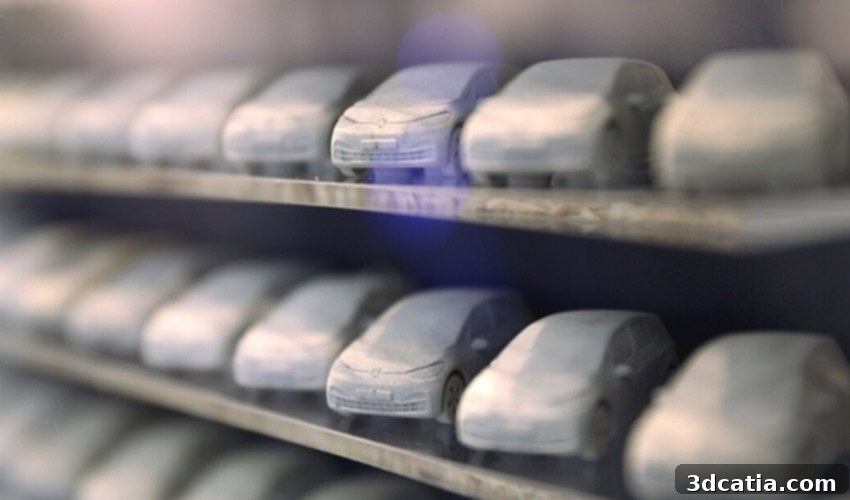
Volkswagen Pioneers Next-Generation Automotive Manufacturing with Advanced 3D Printing
In a significant stride towards revolutionizing vehicle production, automotive giant Volkswagen unveiled its ambitious plans for additive manufacturing in December 2018. The company announced the establishment of a dedicated additive manufacturing center at its primary production facility in Wolfsburg, Germany. This strategic move was specifically designed to rigorously test and integrate HP’s advanced Metal Jet technology. Volkswagen is now actively incorporating the metal binder jetting process into its core manufacturing operations, with an audacious goal: to produce an astounding 100,000 finished parts annually by the year 2025. This pioneering initiative positions Volkswagen as the first major automotive manufacturer to adopt this specific technology at scale within its production workflow, a notable divergence from its competitors who frequently rely on alternative methods such as laser powder bed fusion. The integration of this innovative process promises to yield substantial benefits, most notably enabling the production of components that are up to 50% lighter than their conventional sheet steel counterparts. Furthermore, Volkswagen is leveraging this opportunity to forge a critical software partnership with Siemens, underscoring a holistic approach to embracing digital manufacturing.
Volkswagen’s journey with additive manufacturing is far from new, boasting a rich history spanning approximately 25 years. What began primarily as a tool for rapid prototyping, facilitating quick design iterations and concept validation, has steadily evolved into a sophisticated capability for producing high-quality finished parts and a diverse array of functional components. From intricate dashboard elements and robust bumpers to crucial door skins and structural brackets, 3D printing has become an indispensable part of Volkswagen’s engineering and production toolkit. The expansive Wolfsburg plant currently houses an impressive thirteen specialized units, each dedicated to harnessing the transformative advantages of both plastic and metal 3D printing technologies. On the metal additive manufacturing front, the automobile manufacturer successfully produces a variety of critical components, including sturdy brackets, efficient radiators, and optimized intake manifolds. To date, Volkswagen has proudly produced over one million 3D printed parts, a figure that serves as a testament to its long-standing commitment and expertise in the field, and one that is projected to grow exponentially in the coming years as binder jetting scales up.
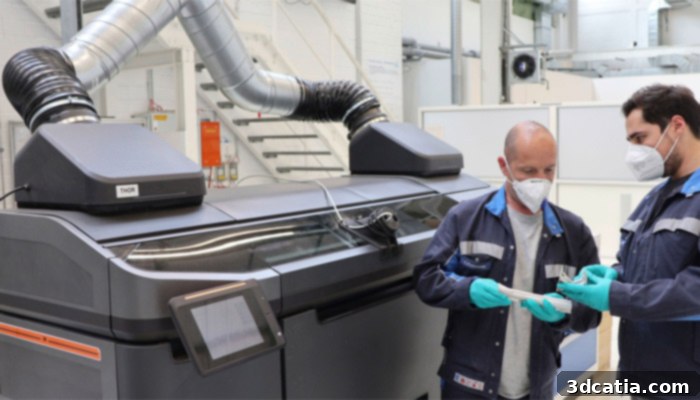
Two Volkswagen employees check the quality of 3D printed structural parts at the Wolfsburg center (photo credit: Volkswagen)
Volkswagen’s Strategic Shift: Embracing Binder Jetting for Automotive Excellence
The decision to deeply integrate HP’s binder jetting technology represents a calculated and forward-thinking move by Volkswagen. This powerful combination of Volkswagen’s engineering prowess and HP’s cutting-edge machines aims to achieve multiple strategic objectives: the production of significantly lighter and more cost-effective parts, alongside a substantial increase in overall manufacturing productivity. This ambitious vision has been backed by a multi-million euro investment over the past five years, underscoring Volkswagen’s serious commitment to this transformative technology. Christian Vollmer, a prominent member of the Volkswagen management board with responsibilities spanning production and logistics, emphasized the company’s unwavering dedication to innovation. He stated, “Despite the ongoing challenges of the coronavirus pandemic, we’re continuing to work on innovation. Together with our partners, we aim to make 3D printing even more efficient in the years ahead and suitable for production-line use.” This sentiment highlights Volkswagen’s resilient pursuit of advanced manufacturing solutions, even amidst global disruptions.
The implementation of this new process isn’t just theoretical; Volkswagen has already put binder jetting to the test with tangible results. The carmaker successfully utilized the technology to create critical structural components for the pillar of its popular T-Roc convertible model. These innovative parts demonstrated a remarkable 50% weight reduction compared to their traditional counterparts manufactured from sheet steel. The advantages of such lightweighting extend beyond mere material savings, contributing significantly to improved vehicle performance, enhanced fuel efficiency, and a reduced carbon footprint – all critical factors in modern automotive design. Following their initial production, these cutting-edge parts were dispatched to the Osnabrück facility, a specialized center within Volkswagen dedicated to the meticulous production of convertibles and limited-series vehicles. Here, they underwent rigorous certification processes, ensuring they met the stringent quality and safety standards expected from Volkswagen, paving the way for their future integration into serial production.
Driving Production Efficiency Through Strategic Partnerships
Recognizing that successful industrialization of additive manufacturing requires more than just advanced hardware, Volkswagen has also forged a vital software partnership with Siemens. This collaboration focuses on optimizing a crucial aspect of 3D printing: the precise positioning of multiple parts on the building plate, a technique scientifically known as nesting. Nesting is a highly sophisticated optimization strategy where complex algorithms are used to arrange numerous individual components within the confined build volume of the 3D printer, maximizing the utilization of space and material. By intelligently packing parts, nesting can dramatically increase the number of components produced in a single print job, thereby significantly boosting overall productivity and reducing per-part costs. Cedrik Neike, a distinguished member of the board of Siemens AG and CEO of Digital Industries, articulated the importance of this collaboration: “We are very proud to support Volkswagen with our innovative 3D printing solutions. Our automation and software solutions are leading in industrial production applications. Using this technology, Volkswagen will be able to develop and produce components faster, more flexibly and using fewer resources.” This partnership highlights the synergistic relationship between hardware innovation and intelligent software in achieving manufacturing excellence.
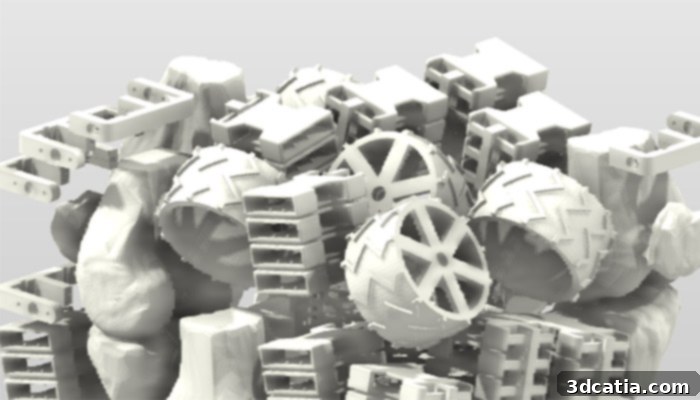
Nesting allows for the optimization of the number of parts per print (photo credits: Sculpteo)
The collaboration between Volkswagen, HP, and Siemens forms a powerful tripartite alliance, each partner bringing unique expertise to the table. Together, these industry leaders are committed to thoroughly understanding and addressing the multifaceted challenges inherent in deploying metal binder jetting at an industrial production scale. Their collective endeavor aims to not only refine the binder jetting process but also to demonstrate how this advanced manufacturing method can fundamentally revolutionize the automotive sector. The ambitious goal of producing 100,000 3D printed parts per year by 2025 stands as a bold testament to their shared vision and confidence in the technology’s potential. This target underscores a paradigm shift in how vehicles will be designed, manufactured, and customized in the future. As the automotive landscape continues to evolve, incorporating more complex geometries, lightweight materials, and demand for personalized options, additive manufacturing, particularly binder jetting, is poised to play an increasingly central role. Volkswagen’s proactive adoption of this technology not only sets a benchmark for the industry but also promises to accelerate the broader integration of additive manufacturing across various industrial applications. We will certainly be keenly observing the progress of this groundbreaking initiative as it unfolds over the coming years, anticipating the profound impact it will have on mass production and beyond. For more detailed insights into this strategic development, readers can refer to the official press release HERE.
Volkswagen’s bold embrace of metal binder jetting, distinguishing itself from the widespread adoption of laser powder bed fusion by many of its peers, marks a pivotal moment in the automotive industry’s engagement with additive manufacturing. This strategic choice underscores a belief in the unique capabilities of binder jetting to deliver on the demands of high-volume, cost-effective, and performance-driven automotive parts production. What are your thoughts on Volkswagen’s pioneering use of powder bed fusion technologies for vehicle manufacturing? We encourage you to share your insights and opinions in a comment below or engage with us on our Facebook and Twitter pages. Don’t forget to sign up for our free weekly Newsletter, ensuring you receive all the latest news, innovations, and developments in the fascinating world of 3D printing delivered directly to your inbox!