
Revolutionizing Coral Conservation: How 3D Printed Corals are Revitalizing Our Oceans
The astonishing capabilities of 3D printing technologies have opened up unprecedented avenues for design freedom, allowing for the creation of intricate and complex structures previously unimaginable. This innovative aspect is not merely a technical marvel but a profound benefit of additive manufacturing, continuously explored by scientists worldwide. Pushing the boundaries of design complexity naturally leads to groundbreaking applications across various fields. One such pioneering application focuses on a critical environmental challenge: increasing marine biodiversity and protecting endangered ecosystems. Researchers from the esteemed University of Cambridge and the University of California San Diego have harnessed the power of 3D printing to create coral-inspired structures. These remarkable bio-mimetic designs are not just aesthetically similar to natural corals; they are functional, capable of fostering dense populations of microscopic algae. Their groundbreaking findings, meticulously detailed in the prestigious journal Nature Communications, represent a significant leap forward. This research not only paves the way for novel bio-inspired materials but also offers tangible applications for urgent coral conservation efforts, presenting a beacon of hope for our rapidly declining coral reefs.
Unveiling Nature’s Masterpiece: The Coral-Algae Symbiosis
At the heart of healthy marine ecosystems lies an incredibly delicate and intricate relationship between corals and algae. This symbiotic partnership is fundamental to the survival and prosperity of coral reefs, which are often dubbed the “rainforests of the sea” due to their immense biodiversity. In this vital alliance, the coral polyp provides a secure and protective host environment for the microscopic algae, specifically zooxanthellae. In return, these algae, through the process of photosynthesis, produce essential sugars and oxygen, supplying the coral with up to 90% of its energy needs. This mutualistic exchange is the powerhouse behind the vibrant growth and structural integrity of coral reefs, supporting an extraordinary array of marine life. Dr. Daniel Wangpraseurt, a distinguished Marie Curie Fellow from Cambridge’s Department of Chemistry, eloquently highlights the inspiration behind their research: “In our lab, we’re looking for methods to copy and mimic these strategies from nature for commercial applications.” This profound understanding of nature’s design principles is precisely what drove the researchers to employ 3D printing. By meticulously replicating the structural characteristics of natural corals, they were able to create artificial habitats that effectively promote algae growth, thereby indirectly feeding and supporting the coral structures, much like in a natural reef.
The Global Crisis of Coral Reefs: Why Innovation is Critical
The importance of these 3D printed coral structures cannot be overstated, especially when considering the dire state of natural coral reefs worldwide. Coral reefs are facing an unprecedented crisis, primarily driven by anthropogenic climate change. Rising ocean temperatures lead to coral bleaching, a devastating phenomenon where corals expel their symbiotic algae, resulting in their whitening and often, eventual death. Ocean acidification, caused by increased absorption of atmospheric carbon dioxide, further weakens coral skeletons, making them more vulnerable. Additionally, pollution from land-based activities, overfishing, and destructive fishing practices all contribute to the rapid degradation of these invaluable ecosystems. The loss of coral reefs has cascading effects, impacting marine biodiversity, coastal protection, and the livelihoods of millions of people who depend on them for food and tourism. In the face of such overwhelming challenges, conventional conservation methods often fall short. This urgent need for scalable, effective, and innovative solutions underscores the significance of initiatives like the 3D printed coral project. By mimicking the natural biological mechanisms, these artificial structures offer a potential pathway to supplement struggling reefs, provide nurseries for marine life, and even create platforms for studying coral resilience and adaptation in controlled environments.
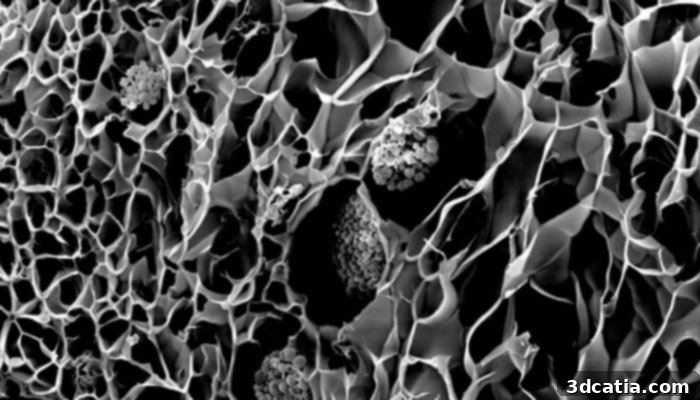
A close-up of a microalgal aggregate (scale bar = 10 µm) | Image via University of Cambridge
Mastering Bioprinting Techniques for Living Structures
To bring these coral-inspired structures to life, the research team employed advanced bioprinting techniques. Bioprinting is a specialized form of additive manufacturing that utilizes “bio-inks” – materials containing living cells – to create functional tissues and organs. In this context, it was crucial not only to replicate the highly detailed and complex architectural designs found in natural coral but also, and perhaps more challenging, to maintain the viability of the live cells throughout the printing process. This is far from a simple task, as living cells are incredibly delicate and sensitive to environmental changes. Professor Shaochen Chen, a co-senior author from UC San Diego, elaborated on the critical innovation of their approach: “Most of these cells will die if we were to use traditional extrusion-based or inkjet processes because these methods take hours. It would be like keeping a fish out of the water; the cells that we work with won’t survive if kept too long out of their culture media. Our process is high throughput and offers really fast printing speeds, so it’s compatible with human cells, animal cells, and even algae cells in this case.”
The rapid printing speed developed by Professor Chen’s team is a game-changer for bioprinting, especially for sensitive marine organisms like algae. Traditional bioprinting methods, while precise, often involve slower deposition rates or multiple processing steps that expose cells to non-physiological conditions for extended periods. This prolonged exposure can lead to significant cell mortality, rendering the printed structures non-viable. The ability to print rapidly, therefore, minimizes the time cells spend outside their optimal growth environment, dramatically increasing their survival rate and the overall success of the bioprinting process. This high-throughput capability not only makes the technique suitable for printing complex biological constructs but also holds immense potential for scaling up production, a crucial factor for any large-scale conservation effort. The precision afforded by these bioprinting techniques allows for the creation of intricate internal structures, such as porous networks and micro-channels, that are essential for mimicking the natural coral environment, promoting efficient nutrient exchange, and maximizing light exposure for the symbiotic algae.
Engineering Biomimicry: Materials and Optical Properties for Algae Growth
The selection of materials for these bio-inspired coral structures was paramount to their functionality. The scientists strategically utilized a sophisticated combination of polymer gels and hydrogels. These materials were carefully chosen for their biocompatibility, structural integrity, and ability to mimic the physical properties of natural coral skeletons. Crucially, these gels were doped with cellulose nanomaterials. The inclusion of cellulose nanomaterials was a key innovation, specifically aimed at replicating the complex optical properties inherent to living corals. Natural corals possess unique light-scattering and light-redistributing characteristics that optimize the amount of sunlight reaching their symbiotic algae, thereby enhancing photosynthesis. By incorporating these nanomaterials, the researchers were able to engineer their 3D printed structures to perform a similar function.
Upon rigorous testing of their 3D printed bionic corals, the team observed resounding success: the artificial structures were indeed highly effective at redistributing light, mirroring the efficiency of their natural counterparts. This ability to precisely manage light within the coral structure is vital for maximizing the photosynthetic output of the cultivated algae, which in turn fuels the growth and health of the artificial reef system. Dr. Daniel Wangpraseurt emphasized the broad potential of this new technology: “There are many different applications for our new technology. We have recently created a company, called mantaz, that uses coral-inspired light-harvesting approaches to cultivate algae for bioproducts in developing countries. We hope that our technique will be scalable so it can have a real impact on the algal biosector and ultimately reduce greenhouse gas emissions that are responsible for coral reef death.” This vision extends beyond mere conservation, aiming to leverage the efficiency of nature’s designs for sustainable economic development and environmental remediation. The cultivation of algae for bioproducts offers a renewable source for biofuels, food supplements, and pharmaceuticals, simultaneously contributing to a circular economy and mitigating the impact of climate change.
The Broader Impact: Additive Manufacturing for a Sustainable Future
This pioneering research into 3D printed corals stands as a powerful testament to the transformative potential of additive manufacturing when applied to complex environmental challenges. It brilliantly illustrates how advanced technological capabilities can be meticulously engineered to imitate nature’s most efficient solutions, providing innovative answers to critical issues confronting our planet. The concept of biomimicry – drawing inspiration from biological designs and processes – is proving to be a fertile ground for scientific discovery and technological innovation. In this instance, by understanding and replicating the sophisticated architecture and symbiotic relationships of coral reefs, scientists are developing tools that could play a pivotal role in reversing ecological damage and fostering marine ecosystem resilience.
The successful development of these functional 3D printed coral structures opens up a myriad of future possibilities. While the initial focus is on coral conservation and sustainable algae cultivation, the underlying principles of precise bioprinting, advanced material engineering, and biomimetic design could be applied to numerous other environmental and biotechnological applications. Imagine customized bioreactors optimized for specific biological processes, or even new forms of biodegradable materials engineered for enhanced ecological integration. However, realizing the full potential of these groundbreaking research projects will hinge on their ability to be successfully scaled up in the coming years. Scaling up from laboratory prototypes to industrial-scale production for widespread deployment presents its own set of challenges, including cost-effectiveness, material supply, and logistical complexities. Nevertheless, the initial results are incredibly promising, offering a glimmer of hope that humanity, through ingenuity and technological advancement, can contribute meaningfully to healing and preserving our precious natural world. It will definitely be interesting to see if these research projects succeed in being scaled up in the coming years. You can find more information HERE regarding the project details.
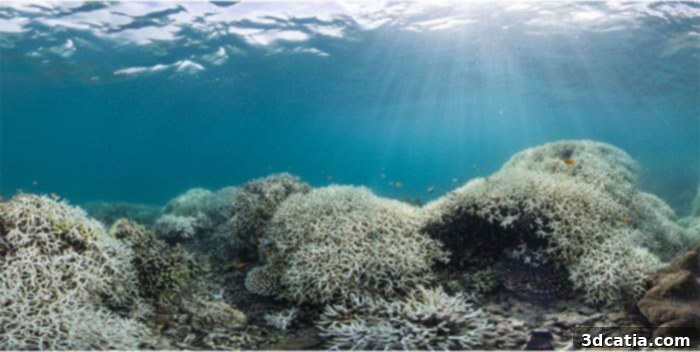
A dying coral reef
What are your thoughts on the revolutionary potential of bioprinting corals to protect our invaluable coral reefs and enhance marine biodiversity? We encourage you to share your insights and opinions by leaving a comment below or engaging with us on our Facebook and Twitter pages! Don’t forget to sign up for our free weekly Newsletter, to receive all the latest news and innovations in the world of 3D printing delivered straight to your inbox!