
The Rapid Ascent of 3D Printing Innovation: Insights from the Latest Patent Trends
The landscape of technological innovation is constantly evolving, but few fields have demonstrated the explosive growth seen in additive manufacturing, commonly known as 3D printing. A recent and comprehensive report from the European Patent Office (EPO) sheds critical light on this dynamic sector, revealing astonishing trends in patent applications worldwide. Between 2013 and 2020, the number of international patent applications related to 3D printing surged at an average annual rate of 26.3%. This remarkable pace is eight times faster than the growth observed across other technological domains, unequivocally showcasing 3D printing’s exceptional vitality and its pivotal role in driving global innovation. This unprecedented momentum is fueled by a concerted effort from global industry players, who are intensely focused on developing groundbreaking new processes, advanced materials, and sophisticated equipment. Simultaneously, leading public research institutes and private sector pioneers are contributing significantly, pushing the boundaries of what’s possible and ushering in an era of unparalleled growth and expansion for the additive manufacturing industry.
Since the turn of the millennium, the EPO reports that more than 50,000 international patent families (IPFs) have been filed globally, all directly connected to additive manufacturing technologies. Historically, the bulk of these applications originated from established engineering corporations. However, a significant paradigm shift is now underway, with a rapidly increasing number of smaller companies and innovative startups venturing into this exciting domain. The entrepreneurial spirit within the 3D printing market is thriving across various sectors, leading to a noticeable diversification of patent holders. Notably, the EPO report highlights the particularly impressive volume of patents filed within the health and medicine sector. Over 10,000 IPFs were published between 2001 and 2010 alone, underscoring the transformative impact of 3D technologies in healthcare. These innovations enable the design and production of highly customized medical devices, ranging from personalized prosthetics and implants to complex surgical guides, pushing the boundaries of patient-specific care. Furthermore, the transportation market also demonstrates robust innovation, accounting for over 7,000 IPFs during the same period, predominantly driven by advancements in the aeronautical and automotive industries. This indicates a strong focus on lightweighting, complex part manufacturing, and efficient production methods within these critical sectors.
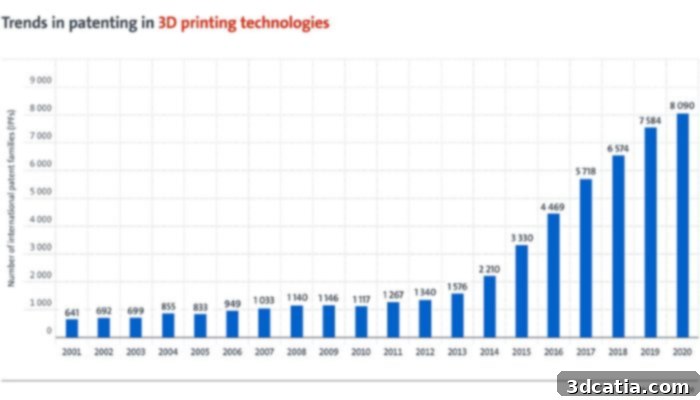
3D printing patents have increased considerably in the past few years (Photo credits: European Patent Office)
The Global Landscape of Additive Manufacturing Intellectual Property
When examining the geographical distribution of 3D printing innovation, the United States firmly retains its position at the forefront. The US leads the pack with the highest number of patents filed in additive manufacturing, capturing nearly 40% of all international patent families recorded between 2001 and 2020. This substantial share places the US ahead of the combined total for all European countries by a significant 6.9%. This leadership is a testament to America’s robust research and development ecosystem, substantial corporate investment, and a vibrant startup culture. Following the United States, Japan ranks second with 13.9% of IPFs, renowned for its precision engineering and advanced manufacturing prowess, while Germany secures third place with 13.4%, driven by its strong industrial base and excellent research institutions. Major corporations like General Electric, Raytheon Technologies, and HP are among the top filers globally, contributing significantly to the patent landscape with 1,793, 1,441, and 1,362 patents respectively. These colossal US-based entities demonstrate their commitment to pushing the technological envelope. However, the EPO report also prominently highlights the crucial role of the burgeoning startup sector within additive manufacturing. These agile new companies continue to grow exponentially, bringing diverse and disruptive applications to the industry, often focusing on niche areas or revolutionary new processes that complement the efforts of larger established players.
Patents as a Barometer for Future Industry Growth and Economic Impact
The EPO report further emphasizes that the sheer volume of International Patent Families filed serves as a potent industry barometer. Given that patents are typically filed years in advance of commercial product launches or widespread market adoption, they offer invaluable insights into potential future growth tendencies and emerging technological directions. This forward-looking indicator is particularly compelling for the 3D printing industry, which is already experiencing an exponential surge in market value. Industry revenue tripled from an impressive $6 billion in 2016 to a remarkable $18 billion in 2022. More strikingly, this continued upward trajectory shows no signs of decelerating, with industry revenue projected to skyrocket further, reaching an estimated $50 billion by 2028. This forecast underscores the profound economic impact and transformative potential of additive manufacturing across various sectors. The sustained investment in research and development, reflected in the vibrant patent landscape, directly correlates with this anticipated financial expansion, signalling a robust and sustainable future for the entire ecosystem of 3D printing technology. Businesses, investors, and policymakers alike closely monitor these patent trends to gauge market health, identify innovation hotspots, and strategize for future opportunities within this rapidly evolving industry.
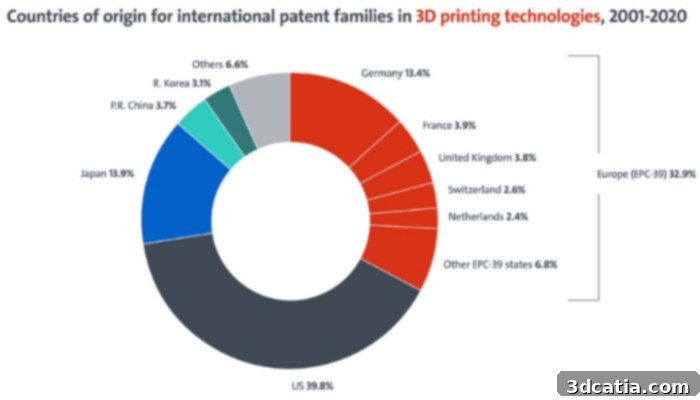
The United States and combined European countries account for the majority of AM technology patents (Photo credits: European Patent Office)
The Increasing Dynamism of Public Research Institutes and Academia
Beyond corporate innovation, the study also highlights the critical and increasingly dynamic role played by universities and public research bodies in shaping the future of 3D printing. These institutions are responsible for filing a substantial 12% of all International Patent Families during the analyzed period. This significant contribution underscores the importance of foundational research and academic exploration in pushing the boundaries of additive manufacturing. Numerous world-renowned universities, such as the Massachusetts Institute of Technology (MIT), Carnegie Mellon University, and Penn State University, have established sophisticated and in-depth additive manufacturing research laboratories. Their cutting-edge university programs are consistently responsible for groundbreaking new creations, often laying the groundwork for future industrial applications. A significant proportion of these academic patents also pertain to the crucial healthcare market, with a notable emphasis on biomaterials and bioprinting technologies. The development of 3D-printed organs and tissues, driven largely by advancements in academic research, has seen meteoric progress in recent years. For those who have been closely following the news in this field, the incredible strides made in creating functional biological structures are truly astonishing. This synergy between academic research and industrial application is vital for sustained innovation. To delve deeper into these fascinating 3D printing patent applications and gain a more comprehensive understanding of the trends, the full study is available for review HERE.
In conclusion, the latest report from the European Patent Office paints a vivid picture of a vibrant and rapidly expanding 3D printing industry, where innovation is not just a buzzword but a tangible force driving exponential growth in patent filings and market revenue. The collaborative efforts of established corporations, innovative startups, and dedicated public research institutions are collectively shaping the future of manufacturing, promising a new era of customized, efficient, and sustainable production. From personalized medicine to advanced aerospace components, additive manufacturing continues to redefine what is possible, making intellectual property a crucial asset in this transformative journey.
What are your thoughts on the phenomenal growth and future prospects of the 3D printing industry? We invite you to share your insights and comments below, or connect with us on our LinkedIn, Facebook, and Twitter pages! Don’t miss out on the latest 3D printing news – sign up for our free weekly Newsletter here, delivered straight to your inbox! You can also explore all our informative videos on our YouTube channel for more content.
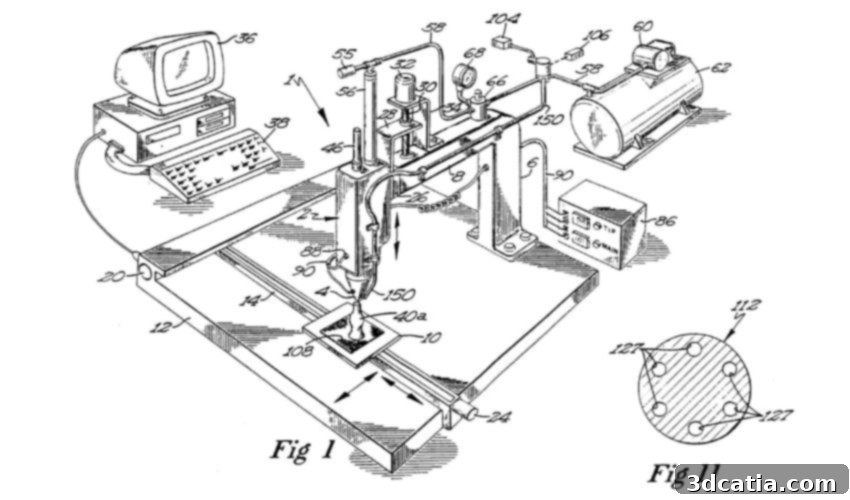
*Cover Photo Credits: Patent US5121329A – Scott Crump