
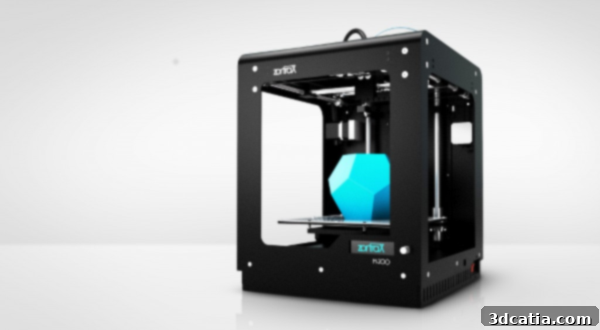
Zortrax M200 3D Printer Review: Unveiling a Benchmark in Desktop FDM Printing
In January of 2013, the 3D printing world was set abuzz when tech giant Dell announced an unprecedented order of no less than 5,000 3D printers from the then-emerging Polish manufacturer Zortrax. This significant endorsement immediately positioned Zortrax as a serious contender in the additive manufacturing space. Among their offerings, the Zortrax M200 quickly garnered attention for its robust design and impressive capabilities. Its alluring aesthetic and promise of reliability captivated our team at 3Dnatives, prompting us to conduct a comprehensive review in our dedicated 3Dnatives lab. We extend our sincere gratitude to Machine-3D, the official distributor of Zortrax, for generously providing us with the machine for this in-depth evaluation.
Originally released in 2014, the Zortrax M200 quickly established itself as a true Plug & Play FDM (Fused Deposition Modeling) 3D printer. Designed for immediate productivity, it boasts a layer resolution range between 90 and 400 microns, offering versatility for both highly detailed models and faster prototypes. Its broad compatibility with Mac OS X and Windows 7 (and all subsequent versions) ensures seamless integration into most professional and personal workflows. A key feature is its integrated heated print plate, essential for printing a variety of materials, particularly ABS, and enabling the creation of objects with a generous maximum build volume of 200 x 200 x 180 mm. This blend of user-friendliness, broad compatibility, and solid build capabilities made the M200 a popular choice for designers, engineers, and educators alike. Now, with the initial specifications covered, let’s dive deeper and see how this impressive machine performs in real-world scenarios!
Unpacking and Initial Impressions of the Zortrax M200
Our first interaction with the Zortrax M200 began with the unboxing, and it immediately set a high standard. The quality of the packaging was undeniably premium, suggesting a meticulous attention to detail from the manufacturer. Every component was carefully nestled and protected by copious amounts of foam, further encased in plastic. This thoughtful approach ensured that the printer and its accessories would arrive in perfect condition, ready for immediate assembly. Even before getting to the machine itself, we discovered a professionally designed presentation booklet and a quick start guide. These guides were not only clear and concise but also beautifully laid out, instilling a sense of confidence and ease for the user. It felt reassuring, making us anticipate that if the print quality matched the packaging and documentation, we were in for a truly positive experience.
The array of accessories provided with the Zortrax M200 is remarkably comprehensive, reminiscent of other premium desktop 3D printers like the Up +2. All tools were neatly organized within a dedicated toolbox, reflecting Zortrax’s commitment to user convenience and a seamless printing journey. This thoughtful kit included: anti-scald gloves for safe handling of hot components, sharp cutters for filament, precision cutters for delicate support removal, a sturdy spatula for easy print detachment from the build plate, fine tweezers for intricate tasks, an Allen wrench for assembly and adjustments, a tube of grease for maintenance, protective goggles for safety, a dedicated reel holder, a filament guide for smooth material feeding, a 1kg (2.2 lbs.) Z-ABS filament reel to get started immediately, an SD card for storing print files, a USB SD card reader for easy file transfer, and a needle nozzle – a small but incredibly useful addition for nozzle maintenance, which many seasoned 3D printer users would appreciate having on hand from the start. This extensive toolkit makes it clear that Zortrax left nothing to chance, equipping users with everything necessary to embark on their first 3D print with complete confidence.
The comprehensive accessories and tools that accompany the Zortrax M200, ensuring a smooth printing experience.
Observing this full complement of equipment immediately instills a sense of reassurance. Zortrax has clearly considered every aspect of the user experience, providing not just a 3D printer, but a complete ecosystem ready for immediate use. Furthermore, the machine is delivered with a Z-ABS coil, which is Zortrax’s proprietary ABS plastic, meticulously optimized for use with their printers. What truly impressed us was that the bobbin holder itself is 3D printed and serves a dual purpose as a test piece. This initial example of a printed object, crafted by the M200, left us genuinely speechless with its quality and precision, offering a compelling first glimpse into the machine’s capabilities. Other small but significant components, such as the fan guide, also come pre-printed from Zortrax, underscoring their commitment to leveraging 3D printing for internal parts and demonstrating the potential of their technology.
Seamless Installation and Robust Hardware of the Zortrax M200
Setting up the Zortrax M200 for printing high-quality ABS parts involves a few essential, yet remarkably simple, steps. The process begins with the installation of the heated print plate. This component is crucial for successful ABS printing as it actively works to prevent material shrinkage and warping, which are common challenges with ABS filament. Following this, the perforated plates are installed. These plates are ingeniously designed to ensure optimal adhesion and maintenance of your models during the entire printing process, minimizing the risk of prints detaching. The installation itself is incredibly straightforward, largely thanks to the inclusion of magnetic points and intuitive ergonomic insertion slots on the plate. These design choices mean that even novice users can confidently assemble the print bed without difficulty.
Connection-wise, there are only two primary connectors that need to be clipped into place, serving for both calibration and heating functions. While these connectors are largely exposed, making them susceptible to accidental dislodgement if not handled with care, their simple design contributes to the printer’s overall ease of setup. Only extended use will truly reveal if this aspect proves to be a long-term weak point after numerous print cycles and plate removals. As a vital reminder from Zortrax, always utilize the provided protective gloves and glasses during setup and operation, especially when dealing with the heated elements, to ensure safety. The overall build quality of the Zortrax M200 feels solid and industrial, with a sturdy frame that minimizes vibrations and contributes to the printer’s consistent performance.
Once the build plate is secured, the next steps involve inserting the coil holder and connecting the cable that powers and feeds the print head. This is followed by threading the Z-ABS plastic filament from your spool into the extruder mechanism. The filament path is clearly designed, minimizing friction and ensuring a smooth feed. With these few, hard steps completed, the majority of the physical setup is done. All that remains is to connect the printer to a power source and press the ON/OFF button to power it up, ready for its first print. The intuitive design and clear instructions make the initial setup process incredibly user-friendly, reinforcing the M200’s reputation as a “plug and play” device.
A detailed view of the robust extruder mechanism of the Zortrax M200, highlighting its precision engineering.
Mastering Your Prints with Z-SUITE Software
The Zortrax M200 comes paired with its proprietary slicing software, Z-SUITE, a testament to Zortrax’s commitment to a streamlined and optimized printing ecosystem. Z-SUITE is lauded for its remarkable simplicity and intuitive interface, making it exceptionally approachable for beginners and efficient for experienced users. While open-source advocates might find the closed-source nature a slight disappointment, this design choice allows Zortrax to precisely optimize printer settings for their proprietary filaments, guaranteeing consistent and high-quality results straight out of the box. This curated experience minimizes the trial-and-error often associated with open-source slicers and third-party filaments.
Upon opening Z-SUITE, users are greeted with a familiar suite of classic 3D model manipulation options: the ability to add and delete models, view them from various angles, rotate, move, scale, and precisely position them on the virtual build plate. However, what truly stands out as an innovative feature is its integrated cutting functionality. We’re not just referring to standard slicing here. Z-SUITE allows users to cut a 3D model into multiple pieces. This capability is incredibly useful for several reasons: it can liberate complex designs from needing excessive support structures, enable the printing of objects larger than the M200’s build volume by assembling them post-print, and simplify the printing of multi-part assemblies. This feature offers immense practical possibilities, streamlining workflows and reducing the need to export models to external 3D modeling software for such modifications, saving valuable time and effort.
The user-friendly Z-Suite software for the Zortrax M200, showcasing its intuitive interface and powerful features.
For the core printing portion, Z-SUITE provides access to key parameters, carefully balanced to offer control without overwhelming the user. Users can select the type of Zortrax filament coil being used, choose from five distinct layer thickness options (ranging from fine detail to faster drafts), two speed settings (for optimizing between quality and print duration), four infill choices (affecting object strength and material consumption), and adjust the fan percentage for precise cooling control. A particularly thoughtful enhancement is the support generation system. Users have the flexibility to define the angle from which supports will generate, and whether they should be full or more spaced, significantly impacting print success and post-processing ease. This level of control over support structures is often overlooked but drastically improves the overall user experience.
Beyond these core settings, Z-SUITE also offers several advanced configurations. One that notably impressed us was the option to choose the “sewing” (or seam) location – either a consistent point or a random placement. This seemingly minor detail addresses a common aesthetic issue in FDM printing, allowing users to eliminate the unsightly vertical line on the back of prints where each new layer begins, thus achieving a smoother, more professional finish. Zortrax has genuinely considered every detail to enhance the customer’s printing experience, making their machine more enjoyable and results-driven. A major highlight is the support material itself: it withdraws with remarkable ease, far surpassing the challenges often encountered with supports on many other FDM machines we have tested, drastically reducing post-processing time and effort.
The Zortrax M200, through Z-SUITE, also provides advanced functional capabilities. It supports multi-color printing by allowing users to pause during a print at a specific height or layer of their choice, facilitating filament changes. This feature opens up a world of creative possibilities, from adding accent colors to embedding functional elements within a print. However, it’s important to acknowledge some parameters that are intentionally restricted in Z-SUITE. Users cannot manually adjust the print temperature, the infill percentage is presented in fixed choices rather than a precise percentage, and only two speed options are available. While these limitations simplify the printing process and ensure optimal results with Zortrax filaments, some advanced users who prefer granular control over every parameter may feel constrained. This approach reflects Zortrax’s philosophy of providing a reliable, optimized, and ‘works-out-of-the-box’ experience, prioritizing consistent quality over endless customizability.
To better illustrate the simplicity and efficiency of the Z-SUITE software, here is a helpful video tutorial:
https://youtu.be/jr94STXOQZc
Precision and Ease: The Zortrax M200 Calibration Process
One of the standout features contributing to the Zortrax M200’s “plug and play” reputation is its semi-automatic calibration system. This intelligent design significantly simplifies a process that can often be a source of frustration for 3D printer users. The calibration is guided by five distinct colored squares strategically placed within the calibration areas on the build plate. When initiating the leveling procedure, the machine autonomously moves the print head to the necessary distance from the heated plate, analyzing the contact points. Instead of manual guesswork, the printer provides clear, actionable feedback. If the print head is either too close or too far from the plate at a specific point, the printer prompts the user to gently turn one of the adjustment screws located underneath the print tray, specifying the direction (screw in or unscrew). Once an adjustment is made, the auto-calibration sequence restarts, moving from one square to the next, iteratively guiding the user until all five points are perfectly leveled. This iterative feedback loop ensures a highly accurate and consistent bed level, which is paramount for successful first-layer adhesion and overall print quality.
The Zortrax M200’s removable heating plate and its five distinct calibration zones, simplifying bed leveling.
The beauty of this semi-automatic system lies not just in its ease of use but also in its enduring reliability. Once this initial calibration step is meticulously performed, the consistency of subsequent impressions is remarkable. For our extensive testing, we were able to conduct over twenty prints without needing to repeat the calibration process. This level of stability is a significant advantage, saving valuable time and reducing material waste, especially in professional environments where consistent results are paramount. A properly calibrated bed is the foundation for virtually every successful 3D print, preventing common issues like warping, poor adhesion, and inconsistent layer lines. The Zortrax M200’s system excels in providing this crucial foundation with minimal effort from the user.
Exceptional Print Quality: A Testament to the Zortrax M200
Now, let’s delve into the most critical aspect of any 3D printer: its print quality. The Zortrax M200 consistently delivered impressive results, particularly when utilizing its optimized Z-ABS filament. To highlight its precision, we conducted a direct comparison using our famous Tree Frog model, designed by MorenaP. On the left, we present the Tree Frog 3D printed on a MakerBot Replicator 2 at 100 microns, a respectable resolution. On the right, you’ll see the same model printed on the Zortrax M200 at an even finer 90 microns. The difference in resolution and surface finish is palpable; one can immediately feel the enhanced detail and smoothness by simply running a finger across the back of the Zortrax-printed frog. The layer lines are significantly less visible, and intricate features are rendered with remarkable fidelity, demonstrating the M200’s capability for producing high-definition models.
Another well-known and challenging model, the Sculptor’s Zombie Hunter bust, was also printed at 90 microns. This print truly showcased the M200’s capability for handling complex geometries, fine facial details, and intricate textures. The success of this print was particularly notable for the ease with which its supports were removed. This attribute is a direct benefit of Z-SUITE’s intelligent support generation algorithms, which create structures that are robust enough to ensure print integrity but designed for minimal post-processing, making cleanup a simple breeze.
Another of our rigorous object tests further illuminated the exceptional precision of the Zortrax M200. This particular test piece, designed to push the limits of FDM technology, highlighted the printer’s ability to maintain tight tolerances, reproduce incredibly fine features, and bridge gaps with minimal sagging. The results consistently demonstrated the M200’s robust engineering and the synergistic optimization between its hardware and the Z-SUITE software, culminating in remarkably accurate and dimensionally stable prints. The consistency across multiple test prints underscores the M200’s suitability for professional prototyping and functional part creation where precision is paramount.
In summary, our initial printing overview with the Z-ABS filament clearly demonstrated the Zortrax M200’s capacity for high-quality, reliable, and precise 3D prints. While our primary focus here was on Z-ABS, it’s crucial to remember that Zortrax offers a diverse ecosystem of specialized filaments. These include the robust Z-Ultrat, flexible Z-Hips, translucent Z-Glass, engineering-grade Z-PETG, and durable Z-PCABS, each meticulously formulated and optimized for the M200 printer. It is paramount for users to understand the characteristics and intended applications of each material to maximize their printer’s potential and achieve desired mechanical properties and aesthetic finishes for their projects. Given the highly affordable price of these proprietary Zortrax filament reels, typically ranging between $21.90 and $50 USD, there is truly no justifiable reason to look beyond their brand. The superior quality, guaranteed compatibility, and pre-configured settings for your printer make Zortrax filaments the ideal choice for consistent, professional-grade results.
Conclusion: The Zortrax M200 – A Reliable Workhorse for Professional 3D Printing
Our extensive testing of the Zortrax M200 has reaffirmed its position as a highly capable and reliable desktop FDM 3D printer. From the moment of unboxing, its premium presentation and comprehensive accessory kit hint at a commitment to quality that is consistently delivered throughout the user experience. The printer’s robust build, semi-automatic calibration, and the intuitive Z-SUITE software work in harmony to provide an exceptionally smooth and user-friendly workflow, truly embodying the “Plug & Play” promise. The innovative cutting feature within Z-SUITE, coupled with highly effective and easily removable support structures, significantly enhances productivity and allows for greater design freedom. While the closed ecosystem and limited parameter adjustments might deter some advanced users seeking granular control, this approach is precisely what ensures the Zortrax M200’s consistent, high-quality output and simplifies operation for a wide audience. The print quality, especially when leveraging Zortrax’s proprietary and affordable filaments like Z-ABS, is outstanding, characterized by fine detail, smooth finishes, and excellent dimensional accuracy. The ability to switch between various specialized Zortrax materials further expands its utility for diverse applications, from rapid prototyping to producing functional parts. In conclusion, the Zortrax M200 stands out as an excellent choice for professionals, educators, and designers who prioritize reliability, ease of use, and consistent high-quality results in their 3D printing endeavors. It’s a true workhorse that continues to set a benchmark in the desktop FDM segment.