
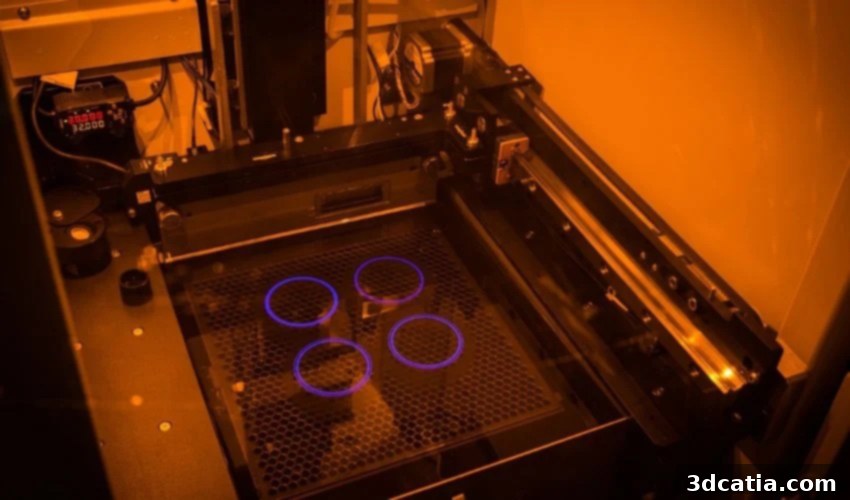
Hubs Report 2023: Unveiling the Future of 3D Printing and Additive Manufacturing Trends
The landscape of modern manufacturing is in constant flux, with 3D printing, or additive manufacturing, emerging as a pivotal force driving innovation and transformation across industries. Its continuous growth and increasing integration into diverse sectors are undeniable, a fact powerfully underscored by the recently published Hubs Report 2023. This in-depth report meticulously analyzes the additive manufacturing market over the past year, offering invaluable insights into its current state, key developments, and future trajectory. It delves into an array of crucial aspects, encompassing exciting metrics, the latest trends in 3D printing, future forecasts, a thorough evaluation of current applications, an inspection of market growth dynamics, and the increasingly vital role of sustainability within additive manufacturing processes. For anyone invested in the evolution of production and technological advancement, understanding these core findings is essential, and we’ve distilled the most impactful points from this year’s comprehensive report for a detailed examination.
The Additive Manufacturing Market: Robust Growth and Industry Confidence
The Hubs Report 2023 presents a compelling and optimistic outlook for the additive manufacturing industry, depicting a sector experiencing remarkable expansion. According to its detailed findings, the global additive manufacturing market has reached an impressive average size of $17 billion. This substantial figure encompasses all vital components of the industry ecosystem, including the sales of advanced 3D printing systems, sophisticated software solutions designed for design and production, a diverse range of materials, and a wide spectrum of related services. Even more encouraging is the reported year-over-year growth rate of 13%, a clear indicator of the technology’s accelerating adoption and its profound impact across various business landscapes. Looking ahead, the report projects an even steeper ascent in this growth, estimating a substantial 17% expansion in 2023 alone. Such robust projections firmly underscore the sustained health, resilience, and promising future of the entire 3D printing sector, signaling continued investment and innovation.
Further validating this optimistic forecast and demonstrating tangible market penetration is a large-scale industry survey conducted in February 2023. This survey gathered insights from over 1,000 respondents spanning various industrial segments and geographical locations. The results unequivocally confirm the industry’s upward trajectory and the practical integration of 3D printing into daily operations: a significant 71% of participants reported producing considerably more parts with 3D printing in 2022 compared to the preceding year. This dramatic increase highlights a shift from experimental adoption to practical, scaled integration of additive manufacturing processes across businesses. Conversely, only a small minority, precisely 8% of respondents, indicated a decrease in their production numbers of 3D-printed parts since 2021. This overwhelmingly positive sentiment and the measurable growth in production volumes reflect a burgeoning confidence in 3D printing as a viable, efficient, and increasingly indispensable manufacturing method. Businesses are not merely experimenting with the technology; they are actively integrating it into their core operational strategies, driving both innovation and efficiency throughout their global supply chains.
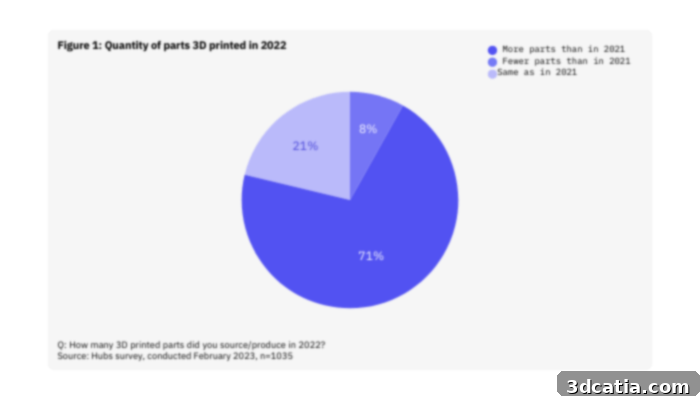
71% of participants said they 3D printed more parts in 2022 than the previous year, highlighting significant industry expansion.
Key Applications and Dominant Technologies in Additive Manufacturing for 2023
When examining the practical deployment and widespread adoption of 3D printing technologies, the Hubs Report 2023 offers clear and definitive insights into the most prevalent applications. Unsurprisingly, prototyping re-emerged as the undisputed most popular application, capturing approximately 66% of all participant votes. This enduring dominance of prototyping is deeply rooted in 3D printing’s unparalleled ability to rapidly produce physical models directly from digital designs. This capability enables engineers and designers to swiftly iterate, rigorously test, and meticulously refine products with a speed and cost-efficiency that traditional manufacturing methods simply cannot rival. This acceleration of the crucial design cycle significantly reduces time-to-market, minimizes developmental costs, and inherently fosters a culture of greater innovation and experimental freedom within product development teams.
Following prototyping, other significant and growing applications for additive manufacturing include toolmaking, small batch production, customer-specific mass production, and increasingly, series production. Toolmaking highly leverages 3D printing for the creation of custom jigs, fixtures, and molds that can drastically optimize existing manufacturing processes, often achieving superior results at a lower cost and with greater design flexibility than conventional methods. Small batch production greatly benefits from the technology’s capacity to produce specialized items or limited runs of products without the prohibitive expense and lead times associated with traditional tooling, making it an ideal solution for niche markets, customized products, or early product launches. Furthermore, the report indicates a clear and accelerating trend towards both customer-specific mass production and full-scale series production, showcasing the industry’s significant maturation beyond mere prototyping into mainstream manufacturing of functional, end-use parts, particularly in scenarios where high levels of customization, complex geometries, and on-demand production are paramount.
In terms of preferred printing technologies, the FDM/FFF (Fused Deposition Modeling/Fused Filament Fabrication) process continues to lead the pack by a substantial margin, favored by 56% of participants. Its widespread popularity stems from a combination of factors including its exceptional accessibility, remarkable cost-effectiveness, and broad material versatility, making it a foundational staple for educational institutions, hobbyists, and a wide array of industrial applications requiring robust, functional parts produced from a comprehensive range of thermoplastic materials. FDM printers are renowned for their relative ease of use, straightforward operation, and their impressive ability to create geometrically complex parts, which collectively explain their sustained market penetration and continued growth in adoption across diverse user groups.
Following FDM/FFF, the other top four most popular and impactful printing methods of 2023 include SLA (Stereolithography), SLS (Selective Laser Sintering), MJF (MultiJet Fusion), and SLM (Selective Laser Melting). Each of these technologies brings unique advantages to specific industrial demands. SLA is highly valued for its ability to produce parts with exceptionally smooth surface finishes and incredibly intricate details, making it an ideal choice for visual prototypes, master patterns for molding, and highly accurate medical models. SLS excels in creating complex geometries without the need for cumbersome support structures, yielding strong, functional parts from robust nylon powders, which are frequently employed for end-use components and demanding functional prototypes. MJF, a relatively newer but rapidly advancing technology, offers high-speed production of functional prototypes and end-use parts with excellent mechanical properties, positioning it as a strong contender for high-volume industrial applications. Finally, SLM (Selective Laser Melting) is absolutely critical for direct metal 3D printing, enabling the production of high-performance, lightweight metal components for the most demanding sectors such as aerospace, medical implants, and automotive, where superior material strength, precision, and complex designs are paramount. These five core technologies collectively represent the cutting edge of accessible, efficient, and highly effective additive manufacturing solutions that are shaping the future of global production.
Industry-Specific Innovations: Where 3D Printing Will Make its Next Major Mark
Beyond its general applications, the Hubs Report meticulously pinpoints several specific industries that are poised for significant breakthroughs and transformative change directly attributable to the advancements in 3D printing technology. At the absolute forefront of this list is the food industry, a sector ripe with immense, untapped potential for innovation. The ability of 3D printing to create incredibly intricate food structures, coupled with the exciting and rapidly developing prospect of producing cultured meat, promises to fundamentally revolutionize how we approach both food production and consumption. Furthermore, the technology enables unprecedented levels of nutrient customization, allowing for highly personalized dietary solutions that can be precisely tailored to individual health needs, preferences, and medical requirements. This could foreseeably lead to a future where meals are not just prepared, but intelligently engineered for optimal health, specific dietary goals, and exquisite taste experiences.
Following closely is the dynamic fashion industry, where 3D printing is already making substantial waves and pushing creative boundaries. The report highlights numerous compelling examples, particularly in the realm of 3D-printed footwear, showcasing the technology’s inherent capacity for intricate designs, customized fits, and the exploration of novel material combinations. This revolutionary capability extends well beyond shoes to bespoke garments, unique accessories, and even entire fashion collections, offering a viable path towards truly sustainable, on-demand production. This approach significantly reduces material waste and enables the creation of highly personalized fashion items that were previously impossible or prohibitively expensive to produce using traditional methods. Motorsports also stand out as a key area for explosive growth, leveraging additive manufacturing for the rapid production of incredibly lightweight, high-performance parts, allowing for quick iteration and testing of aerodynamic components, and facilitating on-demand production of highly specialized tools and spare parts, all of which provide a critical competitive edge on the track and in performance development.
The healthcare sector continues its trajectory as a crucial domain that extensively benefits from 3D printing, with applications spanning from the creation of patient-specific anatomical models for precise surgical planning to custom-fitted prosthetics, personalized implants, and even nascent ventures into bioprinted tissues and organs. The unparalleled precision, rapid customization, and biological compatibility offered by 3D printing are absolutely vital for improving patient outcomes, accelerating medical research, and driving unprecedented medical innovation. Finally, the aerospace industry is widely recognized for its ongoing and deepening adoption of additive manufacturing, primarily for producing exceptionally complex, ultra-lightweight components that drastically enhance fuel efficiency, improve structural integrity, and optimize performance. From intricate engine parts and turbine blades to specialized interior cabin elements, 3D printing facilitates the creation of topologically optimized designs that significantly reduce material waste, streamline complex supply chains, and enable the production of parts with geometries unattainable by conventional manufacturing in this highly demanding and safety-critical sector.
The Future of 3D Printing: Artificial Intelligence and 4D Printing
Looking further into the technological horizon, the Hubs Report emphatically emphasizes that the future evolution of additive manufacturing will be profoundly shaped and defined by groundbreaking technological convergences, most notably with artificial intelligence (AI) and the transformative emergence of 4D printing. These anticipated advancements are not merely incremental improvements; rather, they represent a fundamental paradigm shift that promises to push the very boundaries of what 3D printing can inherently achieve, unlocking entirely new possibilities for design, functionality, and intelligent material responses.

4D-printed self-folding protein demonstrating dynamic material capabilities (Photo Credits: Self-Assembly Lab/Hubs Report).
Artificial intelligence is poised to revolutionize virtually every stage of the 3D printing workflow, from initial design to final production and quality assurance. In particular, AI is expected to significantly enhance 3D print monitoring, utilizing sophisticated machine learning algorithms to detect subtle anomalies, predict potential print failures, and make real-time adjustments to printing parameters, thereby ensuring higher success rates, minimizing material waste, and optimizing overall efficiency. Its role in quality control will become increasingly indispensable, with AI-powered vision systems capable of performing intricate, high-speed inspections that far exceed human capabilities, ensuring every printed part consistently meets rigorous quality and performance standards. Generative design, a transformative process where AI algorithms autonomously explore and optimize countless design iterations based on user-defined parameters, will facilitate the creation of topologically optimized structures that are intrinsically lighter, stronger, and more materially efficient than conventionally designed parts. Furthermore, AI will drive comprehensive print optimization, intelligently adjusting printing parameters for diverse materials and complex geometries to achieve superior mechanical properties, finer details, and significantly faster production times. In the critical medical field, the profound convergence of AI and 3D printing holds immense promise, particularly for accelerating the production of highly customized medical prostheses and implants, which can be perfectly tailored to individual patient anatomy and specific clinical needs, offering unparalleled precision and fit. The report eloquently encapsulates this synergistic potential, stating, “The potential for innovation is limitless when 3D printing and AI converge,” highlighting a future where intelligent design and automated production capabilities unlock unprecedented possibilities across all sectors.
Parallel to the advancements in AI, Hubs also anticipates a strong and rapid advance in 4D printing. This innovative and boundary-pushing concept takes traditional 3D printing a significant step further by introducing ‘time’ as the fourth dimension. This means that objects printed with specialized ‘smart’ materials possess the remarkable ability to change their shape, properties, or functions in a pre-programmed manner, in response to specific environmental stimuli such such as fluctuations in temperature, exposure to light, changes in pH, or variations in moisture. Researchers are already making groundbreaking progress, actively developing sophisticated 4D hydrogels with autonomous drug release capabilities. These intelligent hydrogels are meticulously engineered to detect the body’s vital signs or specific biochemical biomarkers and then precisely release the required medication exactly when and where it is needed, offering a truly revolutionary approach to personalized medicine and highly targeted therapies. In the not-so-distant future, 4D printing will also prove instrumental in producing adaptive implants that can dynamically evolve and adjust to the human body over time, fostering better biological integration, enhanced functionality, and improved long-term performance. The far-reaching implications of 4D printing extend significantly beyond healthcare to include self-assembling structures, responsive robotics, smart materials for consumer goods, and adaptive infrastructure, collectively marking the dawn of a new era of dynamic, intelligent, and interactive physical objects.
Embracing Sustainability Through Additive Manufacturing
Crucially, the Hubs Report also shines a significant spotlight on the inherent and substantial sustainability benefits embedded within additive manufacturing processes. As industries worldwide increasingly strive for more environmentally responsible and eco-friendly practices, 3D printing stands out as a transformative technology that intrinsically contributes to a greener, more sustainable future. One of its primary and most impactful advantages is a drastic reduction in material waste. Unlike traditional subtractive manufacturing methods that cut away material from a larger block, often resulting in significant scrap, 3D printing builds objects layer by precise layer, depositing material only where it is functionally needed. This ‘addictive’ process leads to minimal material scrap, considerably less waste, and significantly more efficient resource utilization. This inherent on-demand production capability further minimizes environmental impact by eliminating the need for large inventories and actively preventing the overproduction of parts that may never be utilized, thereby reducing material consumption and storage requirements.
Furthermore, the distributed nature of 3D printing actively facilitates more localized production. By enabling manufacturers to produce parts closer to the ultimate point of consumption, it significantly shortens complex global supply chains, drastically reducing transportation costs and the associated carbon emissions from logistics. This decentralized manufacturing model not only minimizes environmental impact but also fosters regional economic development, enhances supply chain resilience, and promotes greater self-sufficiency. The technology also strongly supports advanced recycling efforts, with an increasing number of innovative materials being developed that are either manufactured from recycled content or are themselves fully recyclable at the end of their lifecycle. The ability to efficiently repair or customize existing parts, rather than resorting to replacing entire assemblies, further extends product lifecycles, thereby minimizing overall material consumption and reducing landfill waste. In essence, 3D printing offers a powerful and versatile toolkit for industries to transition towards a more sustainable, resource-efficient, and environmentally conscious future, harmoniously aligning cutting-edge technological advancement with critical environmental responsibility and long-term ecological stewardship.
What are your thoughts on the Hubs Report 2023’s comprehensive view of the dynamic 3D printing landscape and its exciting future? We’d love to hear your valuable perspectives and insights! Share your comments and analyses below or join the vibrant conversation on our LinkedIn, Facebook, and Twitter pages! Don’t miss out on the very latest advancements, groundbreaking innovations, and breaking news in the rapidly evolving world of 3D printing – remember to sign up for our completely free weekly Newsletter here, conveniently delivered straight to your inbox. You can also explore all our informative videos, in-depth interviews, and engaging content on our YouTube channel for deeper dives into the fascinating world of additive manufacturing. For those eager to delve deeper into all the detailed findings, the full Hubs Report can be downloaded directly HERE.