
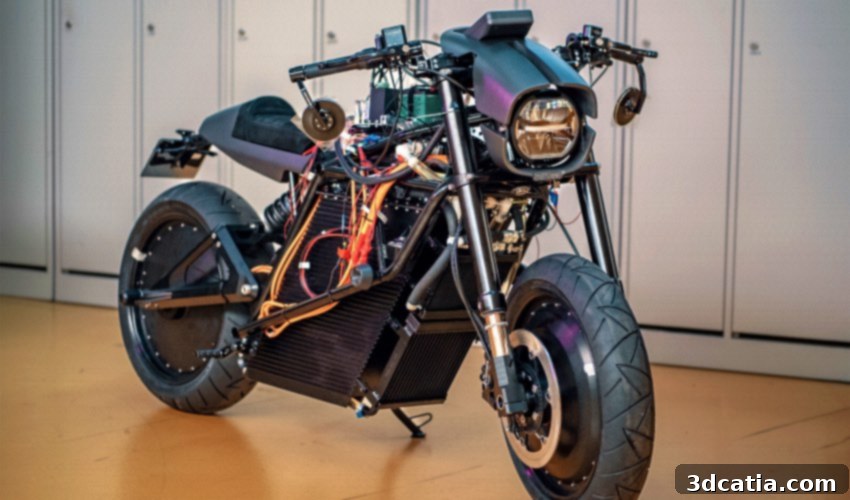
Sustainable Mobility Reimagined: The ETH Zurich ETHEC City 3D Printed Electric Motorcycle Revolutionizing E-Mobility
In an era defined by rapid technological advancements and an urgent need for sustainable solutions, additive manufacturing, commonly known as 3D printing, has emerged as a pivotal force in various industries. Its versatility and precision are transforming how components are designed and produced for an extensive range of vehicles, from high-performance sports cars to innovative bicycles and critical parts for aircraft. This transformative technology is now at the forefront of a groundbreaking project led by ambitious students from the renowned ETH Zurich, one of the world’s leading universities for science and technology.
The project, aptly named ETHEC city, represents a bold vision for the future of urban mobility. It aims to fundamentally redefine sustainable transportation by tackling one of the most pressing challenges of our time: climate change. Recognizing the imperative for eco-conscious solutions, the dedicated student team embarked on an ambitious journey to develop a revolutionary 3D printed electric motorcycle. This isn’t just any electric motorcycle; it incorporates an ingenious two-wheel drive system designed to significantly enhance energy efficiency and extend its operational range, promising a more sustainable and practical mode of personal transport for tomorrow’s cities.
Driving Innovation: The ETHEC City Vision and its Engineering Lead
At the heart of the ETHEC city project is Tobias Oesch, a mechanical engineering student at ETH Zurich, who serves as the technical lead. Tobias and his team embraced a monumental challenge: to conceive, design, construct, assemble, and thoroughly test a prototype of a fully 3D printed electric motorcycle within the span of a single year. This aggressive timeline underscores the team’s commitment and the agility that additive manufacturing brings to complex engineering projects. Tobias’s motivation stemmed from a deep-seated desire to address the critical sustainability issues plaguing the contemporary automotive sector.
“Motorcycles are inherently more efficient than common cars,” Tobias explains, highlighting a frequently overlooked aspect of two-wheeled vehicles. “However, we still see far too few all-electric motorcycles on our streets – that has to change.” This sentiment encapsulates the core philosophy behind ETHEC city: to leverage the inherent efficiency of motorcycles and combine it with cutting-edge electric propulsion and advanced manufacturing techniques to create a truly sustainable and high-performance vehicle. The project is not merely about building a motorcycle; it’s about pushing the boundaries of what’s possible in electric vehicle design and manufacturing, setting a new benchmark for sustainable personal mobility. The integration of 3D printing from the ground up allowed for rapid iteration and customization, proving invaluable in meeting their tight development schedule and stringent performance goals.

The intricately designed casing of the front display was produced using Selective Laser Sintering (SLS), demonstrating additive manufacturing’s capacity for complex geometries and functional parts. (All image credits: Sintratec)
Innovating for Efficiency: The Sustainable Two-Wheel Drive System
One of the most significant innovations of the ETHEC city motorcycle lies in its sophisticated two-wheel drive system, directly addressing a major drawback of conventional motorcycles. In traditional designs, a substantial amount of kinetic energy—up to 80%—is typically lost at the front wheel, particularly during braking. This energy waste significantly impacts the range and overall efficiency of electric vehicles, necessitating larger and heavier batteries to compensate. The ETH Zurich team developed an ingenious solution: integrating a second electric motor into the front wheel. This motor doesn’t just provide additional propulsion; it intelligently functions as a generator.
By utilizing the front wheel motor as a generator, the ETHEC city motorcycle can recuperate a substantial portion of the movement energy back into the electrical system during deceleration and braking. This advanced form of regenerative braking, powered by a two-hub motor configuration, fundamentally transforms the vehicle’s energy management. The recovered braking power allows the motorcycle to achieve significantly longer distances with a smaller, lighter battery pack, drastically improving its overall efficiency and reducing its environmental footprint. This approach not only extends the range but also contributes to a lighter vehicle, which further enhances performance and handling.
For the students involved, this project extends far beyond merely creating a functional prototype. “The ETHEC city is primarily a research prototype for us to investigate this recuperation method and thus improve the e-mobility sector in the future,” the team states. This highlights the project’s broader scientific and societal goals, positioning ETHEC city as a crucial stepping stone towards more efficient and sustainable electric vehicles across the entire e-mobility landscape. The data and insights gathered from this prototype are expected to inform future designs and innovations, contributing to a greener and more efficient transportation ecosystem.
Unleashing Design Potential: The Transformative Power of 3D Printing
Developing a cutting-edge electric motorcycle prototype with a constrained budget and an aggressive one-year timeline presented significant manufacturing challenges. Traditional fabrication methods, which often involve extensive tooling, high minimum order quantities, and lengthy lead times, quickly proved unsuitable for the team’s needs. The students required only single, highly customized work pieces, not thousands of identical parts, making conventional approaches inefficient and cost-prohibitive. This is where additive manufacturing, with its inherent flexibility and rapid prototyping capabilities, became an indispensable tool.
The ETHEC city team strategically employed a combination of advanced 3D printing technologies: Stereolithography (SLA), Selective Laser Sintering (SLS), and Selective Laser Melting (SLM). These technologies were used to produce a variety of components, ranging from intricate design elements for the motorcycle’s casing to critical structural parts, such as the mounting brackets for the foot pegs. Tobias Oesch emphasizes the unparalleled design freedom and efficiency that these technologies provided to the students: “With 3D printing, you can build significantly more complex structures, which gives you the unique possibility to combine several functions into a single part.”
This ability to consolidate multiple components into one complex, optimized part yields numerous benefits. Firstly, fewer individual parts translate directly into lower manufacturing and assembly costs. Secondly, and critically for vehicle design, part consolidation significantly reduces the overall weight of the motorcycle – a key advantage that enhances performance, increases range, and improves handling dynamics for any vehicle. Furthermore, 3D printing allowed for rapid design iterations and customizations, enabling the team to fine-tune components and integrate unique features that would be impractical or impossible with conventional methods. This adaptability was crucial for an experimental research prototype like ETHEC city, allowing the students to continuously improve and refine their design throughout the development process.
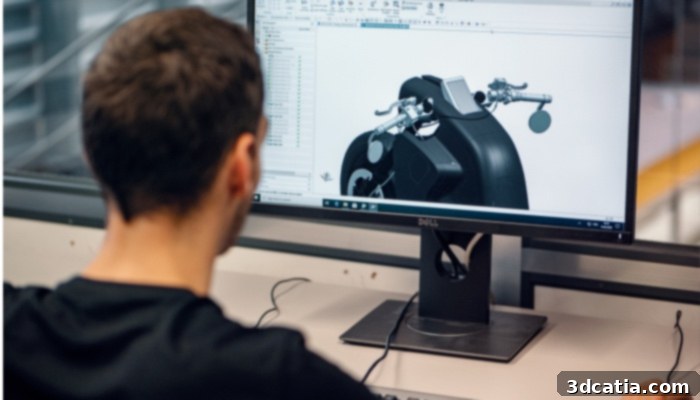
The ETHEC city motorcycle was developed as an advanced research prototype, dedicated to improving the drive systems and overall efficiency of future electric vehicles.
Laser Sintering: Enabling High-Performance End-Use Components
For many of the motorcycle’s components, the goal was not just to create prototypes but to produce robust, end-use parts capable of withstanding real-world conditions. This set exceptionally high requirements for the 3D printed objects: they needed to be not only lightweight but also exceptionally durable and strong. These critical material properties are precisely where Selective Laser Sintering (SLS) technology excels. SLS is renowned for producing parts with excellent mechanical properties, making it an ideal choice for functional components that must endure stress and impact.
As the students began searching for industrial partners to support their ambitious project, Sintratec, a leading Swiss manufacturer of SLS 3D printers, recognized the immense potential of ETHEC city. Sintratec generously decided to sponsor the production of several key components, providing invaluable support to the student team. Subsequently, essential parts such as the casing for the front display unit and the fuel filler flap were expertly 3D printed on the advanced Sintratec S2 system. The material of choice was Sintratec PA12 nylon powder, a material celebrated for its excellent balance of strength, flexibility, and chemical resistance.
The results were overwhelmingly convincing. The display case, for instance, presented a unique set of challenges. It needed to be sufficiently durable to offer comprehensive protection against diverse weather conditions, strong enough to withstand potential mechanical impacts during operation, and robust enough to maintain its structural integrity and aesthetic form without deforming over time. The SLS-printed components, utilizing the high-performance PA12 nylon, met and exceeded all of these stringent requirements. This successful application underscores the growing capability of SLS technology to produce reliable, high-quality end-use parts for demanding applications in the automotive and other sectors, moving beyond mere prototyping to integrated, functional solutions.
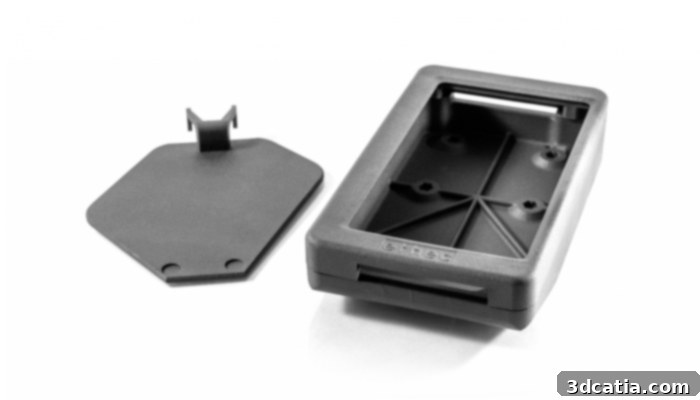
A close-up of the intricately 3D printed fuel filler component for the sustainable electric motorcycle.
The Future of Automotive: Additive Manufacturing’s Indispensable Role
With the successful production of these critical components, the ETH Zurich team meticulously assembled the Sintratec-printed parts after a final painting process, bringing their groundbreaking prototype ever closer to completion. The journey from concept to a tangible, functional electric motorcycle within a year is a testament to the team’s dedication, ingenuity, and the transformative potential of additive manufacturing.
Tobias Oesch encapsulates the sentiment of the entire team regarding the impact of 3D printing: “In my opinion, the SLS technology definitely has a significant place in the automotive sector. It will play an incredibly important role, especially in prototyping and developing vehicles for the future!” His statement resonates deeply, affirming that additive manufacturing, particularly SLS, is not just a niche technology but a crucial enabler for innovation in automotive engineering. Beyond initial prototyping, the ability to produce strong, lightweight, and complex parts on demand opens doors for custom vehicle development, low-volume production of specialized components, and even end-use parts for mainstream applications as the technology continues to evolve.
The ETHEC city project is a shining example of how academic innovation, combined with cutting-edge manufacturing technologies and industry partnerships, can pave the way for a more sustainable and efficient future of mobility. It showcases how student-led initiatives can contribute significantly to global challenges, pushing the boundaries of what is achievable in electric vehicle design and manufacturing. This vision of mobility, one that is truly sustainable, highly efficient, and driven by continuous innovation, will hopefully be shaped and realized by pioneering projects just like ETHEC city for generations to come.
What are your thoughts on the revolutionary 3D printed electric motorcycle developed by the talented students from ETH Zurich? We invite you to share your perspectives and engage in the conversation by leaving a comment below or by connecting with us on our Facebook and Twitter pages! Don’t miss out on the latest advancements and breaking news in the world of 3D printing; remember to sign up for our free weekly Newsletter, delivered directly to your inbox!