
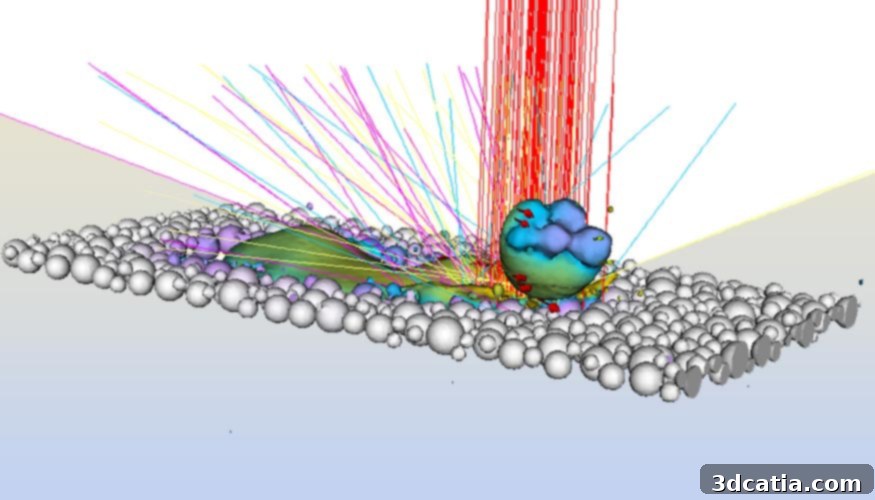
Revolutionizing Metal 3D Printing: LLNL’s Breakthrough in Defect Reduction for Enhanced Quality and Reliability
Metal 3D printing, a transformative force in modern manufacturing, offers unparalleled design freedom and the ability to produce complex geometries. Among its various techniques, laser powder bed fusion (LPBF) stands out for its precision and capability to create high-performance parts. However, this advanced process is not without its challenges. One of the persistent hurdles facing manufacturers is the occurrence of defects, which can compromise the integrity and functionality of the final product. Addressing this critical issue, a dedicated team of researchers at the Lawrence Livermore National Laboratory (LLNL) has unveiled a groundbreaking technique designed to significantly reduce these common defects, particularly those arising during the LPBF process. Their innovative approach, utilizing sophisticated computer models and experimental validation, has led to the development of a stability criterion and a comprehensive power map, promising a future of more reliable and high-quality metal 3D printed components.
The core of their research focuses on mitigating printing defects caused by what are known as “spatters” or “projections.” These are tiny powder particles that are ejected from the laser’s trajectory during the melting process and subsequently fall back onto the workpiece without being properly fused. Such unintended deposits can lead to unwanted pores, cavities, and other imperfections, ultimately diminishing the mechanical properties and surface finish of the printed part. The LLNL team’s work represents a significant leap forward in understanding and controlling these intricate dynamics, paving the way for a new era of defect-free metal additive manufacturing.
Understanding Laser Powder Bed Fusion (LPBF) and Its Intricacies
Laser powder bed fusion (LPBF) is a prominent metal additive manufacturing process celebrated for its ability to construct intricate metal parts layer by layer. In this method, a high-power laser selectively melts successive layers of fine metal powder based on a digital 3D model. As the laser scans across the powder bed, it fuses the particles together, forming a solid cross-section. Once a layer is complete, the build platform lowers, a new layer of powder is spread, and the process repeats until the desired part is fully formed. This iterative process allows for the creation of parts with complex internal structures and geometries that are impossible to achieve with traditional manufacturing techniques.
While LPBF offers immense advantages in terms of design flexibility, material efficiency, and rapid prototyping, its intricate nature demands precise control over numerous parameters. Critical factors such as laser power, scan speed, laser spot size, hatch spacing, layer thickness, build plate temperature, and part orientation all play a pivotal role in determining the quality and integrity of the final product. Even with meticulous control, however, defects such as large cavities, internal pores, residual stresses, and surface roughness are not uncommon. For instance, an excessive concentration of laser energy at a specific point can inadvertently create a “keyhole” effect, where the laser digs a deep hole into the metal, leading to internal porosity. Similarly, insufficient energy can result in incomplete fusion, leaving unfused powder pockets within the part. These imperfections can severely impact a part’s mechanical strength, fatigue resistance, and overall performance, making defect reduction a paramount concern for industrial adoption.
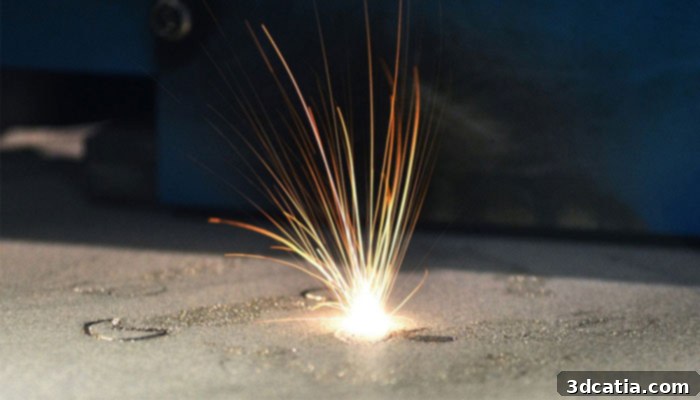
Metal powder spatter could increase defects in the LPBF process.
Confronting the Menace of Metal Powder Spatter
Beyond traditional porosity issues, researchers at LLNL have identified another significant and often overlooked problem: the phenomenon of powder spatter. During the LPBF process, the intense laser-matter interaction can cause microscopic metal powder particles to melt, vaporize, and then be forcefully ejected from the melt pool. These particles deviate from their intended trajectory and, instead of contributing to the fused layer, are haphazardly deposited on the surrounding workpiece. Crucially, these spatters are not properly fused to the part, leading to localized areas of unfused powder and creating nucleation sites for pores and other defects. This significantly compromises the metallurgical bonding and structural integrity of the final component. Saad Khairallah, a lead author of the study and a distinguished computer physicist at LLNL, vividly explains the severity of this issue: “Spatter is the enemy of beautiful parts; it is not just small particles that fly, it can create powder aggregates that can then affect the print in various ways and under different scenarios.” This highlights that spatter is not merely a cosmetic concern but a fundamental impediment to achieving high-quality, reliable metal 3D printed parts.
The implications of spatter are far-reaching. Parts exhibiting high levels of spatter are likely to have inferior mechanical properties, including reduced tensile strength, lower fatigue life, and increased susceptibility to crack propagation. Furthermore, the uneven surface caused by spatter can necessitate extensive post-processing, adding to manufacturing costs and lead times. For critical applications in industries such as aerospace, medical implants, and automotive, where performance and reliability are non-negotiable, effectively eliminating spatter is paramount. The LLNL research directly addresses this need, aiming to unlock the full potential of metal 3D printing by ensuring the production of parts that meet the most stringent quality standards.
LLNL’s Innovative Approach: Simulation, Diagnostics, and a Novel Power Map
To tackle the intricate problem of spatter formation, the LLNL researchers harnessed their extensive simulation capabilities and cutting-edge expertise in both optical and X-ray imaging. This multi-faceted approach allowed them to gain unprecedented insights into the rapid, dynamic processes occurring within the melt pool during laser-powder interaction. The team emphasized the critical role of advanced diagnostic tools: “X-ray diagnostics are the only techniques that can simultaneously probe the surface and underside of metal while providing the fidelity needed to track the rapid dynamics of laser-induced structural changes.” By observing these phenomena in real-time and at microscopic scales, they could meticulously analyze the mechanisms behind spatter generation, leading to a deeper understanding of process instabilities.
Building on this detailed understanding, the researchers successfully developed a novel “stability criterion.” This criterion defines the optimal operating window for the laser, identifying conditions under which spatter is minimized or entirely avoided. Translating this theoretical breakthrough into a practical solution, they created a “power map.” This power map is essentially a sophisticated scanning strategy that dynamically adjusts the laser’s power output along its path. Unlike conventional methods that often employ a constant laser power, this adaptive technique allows the system to fine-tune the energy delivery based on real-time feedback and pre-defined parameters. By intelligently modulating the laser power, the melt pool dynamics can be precisely controlled, ensuring stable fusion and significantly reducing the ejection of unfused particles. This adaptive control mechanism holds the potential to dramatically reduce, or even completely eliminate, the formation of pores, cavities, and other internal deformations, leading to parts with superior structural integrity and surface finish.
Enhancing Quality Through Pre-sintering: A Dual-Pronged Strategy
In addition to their work on the stability criterion and power map, the LLNL team discovered another powerful strategy for spatter reduction: pre-sintering the metal powder. This technique involves an initial, low-temperature pass of a multi-beam laser over the powder bed *before* the final, high-energy melting process. During this pre-sintering step, the laser energy is carefully calibrated to fuse the individual powder particles together without fully melting them. The result is a slightly densified, more cohesive powder bed, creating a stable foundation for the subsequent full-power melting phase. By gently bonding the powder particles, pre-sintering significantly reduces their propensity to be ejected as spatter when the main laser pass occurs. The particles are less likely to become airborne, instead remaining within the melt pool to contribute to the final part. This crucial preparatory step dramatically mitigates the risk of spatter formation, offering a robust method to improve part quality and consistency.
This dual-pronged approach – combining the intelligent power map for dynamic laser control with the preparatory pre-sintering technique – represents a comprehensive strategy for optimizing the LPBF process. By addressing spatter both at the initial powder bed stage and during the active melting phase, LLNL’s research offers a potent solution to one of metal 3D printing’s most persistent challenges. The implications of these findings are profound. Producing parts with fewer defects translates directly into enhanced mechanical performance, improved fatigue life, and greater reliability. For industries where part failure can have catastrophic consequences, such as aerospace and medical device manufacturing, these advancements are invaluable. This research not only pushes the boundaries of additive manufacturing capabilities but also accelerates its adoption into mainstream production, ensuring that metal 3D printed components can consistently meet the rigorous demands of critical applications. You can find more in-depth information about this groundbreaking research HERE.
The Future of Flawless Metal Additive Manufacturing
The work undertaken by the Lawrence Livermore National Laboratory researchers marks a pivotal moment in the evolution of metal 3D printing. By meticulously dissecting the root causes of defects, particularly the problematic phenomenon of spatter, and by developing sophisticated computational models alongside advanced diagnostic techniques, they have provided actionable solutions that promise to elevate the quality and reliability of LPBF-produced metal parts. The introduction of a stability criterion and an intelligent power map allows for unprecedented control over the laser melting process, enabling dynamic adjustment of energy delivery to prevent particle ejection and porosity. Furthermore, the innovative integration of a pre-sintering step offers an additional layer of defense against defect formation, creating a more cohesive and stable powder bed prior to full fusion.
These combined strategies are not merely incremental improvements; they represent a fundamental shift towards a more predictable and robust metal additive manufacturing ecosystem. Industries reliant on high-performance components stand to gain immensely from these advancements, witnessing a reduction in post-processing requirements, fewer material waste, and ultimately, a lower cost of production. As metal 3D printing continues to expand its footprint across diverse sectors, from custom medical implants to lightweight aerospace components and intricate automotive parts, the ability to consistently produce defect-free products will be a critical determinant of its widespread success. LLNL’s commitment to pushing the boundaries of scientific understanding and technological innovation is clearly demonstrated through this research, offering a compelling vision for a future where flawless metal 3D prints are not an aspiration, but a consistent reality. This work will undoubtedly inspire further research and development, fostering an environment where the full potential of additive manufacturing can be realized, leading to stronger, lighter, and more complex components that drive technological progress across the globe.
What are your thoughts on this revolutionary defect reduction technique for metal 3D printing? Do you foresee it rapidly transforming manufacturing processes? Let us know your perspective in the comments down below or join the conversation on our Facebook and Twitter pages! Don’t forget to sign up for our free weekly Newsletter, where you’ll receive all the latest news and breakthroughs in 3D printing delivered straight to your inbox!