
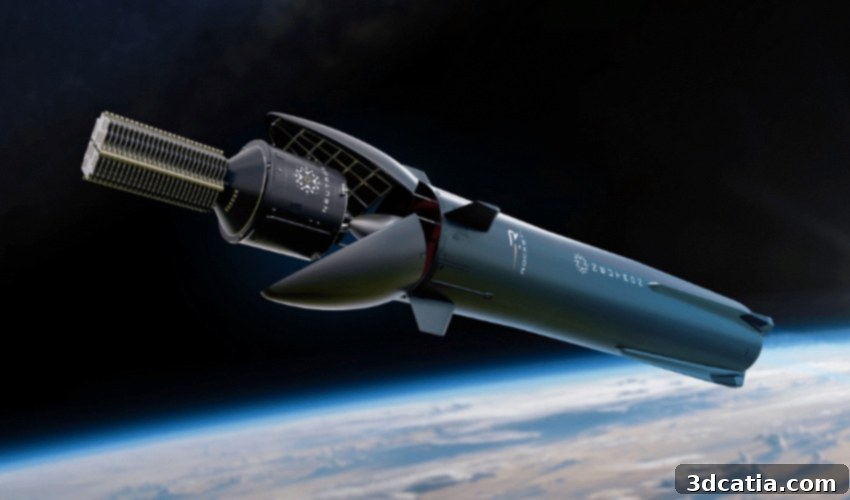
Rocket Lab’s Neutron Rocket Joins NASA VADR: A Leap Forward in Reusable 3D-Printed Space Launch
In a significant stride towards broadening its capabilities in space exploration, NASA has officially partnered with Rocket Lab USA, Inc., integrating the innovative Neutron rocket into its Launch Services Program. This collaboration falls under the VADR (Venture-Class Acquisition of Dedicated and Rideshare) program, a strategic initiative designed to procure dependable launch services at highly competitive prices. The VADR program also aims to streamline mission requirements for a diverse range of spacecraft, including those that have not yet reached orbital deployment. Neutron, Rocket Lab USA’s latest offering, is a sophisticated medium-lift launch vehicle that stands out for its partial reusability and its propulsion system comprising nine cutting-edge, 3D-printed Archimedes engines. These engines are meticulously engineered to dramatically enhance the efficiency, flexibility, and cost-effectiveness of space launches, ushering in a new era for accessing Earth orbit and beyond.
This pivotal agreement marks a continuation of Rocket Lab’s proven track record with NASA. The company is no stranger to executing successful space missions, having previously contributed significantly to NASA’s objectives through its smaller Electron rocket. Electron has consistently launched various payloads into orbit as part of NASA missions and under the VADR program. A prime example of this efficiency was the swift completion of the VADR PREFIRE (Polar Radiant Energy in the Far-InfraRed Experiment) missions, which were accomplished in a remarkably short two-week window. Furthermore, Electron facilitated a rapid double launch in May 2023 for the VADR TROPICS (Time-Resolved Observations of Precipitation structure and storm Intensity with a Constellation of Smallsats) missions, demonstrating unparalleled responsiveness and reliability. With Neutron’s enhanced versatility and robust capabilities, Rocket Lab is now poised to substantially expand its operational scope. This includes tackling more complex and larger-scale space missions and gaining access to previously uncharted or more challenging orbital trajectories, thereby opening up new avenues for scientific discovery and technological advancement.
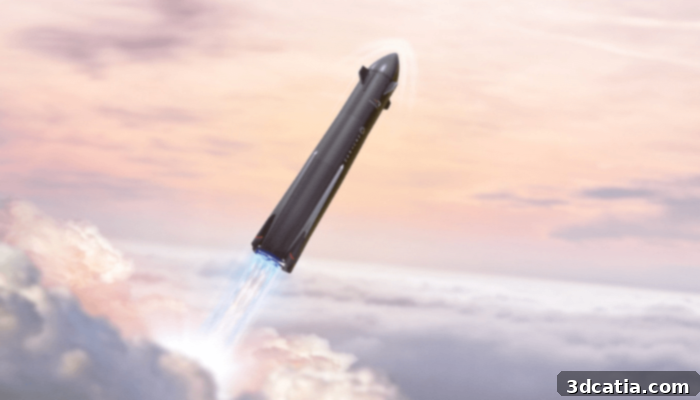
A stylized depiction of Neutron, Rocket Lab’s medium-lift reusable launch vehicle.
The Archimedes Engine: Fueling Neutron’s Ambitions with 3D Printing Technology
As highlighted earlier, the Neutron rocket is powered by an impressive array of nine Archimedes engines. These engines are the culmination of Rocket Lab USA’s ambitious development program for a reusable rocket engine, with a significant proportion of their intricate components manufactured through advanced 3D printing processes. This additive manufacturing approach allows for complex geometries, reduced part counts, and optimized weight, all critical factors in high-performance aerospace applications. In May 2024, Rocket Lab embarked on an extensive and rigorous stress test campaign for the Archimedes engine. Conducted at NASA’s esteemed Stennis Space Center in Mississippi, this campaign meticulously evaluated the engine’s various components, subsystems, and its overall integrated system. The objective was to thoroughly verify its performance across all critical operational phases, including ignition, stable operation at various thrust levels, and controlled shutdown. This demanding testing protocol involved numerous activations of the engine system, systematically progressing until the first “hot ignition” – a full-power firing that validates the engine’s design and operational readiness under real-world conditions. The data gathered from these tests is crucial for refining the engine’s design and ensuring its unparalleled reliability for future spaceflights.
The Archimedes engine boasts a multitude of remarkable and forward-thinking features. Its pioneering use of 3D-printed components is extensive, encompassing critical structures, complex turbopump casings, precision valve bodies, and even intricate pre-combustor and main chamber components. This widespread application of additive manufacturing not only streamlines the production process but also enables the creation of highly optimized parts that would be impossible or prohibitively expensive to produce with traditional methods. Furthermore, the Archimedes engine operates on a sophisticated propellant combination of liquid oxygen (LOX) and methane. It employs an oxidation-rich, staged combustion cycle, an advanced propulsion technology that is renowned for its high efficiency and performance. This specific propellant mix and combustion cycle represent an innovative and highly advantageous configuration for modern reusable spacecraft, offering benefits such as lower coking, easier reusability, and potential for in-situ propellant production for future deep space missions.
A cornerstone of the Archimedes engine’s design philosophy is its exceptional reusability. Each engine is engineered to withstand at least 20 launches, a figure that significantly reduces operational costs and turnaround times between missions. This high degree of reusability contributes directly to making space access more affordable and sustainable. Beyond its impressive endurance, the engine’s operational capacity is also designed to exert a lower structural load on the rocket compared to many other high-thrust engines currently available on the market. This design choice enhances the overall structural integrity of the vehicle, simplifies maintenance, and further supports the goal of rapid reflight. In terms of sheer power, each individual Archimedes engine is capable of generating an impressive 165,000 lbf (733 kN) of thrust at maximum power. When all nine engines on the Neutron’s first stage ignite in unison, they produce a colossal combined thrust of 1,450,000 lbf, providing the necessary power to lift substantial payloads into orbit with remarkable precision and reliability.
Peter Beck, the visionary founder and CEO of Rocket Lab, expressed his profound optimism regarding the Archimedes engine’s progress. “Having a completed Archimedes engine on the test stand is an inflection point in Neutron’s development program,” Beck commented. He emphasized the critical transition the project has made, stating, “Now we’ve entered the home stretch where we breathe fire and refine the engine in preparation for first flight.” Beck further elaborated on Rocket Lab’s unique development approach, contrasting it with common industry practices. “Often with engine development plans there can be a rush to get a minimum viable product to the stand, after which you have to spend years in redesign and iterative testing to get the performance you need, let alone being able to reproduce it reliably on a large production scale.” Rocket Lab, however, adopted a different strategy: “What we’ve taken to the test stand is very close to a flight-like engine, and with all of our production infrastructure stood up alongside the engine’s development, we’re in a prime position to be able to make quick iterations to Archimedes for a rapid development and qualification campaign.” This philosophy of building a flight-ready engine from the outset, coupled with integrated production capabilities, significantly accelerates the path to operational readiness and reduces long-term development risks.
Beck also underscored Neutron’s broader impact on the space industry and its alignment with NASA’s objectives. He explained, “Neutron brings choice and value to the launch industry and is the ideal rocket to support NASA’s goals with VADR to provide new opportunities for science and technology payloads through commercial best practice.” This statement highlights Neutron’s role in fostering a more competitive and innovative launch market, offering greater flexibility and affordability for government and commercial clients alike. Reaffirming Rocket Lab’s enduring partnership with the agency, Beck proudly stated, “Rocket Lab has been a long trusted and reliable launch partner for NASA missions with Electron, and we’re proud to have been selected to expand on this with Neutron.” This continued collaboration with NASA is a testament to Rocket Lab’s consistent performance and its growing prominence in the global space sector, now poised to deliver even greater capabilities with its next-generation launch vehicle.
The Neutron rocket is specifically engineered to transport substantial payloads, with a design capacity to carry up to 13,000 kg (approximately 28,660 lbs) into Low Earth Orbit (LEO). This makes it an exceptionally versatile and powerful platform, particularly well-suited for deploying large satellite constellations—which are crucial for global communication, internet provision, and Earth observation. Beyond commercial ventures, Neutron is also an ideal choice for national security missions, providing a robust and reliable capability for government agencies. Furthermore, its capacity and design flexibility make it perfect for launching a wide array of scientific and research payloads, enabling groundbreaking discoveries and advancing humanity’s understanding of space and our planet. Consequently, Neutron emerges as a highly competitive and reliable alternative in the global launch market, catering to the diverse needs of both commercial and governmental customers. Rocket Lab views Neutron not merely as a launch vehicle but as the spearhead of its integrated space strategy. This comprehensive strategy encompasses not only the design and manufacture of its own advanced components and rockets but also the capability to launch them into space and subsequently operate its own satellite constellations. This vertical integration underscores Rocket Lab’s ambition to become an end-to-end space solutions provider, controlling every aspect from manufacturing to orbital operations.
Neutron’s strategic importance has been recognized at the highest levels, garnering both VADR program approval from NASA and formal acceptance into the United States Space Force’s OSP-4 (Orbital Services Program-4) program. The OSP-4 program represents an Indefinite Delivery Indefinite Quantity (IDIQ) contract, an agreement valued at an impressive $986 million. This substantial contract signals the U.S. government’s confidence in Neutron’s capabilities for critical national security missions. In addition to these significant endorsements, Neutron’s performance is currently under evaluation by the U.S. government’s National Security Space Launch (NSSL) Lane 1. This prestigious assessment could potentially lead to Rocket Lab being awarded another substantial IDIQ contract, this one a five-year agreement worth an estimated $5.6 billion. Such contracts are instrumental in securing long-term funding and establishing Rocket Lab as a foundational partner for national space initiatives, further solidifying its position as a key player in the increasingly vital space industry.
The highly anticipated maiden flight of the Neutron rocket is currently scheduled for mid-2025. This historic launch will take place from Launch Complex 3 at Rocket Lab’s facility on Wallops Island, Virginia, a location strategically chosen for its access to various orbital inclinations. As the countdown to this ambitious project begins, the aerospace community eagerly awaits its outcome. This launch represents far more than just another rocket taking flight; it signifies another major milestone for 3D printing technology within the aerospace sector. Neutron’s success will once again powerfully demonstrate that additive manufacturing is not only capable of meeting but also of overcoming the extreme technical challenges and rigorous demands inherent in such a complex and critical industry. The ability to rapidly design, iterate, and produce high-performance, reusable components through 3D printing is fundamentally transforming how rockets are built and launched, paving the way for more frequent, cost-effective, and sustainable access to space for all.
What are your thoughts on the collaboration between NASA and Rocket Lab regarding the Neutron rocket? Do you believe it will successfully launch in 2025 as planned? Share your insights and predictions in a comment below or join the conversation on our LinkedIn, Facebook, and Twitter pages! Don’t forget to sign up for our free weekly Newsletter here to receive the latest 3D printing news straight to your inbox! You can also find all our videos and exclusive content on our YouTube channel.
*All Photo Credits: Rocket Lab.