
From Automotive Giants to Medical Marvels: Top 5 3D Printing Breakthroughs You Need to See
The world of additive manufacturing continues to evolve at an astonishing pace, pushing the boundaries of what’s possible across a multitude of industries. This week, we’ve curated the TOP 5 most captivating videos that vividly demonstrate how 3D printing technology is not just changing, but actively shaping our modern society. From groundbreaking achievements in automotive engineering and critical discussions on public safety to revolutionary sustainable construction methods, personalized medical solutions, and advanced material innovations, these selections offer a comprehensive glimpse into the dynamic future of digital manufacturing.
Prepare to be inspired by how organizations and innovators are leveraging the power of 3D printing to create never-before-seen solutions. We delve into Ford’s monumental achievement in metal additive manufacturing, explore the ongoing debate surrounding 3D-printed firearms, witness architectural advancements from ETH Zurich, discover personalized ophthalmic solutions from Luxexcel, and examine cutting-edge material processing with German RepRap’s new LSR technology. Each story highlights the immense potential of 3D printing and its profound impact on design, production, and everyday life. If you find these insights compelling, we encourage you to explore even more exciting 3D printing videos on our YouTube channel. Share your thoughts and join the conversation on 3Dnatives’ Facebook or Twitter accounts. Enjoy discovering the cutting edge of additive manufacturing!
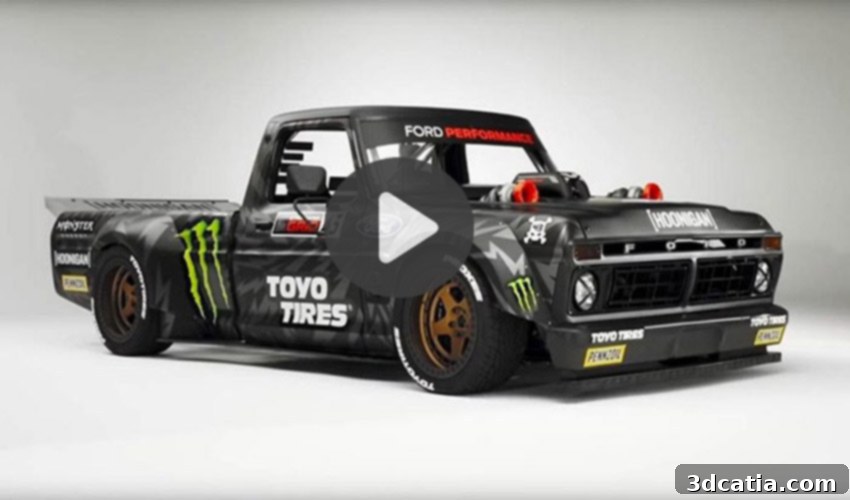
Top 1: Ford 3D Prints the Largest Metal Automotive Part in History for the Hoonitruck!
In a remarkable demonstration of industrial 3D printing capabilities, Ford Performance, the acclaimed high-performance division of Ford Motor Company, has achieved what they proudly claim to be the largest metal automotive part ever produced for a functional vehicle in the history of the automotive industry. This monumental achievement showcases the growing integration of additive manufacturing into mainstream vehicle development and production. The specific component in question is an aluminium manifold inlet, meticulously engineered and 3D printed before being installed into the iconic Hoonitruck. This truck is a heavily modified 1977 Ford F-150, powered by a twin-turbo 3.5-litre V6 EcoBoost engine, and famously owned by Ken Block, the acclaimed star of the popular YouTube series, Gymkhana.
The process of manufacturing this complex aluminium part using advanced metal 3D printing technology took an impressive five days to complete. The finished piece, despite its size and intricate geometry, weighs a mere 6 kilograms, a testament to the lightweighting potential offered by additive manufacturing. This capability allows engineers to optimize parts for both performance and efficiency, reducing overall vehicle weight and potentially improving fuel economy and handling. By utilizing metal 3D printing, Ford was able to design a highly optimized manifold that would be incredibly challenging, if not impossible, to produce using traditional manufacturing methods like casting or machining. This project not only highlights Ford’s commitment to innovation but also solidifies the position of metal 3D printing as a viable and powerful tool for creating high-performance, custom automotive components. It’s a clear indicator of how 3D printing is revolutionizing automotive design and production, paving the way for lighter, stronger, and more complex vehicle parts in the future.
Top 2: Could 3D Printing Become a Threat to Public Safety? The Ghost Gun Debate
The proliferation of 3D printing technology has ignited a fervent debate surrounding its potential impact on public safety, particularly concerning the creation of “ghost guns.” This short documentary from Free the People features Matt Larosiere, a recognized 3D printer expert and ardent gun enthusiast, who delves into the complexities of this highly divisive issue. Larosiere, whose primary professional use of 3D printers involves rapid and cost-effective prototyping for various parts, also possesses a deep understanding of firearms as a collector and enthusiast. He illuminates how 3D printing can serve a unique purpose in the firearms community: enabling individuals to preserve and maintain “stranger, older, more relic and curio weapons alive” by fabricating missing or broken components for historical firearms, ensuring their continued functionality and heritage.
However, mainstream media has frequently raised alarms about the issue of ghost gun printing—untraceable firearms manufactured using 3D printing or other readily available tools, which lack serial numbers and are often created outside regulated channels. Larosiere strongly contends that much of this public apprehension is a characteristic reaction stemming from what he terms the “culture of uninformed gun control alarmism.” He argues that the focus on 3D printing often overshadows the existing ease with which firearms can be acquired or fabricated through traditional, unregulated means. This perspective underscores a critical philosophical divide: whether the ability to digitally fabricate components fundamentally alters the landscape of gun control or merely provides a new method for an old practice. The documentary provides an opportunity for viewers to consider both sides of this multifaceted issue. It prompts a crucial question: are fears about 3D-printed firearms justified, or are they an overreaction to technological advancement? This segment encourages a nuanced understanding of the intersection between emerging technologies, individual liberties, and societal security. Delve deeper into the arguments and form your own opinion by watching the video below!
Top 3: An Eco-Friendly 3D Printed Funicular Floor System from ETH Zurich
In a pioneering step towards sustainable construction and architectural innovation, ETH Zurich’s Block Research Group has unveiled a functionally integrated floor system that promises to redefine eco-friendly building practices. This groundbreaking development utilizes a lightweight, rib-stiffened funicular floor design, which has been ingeniously created with the substantial use of recycled concrete. This approach not only addresses the environmental impact of concrete production but also demonstrates a viable path toward circular economy principles within the construction sector. What sets this system apart is its full integration with optimized heating and cooling systems, meticulously designed to enhance energy efficiency within buildings.
The research undertaken by ETH Zurich’s team showcases how advanced design and additive manufacturing techniques can lead to significantly lighter construction without compromising structural integrity. By leveraging 3D printing technologies, the researchers were able to create complex, optimized geometries that reduce the amount of raw materials needed, leading to substantial savings. This project directly confronts some of the most pressing challenges faced by the construction industry today, namely its considerable contributions to global greenhouse gas emissions and the depletion of finite natural resources. The funicular form, inspired by natural structures, allows for efficient load bearing with minimal material, further amplifying its sustainable credentials. This innovative floor system exemplifies how 3D printing can facilitate the creation of high-performance, resource-efficient building components, paving the way for a more sustainable future in architecture and urban development. Discover the intricate manufacturing process and the ecological advantages of this 3D-printed floor system in the detailed video below!
Top 4: Luxexcel’s Vision Master System to 3D Print Custom Lenses
The field of ophthalmic optics is being revolutionized by additive manufacturing, with Luxexcel at the forefront of this transformation. At the IFB Solutions Twenty200 Optical lab, Luxexcel’s proprietary software, known as Vision Master, is being deployed to design and produce prescription lenses with unparalleled precision and customization. This advanced software platform empowers optical laboratories to create bespoke lenses that meticulously respond to each customer’s unique personal needs, addressing various vision corrections, specific geometries, and even integrated functionalities. The ability to tailor lenses so precisely marks a significant leap forward from traditional lens manufacturing processes, which are often limited by tooling and mass production constraints.
In the video featured, you will gain insight into the sophisticated, turnkey 3D print solution that Luxexcel has implemented specifically for ophthalmic laboratories. This innovative system enables labs to transition from conventional methods to a fully digital workflow for 3D printing custom lenses. The benefits are multifold: increased design freedom, rapid prototyping, reduced material waste, and the capacity for mass customization. The impact of this technology is clearly demonstrated by the impressive production volume at IFB Solutions, where they are now capable of shipping between 1,200 and 1,500 custom-3D-printed lenses every single day! This high throughput underscores the scalability and reliability of Luxexcel’s additive manufacturing solution for the vision industry. This breakthrough signifies a major shift towards personalized vision care, where each pair of glasses can be precisely engineered for optimal performance and comfort, tailored to the individual wearer. It’s a prime example of how 3D printing is enhancing product functionality and transforming the entire customer experience in a critical medical field.
Top 5: German RepRap Releases Their New LSR Technology for Additive Manufacturing
The landscape of additive manufacturing is continually expanding beyond traditional thermoplastics and metals, venturing into new material classes with groundbreaking processes. German RepRap has recently made a significant stride in this area by releasing their innovative Liquid Silicone Rubber (LSR) Technology, marking a pivotal moment in the industry. For the very first time, this advanced system makes it possible to utilize highly viscous liquid materials, such as Liquid Silicone Resin (LSR), for additive manufacturing on an LAM (Liquid Additive Manufacturing) printer. This represents a considerable advancement, as silicone’s unique properties—including biocompatibility, elasticity, heat resistance, and chemical inertness—were previously challenging to leverage effectively in 3D printing for complex geometries and functional parts.
Liquid Additive Manufacturing (LAM) is an emergent process designed to precisely process liquids or low-strength materials in an additive fashion. Unlike traditional FDM or SLS methods, LAM allows for the layer-by-layer solidification of liquid polymers, opening up a vast array of new applications. With this new technology, German RepRap is specifically enabling the precise and repeatable 3D printing of Liquid Silicone Rubber, a material highly sought after in medical devices, consumer goods, automotive components, and industrial sealing applications due to its superior performance characteristics. The company anticipates that in the near future, other advanced liquid materials will also become conceivable for processing with this technology, further broadening the horizons of what can be 3D printed. This development is particularly impactful for industries requiring flexible, soft, and durable components that can withstand demanding environments. The ability to 3D print LSR parts offers immense advantages over conventional molding techniques, including greater design freedom, reduced tooling costs for low-volume production or prototyping, and rapid iteration cycles. Explore the video below to delve deeper into the specific advantages and potential applications of this pioneering Liquid Additive Manufacturing technology from German RepRap!
We hope you enjoyed discovering this week’s TOP 5 videos, showcasing the incredibly diverse and impactful applications of 3D printing technology. From pushing the limits of automotive manufacturing with Ford’s record-breaking part, navigating the complex ethical debates around 3D-printed firearms, advancing sustainable construction with ETH Zurich’s innovative floor system, revolutionizing personalized vision care with Luxexcel, to pioneering new material possibilities with German RepRap’s LSR technology – these stories truly highlight the dynamic evolution of additive manufacturing. The rapid advancements continue to reshape industries and offer solutions to some of the world’s most pressing challenges.
Do you have a favorite among these breakthroughs, or perhaps another video you think deserves recognition? We invite you to share your thoughts and comments either below this article or on our Facebook and Twitter pages. Your engagement helps foster a vibrant community passionate about 3D printing. And to ensure you stay ahead of the curve, don’t forget to sign up for our free weekly Newsletter, delivering all the latest news and innovations from the additive manufacturing industry straight to your inbox!