
The Future of Digital Dentistry: Unpacking the $7.9 Billion Dental 3D Printing Market Growth
The landscape of modern dentistry is undergoing a profound transformation, largely driven by advancements in digital technologies. At the forefront of this revolution is dental 3D printing, a sector that continues to demonstrate explosive growth and innovation. A recent comprehensive report from the research firm Markets and Markets sheds light on this exciting trajectory, projecting the dental 3D printing market to reach an impressive $7.9 billion by 2027. This signifies a remarkable compound annual growth rate (CAGR) of 20.2% from the current year, underscoring the increasing adoption and integration of additive manufacturing across various dental specialties.
This extensive study meticulously dissects the market into several critical segments: identifying the most common applications, scrutinizing the products and services driving the industry, detailing the key end-users, and highlighting the geographical regions where 3D technologies are most prevalent. A clear and compelling trend emerging from the analysis is the growing reliance of industry professionals on service providers. Many dental practices and clinics are opting to outsource the production of their 3D printed dental devices, leveraging the specialized expertise and advanced equipment offered by dedicated additive manufacturing bureaus. This shift points towards both the technical complexity and the initial investment often associated with in-house 3D printing, yet it also signifies a robust ecosystem supporting wider adoption.
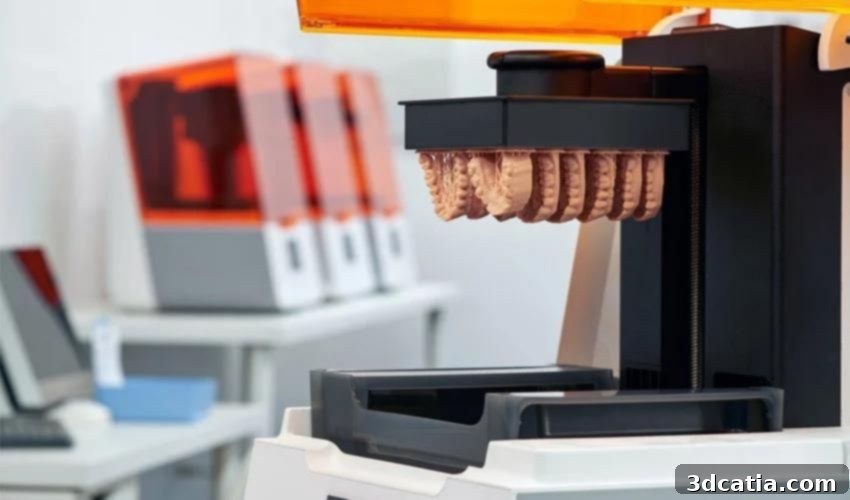
Among the diverse array of additive manufacturing technologies, stereolithography (SLA) continues to hold its position as the most widely utilized process in dental 3D printing. Its enduring popularity is primarily attributed to its exceptional ability to produce highly detailed parts with an outstanding surface finish, crucial characteristics for precision dental applications such as surgical guides, models, and provisional restorations. The intricate nature of dental anatomy demands microscopic accuracy, and SLA technology, with its finely controlled UV light source curing photopolymer resins, consistently delivers the high-resolution output required.
Accelerating Growth and Technological Dominance in Dental Additive Manufacturing
Numerous previous studies on dental 3D printing have consistently pointed towards promising growth rates for the sector, and the latest Markets and Markets report further solidifies these projections. The appeal of 3D technologies for market players is undeniable, offering a suite of highly competitive advantages. These include the unparalleled ability to produce custom, on-demand dental devices tailored precisely to individual patient anatomies. This level of personalization was once impractical or prohibitively expensive with traditional manufacturing methods. Furthermore, additive manufacturing supports a vast array of materials, from biocompatible polymers suitable for temporary crowns and surgical guides, to robust metals for frameworks and implants, and advanced ceramics for aesthetic restorations, providing dentists with unprecedented flexibility in treatment planning and execution.
Despite the availability of various 3D printing methods, the Markets and Markets study emphatically highlights that light curing technologies, encompassing SLA, Digital Light Processing (DLP), and LCD-based resin printing, remain the undisputed leaders. These processes accounted for a dominant 53% of the market share in 2021. Following light curing, other notable technologies like Selective Laser Sintering (SLS), PolyJet, and Fused Deposition Modeling (FDM) contribute to the market, each with their own specific niches. The overwhelming preference for resin-based processes like SLA and DLP can be directly attributed to their superior finesse and resolution capabilities. Dental professionals can design and print incredibly intricate implants, precise prosthetic components, and highly accurate surgical guides with a level of detail that is paramount for patient safety and treatment efficacy. Beyond precision, these technologies also benefit from becoming increasingly accessible and user-friendly, lowering the barrier to entry for many dental practices and laboratories. This combination of accuracy, material versatility, and ease of learning is pivotal in driving their widespread adoption.
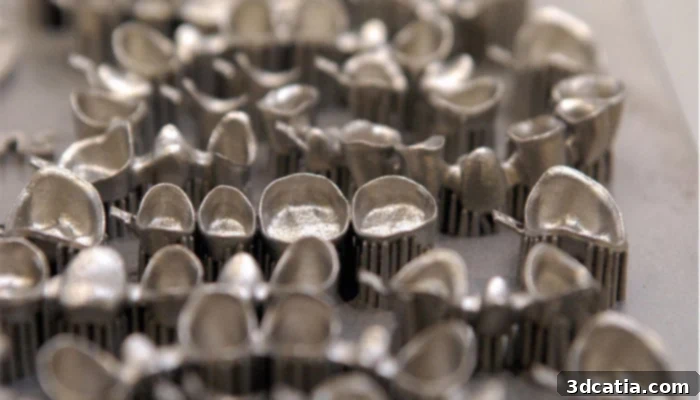
3D technologies now offer multiple solutions in terms of materials, enabling a broader range of dental applications (photo credits: EOS)
Key Users and Expanding Applications of Dental 3D Printing
The report further delves into the specific dental specialties that are at the forefront of adopting additive manufacturing, segmenting its study into three core areas: prosthodontics, orthodontics, and implantology. In 2021, prosthodontics emerged as the largest segment, capturing a substantial 55% of the market. This field, which specializes in the restoration or cosmetic replacement of damaged or missing teeth using fixed or removable dentures, has seen significant benefits from 3D printing. The considerable market share can be attributed to an ever-increasing demand for custom crowns and bridges, driven by a global prevalence of cavities, periodontal disease, and tooth loss due to various factors including an aging population. Additive manufacturing empowers dental professionals to offer highly customized solutions, perfectly adapted to each patient’s unique oral structure, leading to superior fit, function, and aesthetics. While prosthodontics leads in current market share, implantology is projected to exhibit the highest growth rate, an impressive 21.5% CAGR between 2022 and 2027. This surge is fueled by advancements in guided surgery, patient demand for permanent tooth replacement, and the aging demographic seeking durable and functional solutions.
Orthodontics, although not explicitly detailed in the original summary’s market share breakdown for 2021, represents a crucial and rapidly expanding application area for dental 3D printing. The technology has revolutionized orthodontic treatment through the production of clear aligners, indirect bonding trays, custom retainers, and splints. With 3D printing, orthodontists can create a series of precise, patient-specific aligners that gradually shift teeth into the desired position, offering a discreet and often more comfortable alternative to traditional braces. This bespoke manufacturing process streamlines workflow, reduces treatment times, and significantly enhances patient experience and outcomes, making it a powerful driver of digital dentistry adoption.
But who are the primary adopters and main beneficiaries of 3D technologies within the dental industry? The Markets and Markets study delineates the market into three significant user families: dental laboratories, hospitals and clinics, and academic and research institutes. Unsurprisingly, dental laboratories dominate the market, accounting for a substantial 78.6% share in 2021. This dominance is logical, as laboratories serve as the central production hubs for a vast array of dental prosthetics and devices. An increasing number of dental 3D printing solutions are meticulously designed to seamlessly integrate into laboratory environments, offering ready-to-use machines, intuitive software, and materials specifically formulated for dental applications. The workflow in a modern dental lab often involves intraoral scanning, CAD design, and then 3D printing, creating a highly efficient digital chain. Furthermore, the global number of dental laboratories has steadily increased over recent years, providing a larger installed base for these advanced manufacturing technologies and further explaining this significant market share. The ability for labs to produce highly accurate, cost-effective, and personalized restorations in-house or through specialized service providers has revolutionized their business models, allowing for faster turnaround times and improved patient satisfaction.
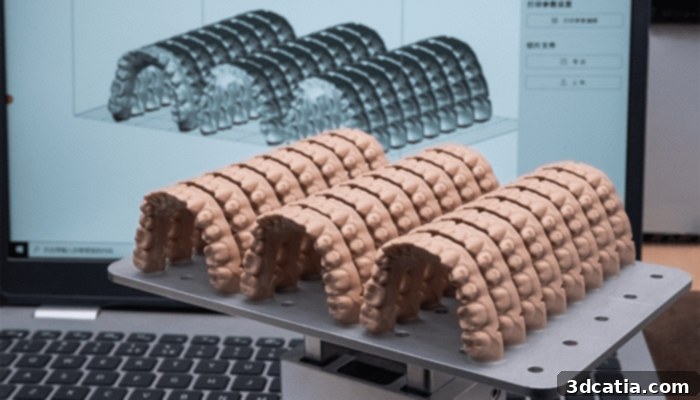
Resin processes remain the most popular in the dental sector due to their precision and material versatility (photo credits: LuxCreo)
Market Dynamics, Challenges, and The Road Ahead for Digital Dentistry
While dental laboratories represent the largest segment of direct users, the study provides crucial nuance by highlighting the significant role of service providers. When considering the trio of equipment, materials, and services collectively, service providers are projected to account for a substantial 65.5% of the market in 2021. This indicates that a considerable portion of dental professionals are opting to outsource the complex aspects of design and 3D printing rather than investing in and managing in-house systems. This trend underscores that while the technology’s benefits are clear, there are still existing challenges that need to be overcome for widespread, direct adoption in every practice. These challenges often include the initial capital investment required for high-quality 3D printers and post-processing equipment, the learning curve associated with advanced CAD/CAM software, the need for specialized training to operate and maintain the technology, and the complexities of material management and regulatory compliance.
The reliance on outsourcing suggests that for many, dental 3D printing has not yet become an intuitive “reflex” integrated seamlessly into daily clinical operations. However, this dynamic also presents a robust opportunity for specialized service bureaus to thrive, acting as crucial enablers for smaller practices and those not yet ready for the full investment. The impressive growth to $7.9 billion clearly demonstrates that the industry is on the right track towards full digital integration, but the “road is still long.” Future developments will likely focus on making 3D printing technology even more user-friendly, reducing costs, expanding the range of biocompatible materials, and further streamlining workflows through artificial intelligence and automation. Continued research and development in areas such as direct printing of permanent restorations, advanced material science, and enhanced regulatory frameworks will pave the way for an even more pervasive adoption of additive manufacturing throughout all facets of dental care, from chairside applications to large-scale laboratory production. This ongoing evolution promises to deliver even greater precision, efficiency, and personalized care to patients worldwide.
For those keenly interested in the granular details and extensive data behind these fascinating trends, the full Markets and Markets report is available for download. You can access the complete study and delve deeper into its findings by clicking HERE.
What are your thoughts on the exponential growth of the 3D printing dental sector? We invite you to share your perspectives and insights in a comment below, or engage with our community on our social media platforms. You can find us on LinkedIn, Facebook, and Twitter! Don’t miss out on the latest advancements and news from the world of additive manufacturing; make sure to sign up for our free weekly Newsletter here, delivering the most current 3D printing news directly to your inbox. For a visual exploration of innovative 3D printing applications, you can also find all our compelling videos on our YouTube channel.
*Cover Photo Credits: Formlabs