
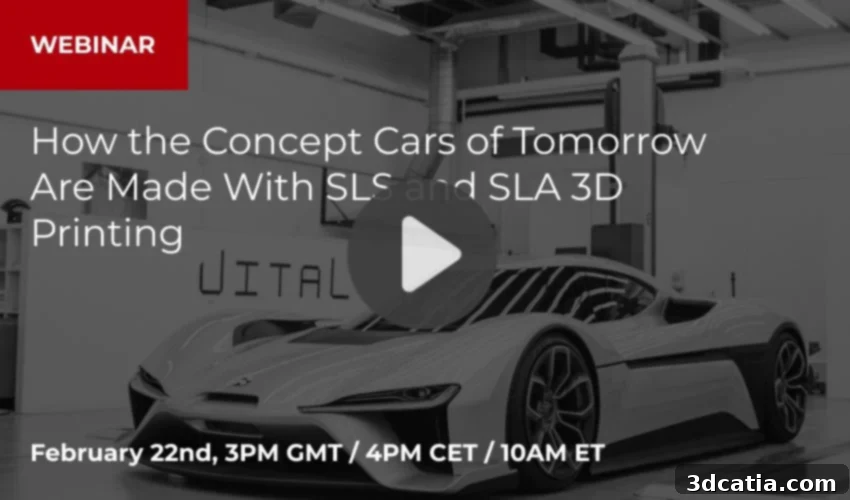
Revolutionizing Automotive Design: How 3D Printing Powers the Future of Concept and Luxury Cars
The automotive sector stands on the precipice of a profound transformation, largely driven by the burgeoning capabilities of 3D printing, also known as Additive Manufacturing (AM). This advanced technology is rapidly redefining how vehicles are conceived, designed, and manufactured, offering unparalleled advantages that resonate across the entire industry spectrum. From the high-stakes world of Formula One racing, where every gram and aerodynamic nuance counts, to the meticulous craftsmanship of luxury automotive brands, AM is proving to be an indispensable tool. It empowers car manufacturers to create parts that are significantly lighter, intricately personalized, and geometrically complex, capabilities that were once unattainable or prohibitively expensive through traditional methods. Moreover, 3D printing offers a vital solution for accurately replicating spare parts, especially for classic or discontinued models, ensuring their longevity and preserving automotive heritage.
The versatility of additive manufacturing extends prominently into the luxury car segment, with renowned companies such as Porsche and BMW actively integrating it into their development workflows. A prime example of this innovative adoption is Vital Auto, a leading industrial design studio based in the UK. Vital Auto specializes in crafting high-fidelity prototypes and visionary concept cars for an elite clientele that includes automotive giants like McLaren, Rolls Royce, and Lotus, among others. Equipped with a sophisticated arsenal of both additive and subtractive manufacturing tools, Vital Auto possesses the unique ability to translate initial ideas, preliminary sketches, detailed drawings, or complex technical specifications into fully realized physical forms. This comprehensive capability allows them to consistently meet and exceed the exceptionally high standards demanded by the cutting-edge automotive industry, pushing the boundaries of what’s possible in vehicle design and engineering.
The Unrivaled Advantages of Additive Manufacturing in Automotive
The integration of 3D printing into automotive design and production workflows delivers a multitude of benefits that are reshaping the industry landscape. One of the most significant advantages is the ability to produce **lightweight components**. By leveraging complex lattice structures and topology optimization, AM can reduce part weight without compromising structural integrity, leading to improved fuel efficiency for road cars and enhanced performance for racing vehicles. This is particularly crucial in Formula One, where even marginal weight savings can translate into critical seconds on the track, offering a competitive edge.
**Personalization and Customization** are another cornerstone of AM’s appeal, especially for luxury and bespoke vehicles. Whether it’s tailor-made interior components, ergonomically optimized dashboards, or unique exterior styling elements, 3D printing enables manufacturers to offer an unprecedented level of customization to discerning customers. This moves beyond mere aesthetics, allowing for functional improvements tailored to individual driver preferences and specific market demands.
**Rapid Prototyping and Iteration** capabilities are arguably where 3D printing shines brightest in the design phase. The ability to quickly produce physical models from CAD data dramatically accelerates the design cycle. Engineers and designers can test multiple iterations of a part or assembly in a fraction of the time it would take with traditional manufacturing. This speed allows for faster identification and rectification of design flaws, leading to more robust and optimized final products. For companies like Vital Auto, rapid prototyping is central to their service, enabling them to quickly visualize and validate complex designs for their high-profile clients, reducing development time and costs significantly.
Furthermore, additive manufacturing excels in creating **complex geometries and intricate designs** that are virtually impossible to produce with conventional methods. This opens new avenues for innovative aerodynamic features, optimized cooling channels, and integrated functionalities within single components, reducing part count and simplifying assembly. The ability to produce **on-demand spare parts** is also a game-changer, addressing the challenge of maintaining older vehicles or limited-run models. Rather than investing in expensive tooling for low-volume parts, manufacturers can simply print them as needed, significantly reducing inventory costs, lead times, and environmental impact by minimizing waste.
Vital Auto: Bridging Innovation and Precision with Formlabs Technology
At the forefront of this automotive transformation is Vital Auto, an acclaimed industrial design studio renowned for its ability to transform conceptual visions into tangible realities. Working with titans of the automotive world like McLaren, Rolls Royce, and Lotus, Vital Auto understands the imperative for speed, precision, and uncompromised quality. Their commitment to innovation is exemplified by their strategic adoption of Formlabs 3D printers, which play a pivotal role in their workflow for both high-fidelity prototypes and critical end-use parts. This symbiotic relationship between Vital Auto’s design expertise and Formlabs’ cutting-edge additive manufacturing technology allows for the creation of automotive components that meet the rigorous demands of performance, aesthetics, and structural integrity.
During a recent insightful webinar hosted by 3Dnatives, Vital Auto’s VP of Innovation and Experiential Technology, Anthony, alongside their Additive Manufacturing Lead & Design Engineer, Shay, offered a deep dive into how they masterfully leverage a diverse array of Formlabs 3D printers. Their discussion illuminated the critical decision-making process behind selecting the right additive technology for specific applications, particularly comparing the strengths and ideal use cases of SLA (Stereolithography) and SLS (Selective Laser Sintering) technologies. This comparison highlighted not only the technical differences but also the strategic advantages each offers in the intricate process of bringing automotive parts to life, showcasing how both technologies can be synergistically used for optimal results.
SLA vs. SLS: Tailoring Technology to Automotive Applications
The choice between SLA and SLS technologies is crucial for automotive prototyping and production, as each offers distinct advantages for different applications and stages of development:
-
**Stereolithography (SLA):** Known for its exceptional accuracy, incredibly smooth surface finish, and fine feature details, SLA is ideal for creating highly aesthetic prototypes, intricate concept models, and master patterns for molds. In the automotive context, SLA is invaluable for detailed interior components, dashboard elements, lighting prototypes, grilles, and aerodynamic surfaces where visual fidelity, precise dimensions, and a premium aesthetic are paramount. Vital Auto utilizes Formlabs’ SLA printers, such as the Form 3L, to achieve the exquisite surface quality and dimensional accuracy required for luxury car mock-ups and high-fidelity concept models that accurately represent the final product’s look and feel, facilitating crucial design validation and client presentations.
-
**Selective Laser Sintering (SLS):** In contrast, SLS technology excels in producing strong, functional, and durable parts without the need for support structures, allowing for incredibly complex and interlocking designs. This makes it perfect for functional prototypes, components requiring good mechanical properties, and even end-use parts in low-volume specialty vehicles. For automotive applications, SLS is often employed for functional components like air ducts, robust brackets, custom jigs and fixtures, and under-the-hood parts that need to withstand demanding conditions. Vital Auto’s impressive fleet of Formlabs Fuse 1 printers leverages SLS for creating robust parts from durable nylon powders, providing the necessary strength, flexibility, and temperature resistance for rigorous functional testing and direct application in concept vehicles, demonstrating real-world performance.
By strategically deploying both SLA and SLS, Vital Auto maximizes efficiency and output quality across their projects. SLA enables rapid visualization and aesthetic validation, allowing designers to quickly iterate on visual elements. Meanwhile, SLS provides the structural integrity for functional testing and direct integration, ensuring parts perform as expected. This sophisticated, dual-technology approach underlines their commitment to delivering comprehensive and innovative solutions for their discerning automotive clients, guaranteeing that every prototype and concept car is both visually stunning and functionally sound, meeting the highest industry standards.
Meet the Visionaries: Webinar Speakers
The invaluable insights shared during the 3Dnatives webinar were brought to life by a panel of distinguished experts, each contributing their unique perspective and extensive experience in the rapidly evolving fields of additive manufacturing and automotive design:
 **Anthony, VP of Innovation and Experiential Technology, Vital Auto:** With a decade of invaluable experience steeped in the niche vehicle sector, Anthony brings a profound understanding of specialized automotive requirements to Vital Auto. Initially joining as an engineering support body for the design studio, he quickly recognized the immense design freedom and transformational potential offered by additive manufacturing. Over the past three years, Anthony has been instrumental in expanding Vital Auto’s formidable presence in this sector, spearheading the adoption of advanced 3D printing technologies. He currently oversees a sophisticated operation that includes five Formlabs Fuse 1 SLS printers, three Formlabs Form 3L SLA printers, and more than ten large-format FDM printers. This diverse and powerful fleet works in concert under his visionary leadership to produce truly outstanding and innovative results, consistently pushing the boundaries of what is achievable in concept and prototype development for the most demanding clients. His expertise lies in seamlessly integrating these varied technologies to achieve optimal outcomes for complex automotive projects, ensuring both efficiency and groundbreaking innovation.
 **Shay, Additive Manufacturing Lead & Design Engineer, Vital Auto:** Shay, along with the dedicated team at Vital Auto, embodies the spirit of analogue aficionados thriving in an increasingly digital landscape. From their strategic base in Coventry, UK, Shay leads their clients in integrating crucial insights, imaginative thinking, and practical making skills into every project. His multifaceted role involves spearheading design investigations and pioneering research into emerging areas of growth within creative technology and experiential design, constantly seeking out new methodologies and tools. Shay’s passion for pushing creative boundaries and his deep, hands-on understanding of additive manufacturing processes ensure that Vital Auto remains at the cutting edge of automotive design and innovation, consistently delivering groundbreaking solutions for their high-profile clients and shaping the future of vehicle aesthetics and functionality.
 **Madeleine Prior, English Content Specialist, 3Dnatives:** As the English Content Specialist for 3Dnatives, the premier international online magazine dedicated to 3D Printing and Additive Manufacturing, Madeleine plays a crucial role in bringing the latest industry news and developments to a global English-speaking audience. She is responsible for meticulously defining the content 3Dnatives covers, ensuring readers receive timely, relevant, and in-depth information about the additive manufacturing sector and its far-reaching implications across various industries. Her insights help to bridge the gap between complex technological advancements and a broad readership, making vital information accessible, engaging, and digestible for professionals and enthusiasts alike. Madeleine’s work is essential in keeping the community informed about the innovations driving the industry forward.
Don’t Miss Out: Engage with the Future of Automotive!
Are you ready to dive deeper into how 3D printing is shaping the concept cars of tomorrow and influencing the luxury vehicle market? The profound insights shared in this webinar are invaluable for anyone involved in automotive design, engineering, manufacturing, or simply passionate about the future of transportation. We strongly encourage you to watch the replay and gain firsthand knowledge from these industry leaders who are actively driving innovation.
We invite you to share your thoughts and questions about creating the next generation of concept cars with 3D printing. Let us know your perspective in a comment below, or engage with our vibrant community on our LinkedIn, Facebook, and Twitter pages! For the very latest updates, breaking news, and in-depth analyses from the dynamic world of additive manufacturing, don’t forget to sign up for our free weekly Newsletter here, delivered straight to your inbox. Additionally, you can find a wealth of informative videos and discussions on our YouTube channel. Join us in exploring the cutting-edge innovations that are driving the automotive industry forward and shaping the vehicles of tomorrow!