
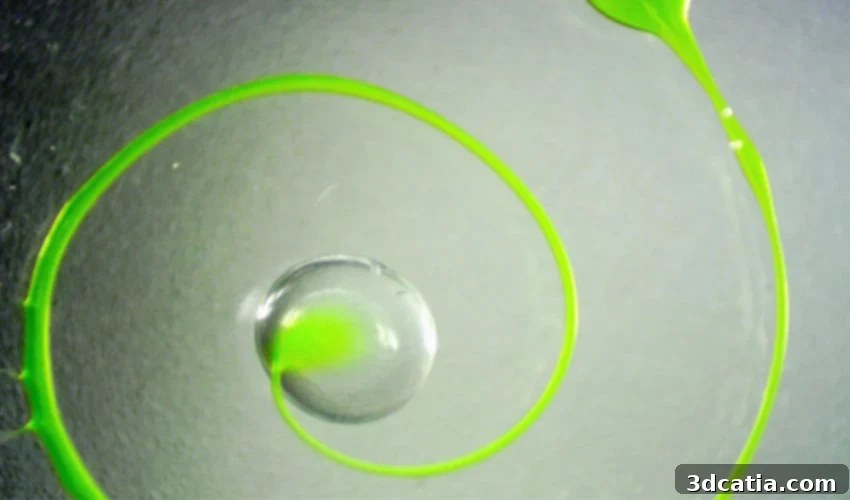
Revolutionizing Additive Manufacturing: Lawrence Berkeley Lab Pioneers Breakthrough in Liquid 3D Printing
A team of visionary scientific researchers at the prestigious Lawrence Berkeley National Laboratory has made a groundbreaking claim: they have successfully developed a novel 3D printing methodology capable of creating entirely liquid structures. This innovative technique employs a specialized 3D printer designed to meticulously deposit intricate “water nets” within a base material composed of silicone oil. This revolutionary approach promises to unlock unprecedented possibilities, particularly in advanced fields such as chemical synthesis and the fabrication of cutting-edge liquid electronics.
Traditional 3D printing, widely recognized as additive manufacturing, operates on the principle of successively depositing layers of material to construct a desired three-dimensional object. Historically, these materials have predominantly been solid, ranging from various plastics and metals to ceramics and composites. The established paradigm involves building up physical structures layer by layer, where each new layer solidifies or cures upon deposition, forming a rigid or semi-rigid object. However, the researchers at Lawrence Berkeley have pushed the boundaries of this conventional understanding, venturing into an entirely new dimension of additive manufacturing. Their pioneering work extends the very concept of 3D printing to encompass structures made from liquid materials, opening a fascinating frontier for scientific and industrial innovation. This departure from solid-state fabrication represents a significant leap, challenging and redefining the fundamental principles of what can be “printed.”
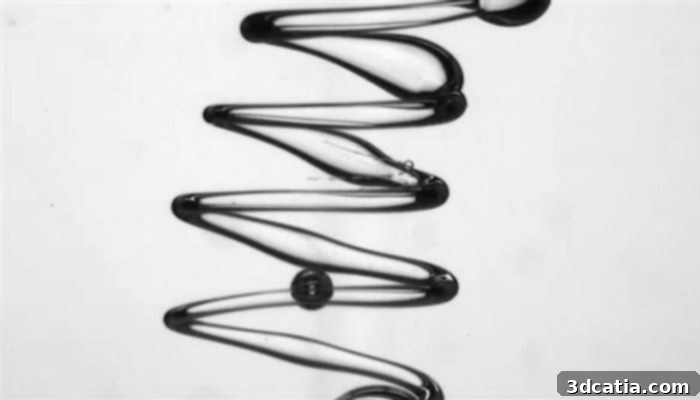
Scientists at the Berkeley Lab meticulously explain the ingenious mechanism behind their discovery. By precisely printing thin, continuous streams of water into a host substance of silicone oil, they have demonstrated the ability to fashion intricate liquid tubes completely encased within another liquid. This process, while seemingly simple, involves complex interplay of fluid dynamics and material science. At the current stage of their groundbreaking research, the team has successfully 3D printed networks of water, often referred to as “water nets,” with diameters ranging from a remarkably fine 10 microns up to 1 millimeter. This precision allows for the creation of diverse and complex architectures, including elaborate spiral patterns and branching models that can extend up to several meters in length. What’s even more astonishing is the inherent adaptability of these liquid structures; they possess the unique capability to dynamically change their shape and conform to their surrounding environment. The researchers firmly believe that this advanced liquid 3D printing technique holds immense utility, not only for the burgeoning field of liquid electronics but also for transformative applications in chemical synthesis. Addressing the latter, Tom Russell, a lead scientist at Berkeley Lab, emphasizes the profound implications: “This is a class of materials that can be reconfigured and can be adapted as needed in liquid reaction vessels, whether for chemical syntheses or ionic transport, by catalysis.” This statement underscores the potential for creating dynamic, programmable reaction environments unlike anything seen before.
The Secret to Stability: Introducing “Supersoap” Nanoparticles
One of the most significant challenges in printing liquid within another liquid is maintaining the structural integrity of the printed liquid. Without proper stabilization, the injected water would simply disperse into droplets due to surface tension. The Berkeley Lab team ingeniously overcame this hurdle by developing a unique method to coat the 3D printed water tubes with a specialized substance akin to soap. Specifically, these delicate liquid tubes are coated with a novel surfactant, a compound critical for reducing surface tension, which enables them to retain their intricate shapes and prevents them from breaking down into unbound droplets within the silicone oil matrix. This isn’t just any ordinary soap; the surfactant is formed from a sophisticated combination of a polymeric ligand and precisely engineered gold nanoparticles. This innovative “supersoap” allows the water to form exceptionally stable structures that defy conventional fluid dynamics.
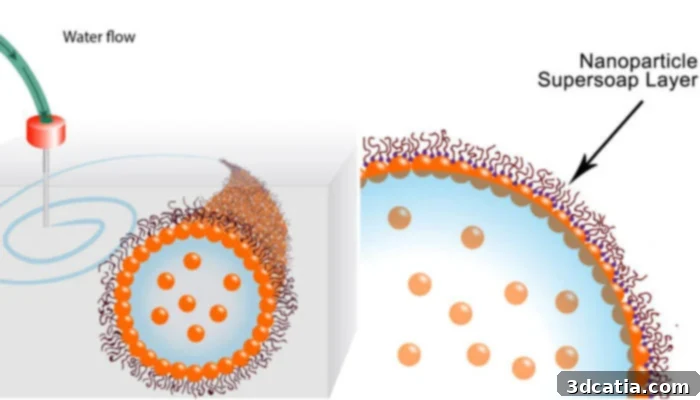
The chemical magic behind this stability lies in the interaction between the components. The water, initially mixed with tiny gold nanoparticles, is injected into the silicone oil. The polymeric ligands, already present in the silicone oil, possess a natural affinity for these gold nanoparticles. As the water stream is extruded, these ligands swiftly bind to the gold nanoparticles suspended within the water, instantly forming a robust, self-assembled surfactant layer at the interface between the water and the oil. The researchers have aptly named this remarkable stabilizing agent a “supersoap” due to its extraordinary efficacy and durability. Tom Russell further elaborates on its incredible properties: “This stability means we can stretch the water in a tube without changing the shape of the tube. We can also model the water into an ellipsoid and it will remain an ellipsoid. We used these supersoaps of nanoparticles to print water tubes that are maintained for several months.” This exceptional longevity and structural resilience are crucial for practical applications, ensuring that the created liquid structures can function reliably over extended periods.
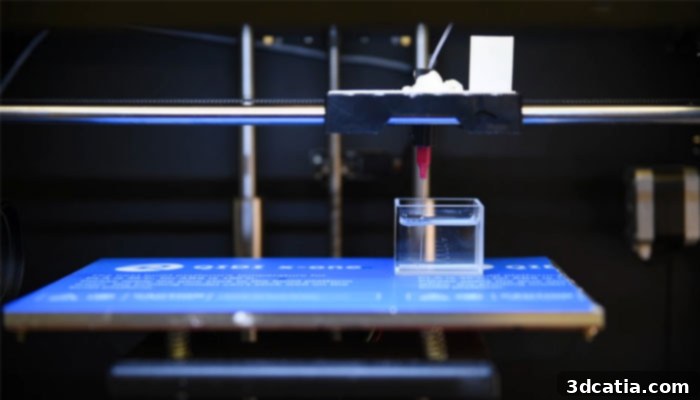
Engineering for Innovation: Adapting Desktop 3D Printers for Liquid Fabrication
To transition this groundbreaking scientific discovery into an automated and reproducible liquid printing process, the Berkeley Lab scientists undertook a clever modification of a standard desktop 3D printer. This involved integrating specialized components essential for handling and precisely depositing liquid materials. The key adaptations included installing a high-precision syringe pump, which allows for the controlled and continuous extrusion of water, and outfitting the printer with a fine liquid extrusion needle. This needle is designed for accuracy, capable of delivering the water stream with the necessary precision to create the desired micro-scale liquid structures.
Beyond the hardware modifications, extensive software programming was undertaken. The 3D printer was meticulously programmed to guide the extrusion needle into the silicone oil base and then inject the water according to a predefined, complex pattern dictated by a digital 3D model. This programming ensures that the liquid structures are formed with high fidelity and repeatability, mimicking the complexity and resolution typically associated with solid 3D printing. The ability to automate this delicate process is a critical step towards making liquid 3D printing a viable manufacturing technique, paving the way for intricate designs and scalability. This demonstrates how existing additive manufacturing platforms can be re-engineered and adapted for entirely new material paradigms, broadening the scope of what 3D printing can achieve.
Transformative Applications: From Chemical Reactors to Flexible Electronics
The potential applications of this liquid 3D printing technology are vast and transformative. In chemical synthesis, the ability to create dynamic, reconfigurable liquid channels and compartments within another liquid matrix could revolutionize laboratory procedures. Imagine microreactors where reactants can be introduced and mixed with unparalleled precision, or where catalytic reactions can be finely controlled within bespoke liquid architectures. This offers a level of control over reaction kinetics and product purity that is difficult to achieve with traditional vessels. Furthermore, these liquid networks could serve as ideal conduits for ionic transport, crucial for various electrochemical processes and energy storage solutions.
For liquid electronics, the implications are equally profound. The creation of stable, conductive liquid pathways could lead to the development of truly flexible and even self-healing electronic components. Unlike rigid circuits, liquid electronics could adapt to changing environments, stretch, bend, and even repair minor damage automatically. This could be instrumental in wearable technology, soft robotics, and advanced bio-integrated devices where flexibility and adaptability are paramount. The “water nets” could encapsulate conductive fluids, creating circuits that are impervious to mechanical stress or physical distortion, opening doors for entirely new generations of electronic devices.
Future Outlook and Expanding Horizons
This pioneering research from Lawrence Berkeley National Laboratory marks a significant milestone in additive manufacturing. By enabling the precise 3D printing of stable liquid structures, the team has not only expanded the definition of 3D printing but also opened numerous avenues for interdisciplinary research and development. Future work may explore different types of liquid materials, advanced “supersoap” formulations for even greater stability and diverse chemical functionalities, and the integration of smart materials that respond to external stimuli. The scalability of this process, moving from desktop modifications to industrial applications, will be a key area of focus, along with optimizing printing speeds and material efficiency. This breakthrough has the potential to impact fields far beyond chemistry and electronics, including biomedical engineering (e.g., cell scaffolding, drug delivery systems) and material science, where dynamic and responsive liquid architectures could lead to entirely new classes of functional materials. The ability to precisely manipulate and structure liquids at microscopic levels could fundamentally change how we design, fabricate, and interact with matter.
For those interested in delving deeper into the scientific intricacies of this remarkable discovery, more detailed information can be found in the associated research paper, accessible here. Additionally, a visual demonstration of the process and its capabilities is available in the video below: