
Revolutionizing Immersive Audio: Syng’s Cell Alpha Speaker Powered by HP Multi Jet Fusion 3D Printing
The landscape of the music industry is undergoing a profound transformation, with additive manufacturing emerging as a pivotal force. Far from being a niche application, 3D printing technologies are empowering musicians, designers, and audio engineers to transcend traditional limitations, pushing the boundaries of acoustics, ergonomics, and aesthetic design. This innovative approach allows for the creation of incredibly intricate and optimized geometries for instruments like guitars, violins, and drums, alongside specialized accessories that enhance the overall sound experience or simply offer superior comfort for performers. By enabling unprecedented design freedom, 3D printing facilitates the integration of complex internal structures and finely tuned components that were previously impossible or prohibitively expensive to produce. This paradigm shift in manufacturing is precisely what underpins the philosophy of Syng, a California-based company that has harnessed the power of additive manufacturing to develop a groundbreaking triphonic speaker. The result is the Cell Alpha, a device that promises a totally immersive, high-fidelity sound experience unlike any other. By leveraging HP’s Multi Jet Fusion (MJF) technology, Syng was able to conceptualize and realize a novel speaker architecture, delivering a listening experience that redefines audio immersion. To delve deeper into this new generation of audio speakers and the integral role 3D printing played in its creation, we recently had the opportunity to speak with Yoav Ben-Haim, Director of Mechanical Engineering at Syng.
Introducing Syng: Pioneering the Future of Audio

Yoav Ben-Haim, Director, Mechanical Engineering at Syng
Syng was founded on a singular, ambitious vision: to unlock a completely new dimension in audio. The company’s mission goes beyond merely reproducing sound; it aims to transform the way we experience it. Traditional audio systems, while sophisticated, often struggle to deliver a truly spatial and all-encompassing sound field that mirrors the artist’s original intent across diverse content types. Recognizing this gap, Syng set out to engineer a product that could render sound with unparalleled precision and immersive quality for the vast spectrum of content consumed today, from intricate musical compositions to dynamic cinematic experiences and everything in between. Their flagship product, the Cell Alpha, embodies this ambition. It represents an entirely new speaker architecture, meticulously designed from the ground up to overcome the limitations of conventional audio setups. The core objective was to create a system capable of delivering any form of audio content exactly as the creator intended, while simultaneously filling an entire space with rich, high-fidelity sound that envelops the listener. This commitment to innovation and pushing the boundaries of audio engineering defines Syng’s unique position in the market.
The Cell Alpha: Redefining Immersive Sound with Triphonic Technology
The Cell Alpha is not just another speaker; it’s the culmination of years of research and development, designed to offer an audio experience that is genuinely all-encompassing. At the heart of its revolutionary performance lies Triphonic, Syng’s proprietary driving technology. Triphonic fundamentally transforms the listener’s environment into an expansive field of pristine, detailed sound. This creates a fully immersive experience that transcends passive listening, placing you directly within the sonic landscape of your favorite music, movies, or games. Unlike traditional stereo or even many surround sound systems that aim to simulate spatial audio, Triphonic actively projects sound with unrivaled precision. It directs audio to exactly the right points within your listening space, creating a dynamic sound field that is both more spacious and incredibly immersive than anything previously possible. The quality and potential of Triphonic’s dynamic sound are truly unmatched. Listeners don’t just hear the music; they feel themselves enveloped by it, experiencing every nuance and layer with breathtaking clarity and depth. This level of immersion fosters a deeper connection with the content, allowing for a more profound and engaging interaction with sound.
Complementing the Cell Alpha’s sophisticated hardware is Syng Space, an intuitive mobile application designed to provide listeners and creators with an unprecedented level of control over their audio environment. This app acts as the command center, allowing users to fine-tune their listening experience, adjust sound fields, and customize settings to perfectly match their preferences and the specific content they are enjoying. Syng Space empowers users to not only optimize the sound for their unique room acoustics but also to experiment with various sonic profiles, ensuring that the Cell Alpha delivers its full potential in any setting. This seamless integration of cutting-edge hardware and user-friendly software creates a truly holistic and personalized audio journey, making the Cell Alpha a standout innovation in the world of high-fidelity sound.
The Indispensable Role of 3D Printing in Cell Alpha’s Production
The innovative design and unparalleled acoustic performance of the Cell Alpha owe a significant debt to the strategic integration of 3D printing in its production process. A critical component, both structurally and acoustically, is the Triphone – Syng’s unique three-horned sound projector. For the Triphone to function optimally and deliver its groundbreaking sound experience, it was absolutely essential for it to be manufactured as a single, monolithic part. This requirement stemmed from the need to ensure complex, uninterrupted pathways for sound within the system. Any seams, joints, or inconsistencies that would typically arise from assembling multiple parts using traditional manufacturing methods could introduce acoustic distortion, unwanted reflections, or energy loss, thereby compromising the purity and precision of the Triphonic sound. Such complex internal geometries, perfectly optimized for sound propagation, are incredibly challenging, if not impossible, to achieve with conventional manufacturing techniques like injection molding or machining, which often necessitate multi-part assemblies and subsequent gluing or fastening. Additive manufacturing, specifically 3D printing, emerged as the singular viable method that allowed Syng to create this crucial component as a unified, seamless piece. This not only ensured the structural integrity and acoustic purity but also enabled the integration of multiple functionalities directly into the single part.

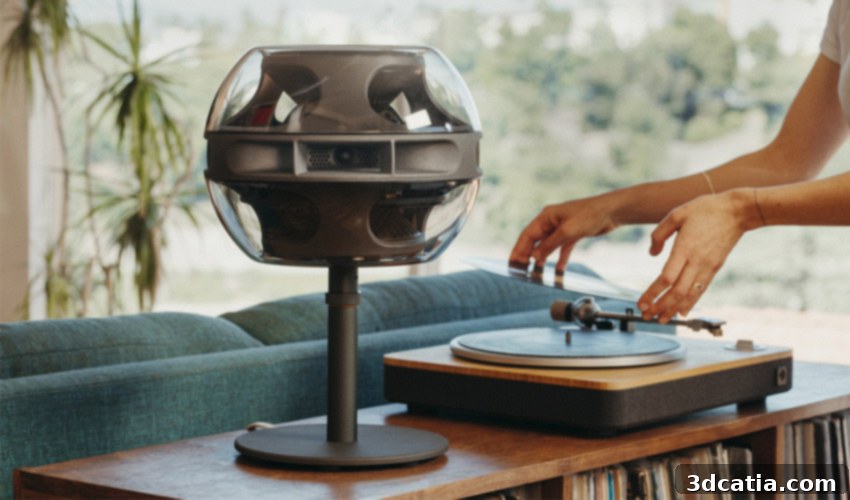
Cell Alpha speaker (Photo Credit: Syng)
The Triphone, as a single 3D-printed component, ingeniously incorporates several critical elements that are essential for the Cell Alpha’s performance. This includes precisely engineered mounts for six individual speakers, ensuring their optimal placement and orientation for coherent sound projection. Furthermore, it integrates ten intricate pressure seals, vital for maintaining acoustic isolation and preventing unwanted vibrations or air leaks that could degrade sound quality. Most impressively, the Triphone features complex internal airways, meticulously designed to guide and shape the sound waves, contributing directly to the speaker’s expansive and detailed sound field. The ability to integrate these diverse functionalities – structural support, speaker mounting, sealing mechanisms, and intricate acoustic pathways – into one consolidated part through 3D printing represents a monumental leap in design and manufacturing. Beyond its functional prowess, 3D printing also allowed for the incorporation of unique cosmetic features, ensuring that the Triphone not only performs flawlessly but also contributes to the Cell Alpha’s distinctive and visually appealing design. This holistic approach, made possible by additive manufacturing, allowed Syng to realize their ambitious vision for the Cell Alpha without compromise.
Material Selection and HP MJF Technology: A Synergistic Choice
When designing the Cell Alpha, Syng’s engineering team prioritized several key attributes for the enclosure and critical internal components: a seamless finish, exceptional durability, and striking visual appeal. To achieve these demanding specifications, the choice of material and manufacturing technology was paramount. Syng opted for PA 12 (Nylon 12), processed using HP Multi Jet Fusion (MJF) machines. This specific combination proved to be uniquely suited for the Cell Alpha. PA 12, as a material, offers an outstanding balance of mechanical strength, impact resistance, and flexibility, making it ideal for a durable consumer electronics product that needs to withstand daily use. Its inherent properties also contribute to excellent acoustic damping, minimizing unwanted resonances that could color the sound.
What truly set PA 12 printed on HP MJF machines apart for Syng was its unique appearance and surface finish. Unlike the often rough or layered aesthetics associated with some other 3D printing technologies, MJF produces parts with a fine, uniform, and slightly textured surface that is visually distinct and aesthetically pleasing. This characteristic finish was crucial for the Cell Alpha, which was conceived not just as an audio device but as a sculptural piece of industrial design intended to blend seamlessly and elegantly into any modern environment. The combination of PA 12’s robust physical properties and MJF’s superior surface quality resulted in a product that exudes both advanced capability and sophisticated confidence. Furthermore, HP’s MJF technology offered significant advantages in terms of production efficiency and part consistency. MJF is known for its ability to produce functional, isotropic parts at speed and scale, making it viable for production-intent components. This meant that the engineering team could rely on consistent mechanical properties across batches, which is critical for maintaining the high-performance standards of the Cell Alpha. The ability to produce complex internal geometries with excellent dimensional accuracy also played a crucial role in enabling the intricate design of the Triphone, ensuring precise fitment for speakers and seals, and perfectly formed acoustic pathways. This synergistic choice of material and technology was instrumental in bringing Syng’s ambitious design to life without compromise.
Beyond Prototyping: 3D Printing as a Production Intent Technology
The decision to embrace 3D printing as a core manufacturing method for the Cell Alpha was a deliberate and strategic one, offering profound advantages that extended far beyond the initial prototyping phase. Traditionally, 3D printed prototypes serve as early design validation tools, after which the design is typically adapted for mass production techniques like injection molding, often necessitating a complete switch to different materials and processes. This conventional workflow often introduces a disconnect: learnings from the prototype material and manufacturing nuances may not directly transfer to the final production material, potentially leading to unforeseen challenges and iterative redesigns during the costly tooling phase for injection molding. Syng recognized this inherent inefficiency and chose a different path.

Photo Credit: Syng
By using 3D printing, specifically HP MJF with PA 12, as their *production intent* manufacturing method, Syng’s mechanical engineering team gained unparalleled confidence in the structural integrity and acoustic performance of the product architecture from the earliest stages of design and development. This approach meant that any insights gathered regarding the specific resin’s mechanical properties, acoustic characteristics, and manufacturing tolerances during the prototyping phase were directly and seamlessly transferable to the final production design. There was no need to re-engineer for a different material or process, significantly reducing risks, development time, and potential costs associated with traditional tooling and material qualification. This continuity accelerated the design iteration process, allowing engineers to validate complex geometries and integrated functionalities with certainty. It also provided immense design freedom, enabling the team to create the highly complex, unified Triphone component – a design that would have been financially and technically unfeasible with conventional mass production techniques. By leveraging 3D printing as a direct route to production, Syng not only streamlined their development pipeline but also ensured that the innovative spirit of their initial designs was fully preserved in the final product, embodying a truly agile and forward-thinking manufacturing strategy.
Syng’s Future: Accelerating the Evolution of Sound Experiences
With the introduction of the Cell Alpha, Syng has not just launched a product; it has heralded a revolution in the audio industry. The company’s ambitions stretch far beyond current achievements, aiming to continually accelerate the possibilities for how people interact with sound and fundamentally expand the concept of what audio can be. Syng envisions a future where sound experiences are as dynamic, personalized, and visually rich as the content they accompany. This involves exploring new interfaces, developing more sophisticated algorithms for spatial audio rendering, and integrating audio technology even more deeply into our daily lives, transforming everything from home entertainment to virtual reality. The goal is to move beyond passive listening to active, immersive sonic engagement, allowing users to sculpt and personalize their soundscapes in unprecedented ways. The future for Syng is vast and brimming with potential. The team is incredibly excited about the transformative impact their sound experience will have in bridging the existing gap between audio technology and the rapid advancements seen in visual technologies. While screens have evolved to deliver stunningly realistic and immersive visuals, audio has often lagged, remaining largely confined to traditional stereo or basic surround sound formats. Syng aims to rectify this imbalance, bringing audio technology up to speed by creating truly spatial, adaptive, and intelligent sound environments that complement and elevate visual content. This continuous pursuit of innovation promises to unlock new realms of sonic exploration, further solidifying Syng’s position as a pioneer at the forefront of audio technology.
3DN: Any last words for our readers?
Experience the future of immersive audio today. The Cell Alpha is currently available for purchase directly from the official Syng website, SyngSpace.com, with prices starting at $1799. We invite you to explore the possibilities of Triphonic audio and discover how it can transform your listening experience.
What are your thoughts on the Cell Alpha speaker and the innovative use of 3D printing in high-fidelity audio? Share your insights and comments below, or connect with us on our social media channels via Facebook and Twitter. For the latest news and developments in the exciting world of 3D printing, don’t forget to subscribe to our free weekly newsletter, delivered straight to your inbox!