
Mitsubishi Electric Unveils AZ600 Wire-Laser Metal 3D Printer: A Leap Towards Sustainable Additive Manufacturing
The additive manufacturing industry continues its rapid expansion, marked by a significant development from an unexpected, yet highly influential, global player. Mitsubishi Electric, the renowned Japanese conglomerate, has officially announced the launch of its innovative AZ600 wire-laser metal 3D printer. Set to be released on March 1st, this launch introduces two distinct models, signaling a pivotal moment not only for Mitsubishi Electric but for the broader industrial landscape. This strategic move underscores the growing adoption of 3D printing technologies by major corporations and highlights Mitsubishi Electric’s profound commitment to sustainability. The development of the AZ600 series is an integral part of their ambitious efforts to drastically reduce CO2 emissions within metal manufacturing processes, aligning with global decarbonization goals.
Established in 1921, Mitsubishi Electric Corporation stands as the electronics and electrical equipment core of the vast Mitsubishi group. While its automotive counterpart, Mitsubishi Motors, might be more universally recognized, Mitsubishi Electric has carved out an illustrious reputation as a formidable leader in cutting-edge electronics and industrial solutions. Its extensive portfolio spans an incredibly diverse array of sectors, delivering sophisticated technologies in air conditioning, transportation systems, advanced factory automation, building infrastructure, energy management, space exploration, and much more. This rich heritage of innovation now extends vigorously into the realm of metal 3D printing, as the company prepares to introduce what it proudly touts as the “world’s first wire-laser metal 3D printer that combines simultaneous 5-axis spatial control and digital additive-manufacturing technology that precisely and cooperatively controls processing conditions.” This bold claim positions the AZ600 as a groundbreaking innovation, promising unprecedented levels of precision, efficiency, and versatility in metal additive manufacturing.
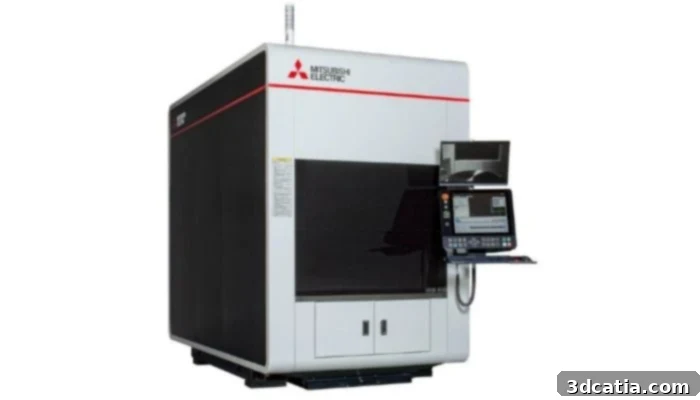
Photo Credits: Mitsubishi Electric
Why Mitsubishi Electric is Pivoting Towards Advanced Additive Manufacturing
The global manufacturing sector is increasingly recognizing the transformative potential of additive manufacturing (AM) to achieve diverse production goals, thanks to its myriad inherent benefits. This fundamental shift has undoubtedly influenced Mitsubishi Electric’s decision to develop and launch its proprietary metal 3D printer. The company specifically emphasizes several key advantages that AM offers over conventional manufacturing techniques. These include the ability to significantly shorten the overall manufacturing process, drastically reduce material waste through optimized material utilization, and substantially enhance design flexibility. This flexibility manifests in easier part integration, allowing for more complex geometries and consolidated assemblies, and a notable reduction in component weight, which is critical for performance-driven applications. Mitsubishi Electric particularly highlights the latter two benefits—improved design flexibility and weight reduction—as instrumental in propelling manufacturing towards a more decarbonized and environmentally responsible era.
Mitsubishi Electric Group’s dedication to environmental stewardship is formally outlined in its ambitious Environmental Sustainability Vision 2050. This comprehensive roadmap details the company’s commitment to proactively address critical environmental issues and vigorously drive decarbonization across all its operations and value chains. One of the core strategies for achieving these monumental goals involves the astute adoption and integration of diverse, cutting-edge technologies. The company aims to achieve stringent greenhouse gas reduction targets throughout its entire value chain, from raw material sourcing to product end-of-life. Within the critical domain of metal manufacturing, Mitsubishi Electric has unequivocally identified metal additive manufacturing as a cornerstone technology for realizing its decarbonization objectives. The company specifically notes that AM profoundly contributes to a decarbonized manufacturing landscape by significantly “reducing energy consumption, saving resources through the shortening of processing time and utilizing highly efficient production methods such as ‘near-net-shape,’ and supporting the build-up of repairs for the maintenance of specialist parts for automobiles, ships and aircraft.” This holistic approach demonstrates a deep understanding of AM’s potential to foster both economic and environmental gains.
While embracing metal 3D printing does not inherently necessitate the development of a proprietary machine, Mitsubishi Electric has chosen a path of self-innovation. The company could have easily followed the precedent set by its affiliate, Mitsubishi Power, which already leverages established directed energy deposition (DED) and binder jetting solutions from leading manufacturers such as ExOne and FormUp. However, Mitsubishi Electric opted to design its own specialized additive manufacturing solutions. This decision stems from a strategic intent to directly address what it perceived as existing limitations and challenges inherent in conventional powder-based 3D printing systems. By developing its unique wire-laser AM process, Mitsubishi Electric aims to overcome prevalent issues related to material management complexities, workability constraints, and safety concerns often associated with powder handling. This bespoke approach ensures that their technology is optimized to meet their specific manufacturing demands and sustainability goals, offering greater control and innovation.
The AZ600 wire-laser metal 3D printer distinguishes itself through several advanced features, most notably its “simultaneous 5-axis spatial control.” Unlike conventional 3-axis systems that move along X, Y, and Z coordinates, 5-axis control allows for rotation around two additional axes, typically A and B or B and C. This capability enables the print head to approach the part from virtually any angle, drastically improving the ability to create complex geometries, overhangs, and internal structures without the need for extensive support materials. The integration of this advanced motion control with “digital additive-manufacturing technology that precisely and cooperatively controls processing conditions” means that every parameter—from laser power and wire feed rate to melt pool temperature and deposition speed—can be dynamically adjusted and synchronized in real-time. This level of precise, cooperative control results in superior material properties, enhanced part integrity, and significantly reduced post-processing requirements, translating into more efficient production and higher-quality components. The wire-laser approach itself offers advantages over powder bed fusion, primarily in material efficiency and safety. Using metal wire as feedstock reduces material waste, simplifies handling, and eliminates the risks associated with fine metal powders, making it a more environmentally friendly and safer choice for industrial environments.
Ultimately, Mitsubishi Electric expresses strong confidence that its new AZ600 printer will be a game-changer, significantly contributing to the realization of high-quality, high-precision 3D printing across various demanding industries. Concurrently, the company anticipates that this innovative technology will play a crucial role in advancing manufacturing processes towards a future characterized by a substantially reduced environmental impact. For those eager to delve deeper into the capabilities and features of this groundbreaking new printer, it will be prominently exhibited at the “Additive Manufacturing Expo,” scheduled to take place from March 16-18 at Tokyo Big Sight. This event offers an invaluable opportunity for industry professionals, researchers, and enthusiasts to witness the AZ600 firsthand and learn about its transformative potential. Further comprehensive details about this significant launch can also be found directly within Mitsubishi Electric’s official press release, available HERE.
What are your thoughts on Mitsubishi Electric’s bold entry into the metal 3D printer market with its wire-laser technology? Do you believe this will accelerate the adoption of additive manufacturing in traditional industries, or do you foresee specific challenges? We invite you to share your insights and opinions in a comment below, or engage with our community on our LinkedIn, Facebook, and Twitter pages! For the latest updates and breaking news in the dynamic world of 3D printing, don’t forget to sign up for our free weekly Newsletter here, delivered directly to your inbox. You can also explore all our informative and engaging videos on our dedicated YouTube channel.