

DIY Dream Car: How a Father and Son 3D Printed a Full-Scale Lamborghini Aventador in Their Garage
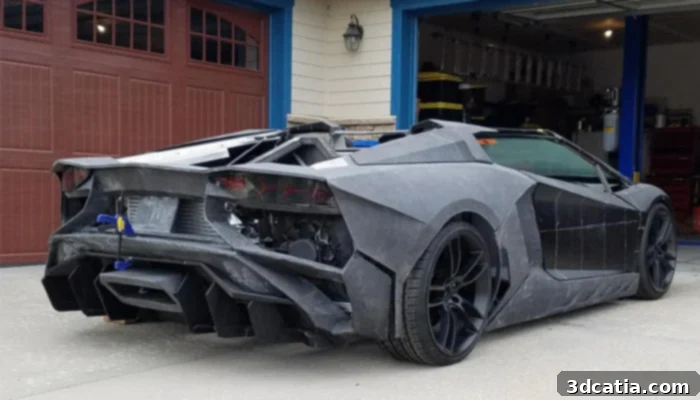
In an era where automotive giants like BMW showcase future concepts of 3D printable vehicles designed for home assembly, a remarkable project was already underway in a modest garage. This ambitious endeavor saw a father and son team embark on an incredible journey: constructing a full-sized, 3D printed Lamborghini Aventador. This inspiring duo set out to manufacture the vast majority of the supercar’s components using only the small, accessible 3D printers they owned, and the outcome has been nothing short of astonishing. Sterling Backus, a physicist and the father behind this colossal undertaking, was driven by a desire to bring a seemingly impossible vision to life. His primary motivation was to demonstrate to his son the boundless potential of modern technology and the power of creative problem-solving. Their project stands as a powerful testament to the evolving landscape of additive manufacturing, pushing the boundaries of what is considered “large-format 3D printing” and making it accessible to enthusiasts beyond industrial settings.
The Inspiration Behind the Build: Passion Meets Practicality
The genesis of this extraordinary project was not merely a whim but a deep-seated passion for both automotive design and technological innovation. Sterling Backus, with his background in physics, saw an opportunity to bridge the gap between theoretical understanding and practical application. He wanted to instill in his son a profound appreciation for engineering, design, and the iterative process of creation. This undertaking was more than just building a car; it was a hands-on masterclass in modern manufacturing, problem-solving, and perseverance. The idea of printing a life-size car in their home garage seemed audacious, yet it perfectly encapsulated their adventurous spirit and belief in accessible technology. The project quickly garnered attention, not just for its scale, but for its potential to inspire a new generation of makers and engineers, proving that with dedication, sophisticated projects can be tackled outside traditional industrial environments.
3D Printing’s Evolving Role in the Automotive Industry
When discussing the intricate relationship between the automotive sector and 3D printing, it’s essential to acknowledge that, as of July 12th, 2019, most commercially produced vehicles incorporate only a handful, if any, 3D printed components. The prevailing additive manufacturing technologies, while rapidly advancing, are not yet mature enough for the mass production of entire vehicle models. However, this reality in no way diminishes the pioneering spirit and significant advancements being made across the industry. We must commend the myriad initiatives that are continuously pushing the envelope, fostering innovation, and driving the development of future car production methodologies. Thanks to the inherent advantages of additive manufacturing, numerous vehicle components can be meticulously optimized for performance. This optimization frequently leads to significant weight reductions, which in turn enhances fuel efficiency, improves handling characteristics, and boosts overall vehicle capabilities. Furthermore, by minimizing material waste and allowing for on-demand production, 3D printing contributes to reduced manufacturing costs. In the unique case of Sterling Backus and his son, these technological developments offered a pathway to realizing their dream of owning a supercar – specifically, a Lamborghini Aventador – without incurring the prohibitive costs associated with purchasing such a luxury vehicle, which typically runs into hundreds of thousands of dollars.
The Technical Marvel: Materials and Machines Behind the Build
Selecting the Right Tools for the Job
Sterling Backus, a physicist with considerable prior experience in FDM (Fused Deposition Modeling) 3D printing, meticulously selected the equipment for this ambitious project. His rich history with various FDM printers provided him with invaluable insights into their capabilities and limitations. For the Lamborghini Aventador replication, the team primarily utilized a trio of widely accessible desktop machines: the Creality CR-10S, the CR-105S, and the QIDI Xpro. The choice of these particular printers is significant because they are relatively affordable and commonly used by hobbyists and small businesses, underscoring the “DIY” and accessible nature of the project. These machines, while not industrial-grade, demonstrated their surprising robustness and precision through careful calibration and persistent effort. The process involved breaking down the complex geometries of the Aventador into manageable, printable segments, a challenging task that required extensive planning and digital modeling. Each part was then meticulously printed, piece by piece, gradually bringing the supercar’s iconic form to life within the confines of their garage.
Filament Choices: A Material Masterclass
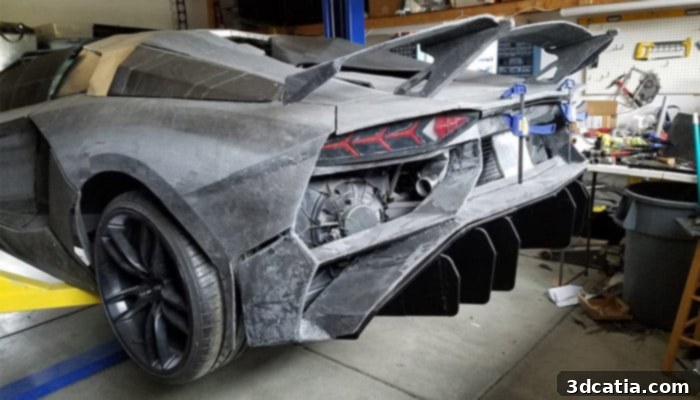
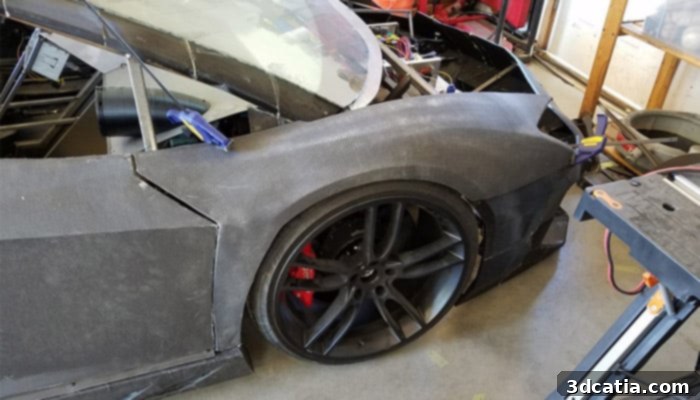
The selection of appropriate thermoplastic filaments was a critical aspect of the project, dictating the structural integrity, aesthetic quality, and durability of the finished vehicle. In total, an astonishing 220 spools of filament were consumed to construct the entire body of the supercar. A variety of materials were employed, each chosen for its specific properties tailored to the demands of individual components. PLA (Polylactic Acid) was the material of choice for the primary body panels due to its excellent dimensional stability and ease of printing, providing a smooth and accurate surface finish. For components requiring higher heat resistance and UV stability, such as the rear light housings and headlights, ASA (Acrylonitrile Styrene Acrylate) and ABS (Acrylonitrile Butadiene Styrene) were strategically used. These materials offer superior performance in outdoor environments, resisting warping and degradation from sun exposure. Furthermore, for interior parts that demanded exceptional strength and rigidity, carbon fiber-filled nylon was utilized. This composite filament provided the necessary structural integrity for critical internal components, demonstrating a thoughtful and engineering-driven approach to material selection. The printing process, as expected for a project of this scale, was not without its challenges and setbacks. Sterling candidly admits that approximately 50 spools of filament were dedicated to various tests, failed prints, and iterative design refinements, highlighting the experimental nature and persistent problem-solving required to achieve such a monumental feat.
Beyond the Printers: A Hybrid Manufacturing Approach
While 3D printing formed the core of their construction methodology, the father-son team wisely understood that a project of this complexity and scale necessitated a multifaceted approach. To achieve the desired level of strength, finish, and overall automotive quality, they integrated several traditional manufacturing processes alongside their additive methods. These included CNC machining for precision components, waterjet cutting for accurate material separation, vacuum infusion for composite fabrication, and advanced carbon fiber encapsulation for critical structural elements. Sterling Backus articulated their strategic reasoning: “We decided to use advanced technologies to build the car. However, we wanted to use low-cost options. This led us to researching different techniques of automobile construction. After choosing to use 3D printing for most of the car body, we needed solidity. Very few choices of heat stress resistant materials were compatible with our 3D printers; so we turned to encapsulation of 3D printed parts with carbon fiber.” This quote perfectly encapsulates their pragmatic approach, blending innovation with practicality. By encapsulating the 3D printed parts with carbon fiber, they effectively reinforced the structure, dramatically enhancing its rigidity, impact resistance, and thermal stability – crucial attributes for any vehicle, let alone a supercar replica. This hybrid manufacturing strategy not only compensated for the inherent limitations of home 3D printers in terms of material strength and heat resistance but also demonstrated a sophisticated understanding of engineering principles, resulting in a robust and visually impressive final product. The combination of digital fabrication and artisanal finishing techniques showcases a mastery of both modern and traditional craftsmanship, setting a new benchmark for DIY vehicle construction.
An Investment in Education and Innovation
Sterling Backus envisions his large-format project as far more than just a personal achievement; he intends for it to be a powerful educational tool. He plans to share his incredible creation with a broader audience, including local schools, as an integral part of their STEM (Science, Technology, Engineering, and Mathematics) programs. His ultimate goal is to ignite a spark of interest in children, drawing them into the captivating worlds of science, technology, engineering, and mathematics. What better way to capture a child’s imagination and attention than with a life-size, partially 3D printed Lamborghini Aventador? The sheer visual impact and tangible nature of the project serve as an unparalleled catalyst for curiosity and learning. The physicist fondly recollects the ambitious nature of the idea when he first embarked on it over a year ago with his son. Their commitment was unwavering, dedicating at least an hour each day to the project. Financially, the entire endeavor required an investment of just over $20,000 – a remarkably low figure when juxtaposed with the official Aventador’s starting retail price, which easily exceeds $300,000. This stark contrast highlights the incredible cost-effectiveness and accessibility that 3D printing can offer to passionate individuals. Sterling emphatically stated that he has no plans to sell the car, emphasizing that his motivation was not commercial or competitive with the original manufacturer. Instead, this project is a celebration of innovation, a testament to the power of dedication, and a hands-on lesson in advanced manufacturing made accessible. Sterling meticulously documents every step of their journey, sharing insights, challenges, and successes on his dedicated Facebook page, which can be found HERE, inviting others to learn and be inspired by their groundbreaking work.
The Legacy of a Home-Built Supercar
The 3D printed Lamborghini Aventador project spearheaded by Sterling Backus and his son stands as a monumental achievement, redefining the possibilities of personal manufacturing and large-scale 3D printing. It is a powerful narrative of ingenuity, perseverance, and the democratizing potential of technology. This project not only delivers an astonishing physical replica of a dream car but also serves as an educational beacon, inspiring future generations to engage with STEM fields through hands-on, impactful experiences. It challenges conventional notions of automotive production, demonstrating that with accessible tools, strategic material selection, and unwavering dedication, complex engineering feats can be accomplished outside industrial behemoths. The blending of additive manufacturing with traditional techniques showcases a holistic approach to problem-solving, yielding results that are both innovative and robust. As we look towards a future where personalized manufacturing becomes increasingly prevalent, projects like this illuminate the path forward, proving that the ultimate supercar might just be within reach, printed right in your own garage.
What are your thoughts on this groundbreaking 3D printed Lamborghini project? Share your opinions and insights with us in the comments section below or join the conversation on our Facebook and Twitter pages! Don’t miss out on the latest advancements and stories in the world of additive manufacturing – be sure to sign up for our free weekly Newsletter, delivering all the essential 3D printing news directly to your inbox!