

UAE Residents Champion 3D Printing: A National Commitment to Future Technology and Societal Benefit
In recent years, the evolution of 3D printing technology from a niche industrial tool to a more accessible, mainstream innovation has been undeniable. This burgeoning acceptance is particularly evident in the United Arab Emirates (UAE), where a recent YouGov survey has shed light on public perception regarding emerging technologies. The comprehensive study revealed that among sixteen cutting-edge technologies, UAE residents overwhelmingly identified 3D printing as the one most likely to deliver significant benefits to society. Furthermore, it was singled out as the top technology that citizens believe their government should prioritize for investment, underscoring a strong national confidence in additive manufacturing’s future.
For those unfamiliar with its operations, YouGov stands as a prominent international online research data and analytics technology group. With a substantial global footprint spanning the UK, the Americas, Europe, the Middle East, India, and the Asia Pacific region, the group proudly maintains one of the world’s largest research networks. For the purposes of this particular survey, YouGov strategically focused on the UAE, recognizing it as, in their own words, “one of the world’s leading hubs for technological advancement.” Data for the survey was meticulously collected online from a sample of 1,005 respondents between May 12th and 19th. While a sample poll cannot claim to be exhaustively representative of the entire UAE population, such surveys are carefully designed to capture and reflect broader societal trends and prevailing sentiments. The respondents engaged with a diverse set of questions, exploring their attitudes towards and levels of knowledge about a wide array of innovative fields. These included cryptocurrency, virtual reality (VR), self-driving cars, 3D printing, artificial intelligence (AI), blockchain, the metaverse, NFTs, augmented reality (AR), artificial organs, personal space travel, gene editing technology, lab-grown meat, quantum computing, implantable brain-machine interfaces (BMIs), and decentralized autonomous organizations (DAOs). This comprehensive scope allowed for a thorough comparative analysis of public opinion across various technological frontiers.
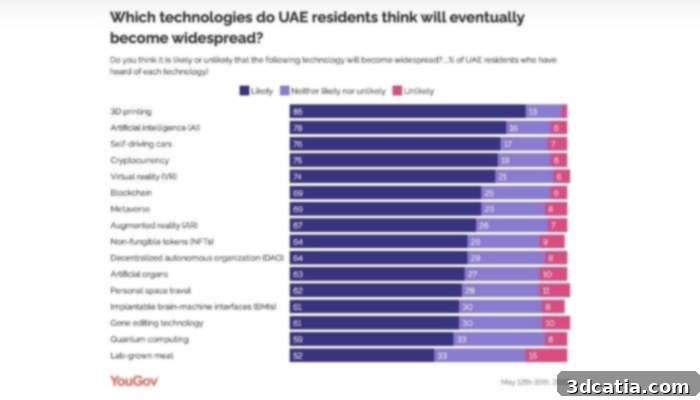
Image Credits: YouGov
How Do UAE Residents Perceive and Value 3D Printing?
Upon closer examination of the survey results, as depicted in the image above, it becomes clear that 3D printing was not the technology with which most UAE residents reported the highest level of familiarity. That particular distinction, perhaps not unexpectedly, was claimed by cryptocurrency, with a notable 50% of respondents indicating they knew “a lot” about it, 36% claiming “a little” knowledge, and only 14% admitting to knowing “nothing at all.” However, despite this, 3D printing lagged only slightly behind in terms of general awareness. Specifically, 44% of respondents stated they knew “a lot” about 3D printing, an even higher 47% reported knowing “a little,” and a mere 9% confirmed having “no knowledge at all.” This statistical breakdown suggests that, when combining those with significant and moderate knowledge, 3D printing might actually be slightly better known than cryptocurrency among the general populace. More importantly, in several other critical categories that gauge societal impact and strategic importance, 3D printing decisively secured the top position, demonstrating a deeper resonance beyond mere familiarity.
Crucially, when respondents were asked to identify technologies they believed would significantly benefit society and were poised to become widespread, 3D printing emerged as the unequivocal top choice. Of those who had prior knowledge of 3D printing, a staggering 85% deemed it “likely to become widespread,” with only 13% expressing uncertainty and a mere 2% considering it “unlikely.” To put this into perspective, artificial intelligence, which was the runner-up in this category, garnered belief in its widespread adoption from only 78% of respondents, highlighting 3D printing’s distinct lead. Similarly, regarding technologies perceived as “good for society,” 3D printing was endorsed by an impressive 83% of respondents, as illustrated in the accompanying image. Just 10% were unsure about its societal impact, and a minimal 7% held a negative view. In stark contrast to AI, which received the next highest percentage of “good” votes, 3D printing clearly demonstrated its exceptional relevancy and profound importance within the UAE context. This perception likely stems from its tangible applications in diverse sectors such as construction, healthcare, and manufacturing, promising concrete improvements in daily life and infrastructure.
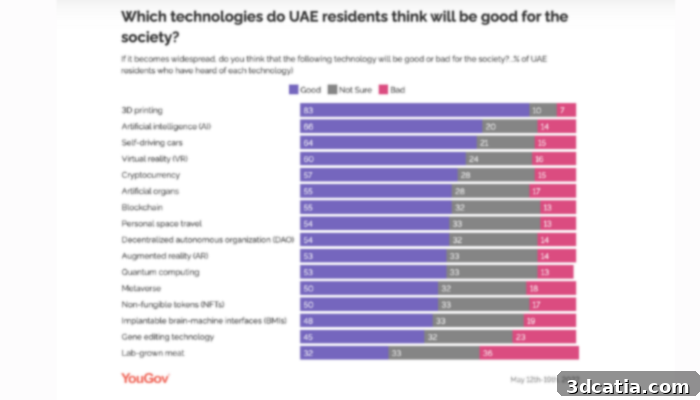
Image Credits: YouGov
The survey further solidified this sentiment when participants were directly posed the question: “Which technology do UAE residents feel the government should invest in?” The response was decisive, with over half (52%) of respondents emphasizing the critical importance of government investment in 3D printing. This public desire for investment resonates strongly with existing governmental initiatives and long-term strategic planning. Indeed, the UAE government has already demonstrated a proactive commitment to advancing additive manufacturing. In previous years, the nation has seen the successful implementation of numerous groundbreaking 3D printing construction projects, including an innovative plan to leverage 3D printing for efficient road maintenance and infrastructure development. A cornerstone of this national strategy is the Dubai 3D Printing Strategy, officially launched in April 2016. Its ambitious objective is to firmly establish Dubai as a global leader and pivotal hub for 3D printing technology by the year 2030, fostering innovation and economic diversification. Beyond construction, the government’s more recent endeavors have increasingly focused on the rapidly growing field of medical 3D printing. Significant interest and investment are being directed towards pioneering applications such as the creation of advanced artificial limbs and highly customized dental prosthetics in the coming years, showcasing a versatile approach to technological adoption.
The widespread enthusiasm for 3D printing among UAE residents is not merely anecdotal; it is a reflection of the technology’s tangible benefits across various sectors. In manufacturing, 3D printing facilitates rapid prototyping, allowing companies to quickly iterate and test designs, significantly reducing development cycles and costs. This capability is crucial for fostering an innovative ecosystem. For specialized industries, it enables the production of complex, customized parts with unprecedented precision, leading to performance enhancements and material efficiency. From an economic diversification standpoint, embracing 3D printing allows the UAE to move beyond traditional oil-based industries, creating new jobs and attracting foreign investment in high-tech sectors. Environmentally, additive manufacturing can contribute to sustainability by reducing material waste, optimizing designs for lighter components, and enabling localized production, thereby shortening supply chains and decreasing transportation emissions. Furthermore, its potential in education is immense, offering hands-on learning experiences that prepare the future workforce for advanced manufacturing roles. This comprehensive appeal is undoubtedly a key driver behind the public’s strong positive outlook.
In essence, this YouGov survey serves as a powerful testament to the escalating influence of 3D printing within the UAE. It unequivocally demonstrates that as more individuals gain exposure to and understanding of additive manufacturing, the recognition of its immense benefits across a diverse spectrum of sectors only continues to grow. This alignment between public perception and governmental strategy paints a promising picture for the future of 3D printing in the Emirates, positioning the nation at the forefront of technological innovation and application. The synergy between citizen confidence and governmental foresight ensures that the UAE will likely remain a vibrant testbed for 3D printing advancements, contributing significantly to both its national development goals and global technological progress. You can find out more about the detailed results of this insightful survey HERE.
What are your thoughts on the remarkable confidence UAE residents have placed in the potential of 3D printing? Share your insights and opinions in a comment below or engage with us on our Linkedin, Facebook, and Twitter pages! Don’t forget to sign up for our free weekly Newsletter here to receive the very latest 3D printing news directly to your inbox. You can also explore all our informative videos and engaging content on our dedicated YouTube channel.
*Cover Photo Credits: Pranjal Srivastava, CC0, via Wikimedia Commons