
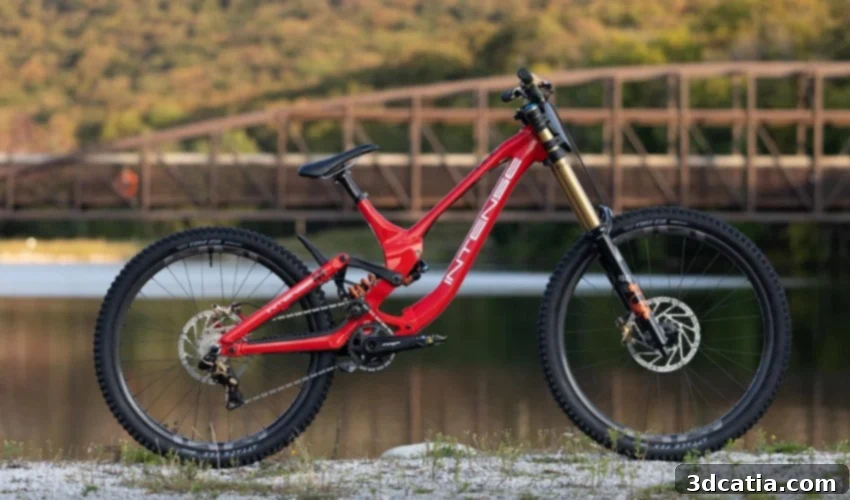
Revolutionizing Downhill Biking: The 3D Printed INTENSE M1 Sets New Performance Standards
For professional downhill mountain bikers and passionate enthusiasts alike, the demands placed on equipment are immense. Conquering steep descents, launching off massive drops, and navigating relentlessly unpredictable terrain requires not just skill and courage, but also exceptionally lightweight and durable biking gear. In this high-stakes environment, every gram saved and every ounce of structural integrity gained can significantly impact performance, safety, and the overall riding experience. For many years, INTENSE Cycles has been at the forefront of this demanding sport, with their iconic M1 downhill bike consistently leading the pack. However, in a bold move to push the boundaries of innovation even further, INTENSE has taken a significant leap forward, redefining what’s possible in bicycle design.
This transformative redesign of the INTENSE M1 is the result of a groundbreaking collaboration between two industry titans: TRUMPF, a global leader in laser technology and additive manufacturing, and Elementum 3D, renowned for its advanced metal additive manufacturing materials. At the heart of this innovation lies the strategic integration of additive manufacturing, more commonly known as 3D printing. INTENSE identified a critical need to enhance the bike’s already robust suspension system, a component vital for absorbing impacts and maintaining control during extreme downhill maneuvers. This vision necessitated a complete rethinking of the M1’s design, pushing beyond the limitations of conventional manufacturing methods to achieve unprecedented levels of performance and structural efficiency.
Central to this pioneering redesign effort was the development of an entirely new, 3D printed backbone, specifically targeting the bottom bracket foundation. In traditional manufacturing, the original M1 bottom bracket was a complex assembly, typically comprising multiple individual parts that were then welded, bolted, or bonded together. While effective, this multi-component approach inherently introduced potential points of weakness, increased assembly time, and limited design freedom. The engineering team at INTENSE, driven by a relentless pursuit of perfection, recognized the immense potential for improvement by consolidating this crucial structure. Their goal was to transform the bottom bracket into a single, monolithic piece crafted from high-strength 6061 Aluminum. This unified design promised to significantly enhance both the performance and the long-term durability of the entire suspension system, offering a more rigid, integrated, and responsive connection between key components.
However, the ambition of this single-piece design presented an insurmountable challenge for conventional manufacturing techniques. To achieve optimal strength-to-weight ratios and structural integrity under the extreme stresses of downhill riding, the design incorporated intricate internal ribbing and complex geometries. These sophisticated internal lattice structures are impossible to create with traditional subtractive methods like CNC machining or formative processes such as casting or forging, which are limited by tool access and material flow. This technological impasse forced INTENSE to look beyond the ordinary, paving the way for a revolutionary approach.
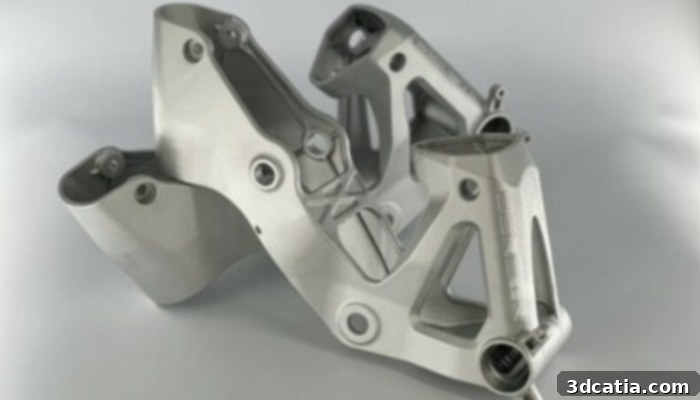
Completed 3D printed INTENSE M1 backbones, made from Elementum 3D’s A6061-RAM2 alloy.
This formidable manufacturing challenge ultimately led INTENSE to explore the cutting-edge capabilities of 3D printing as the definitive solution, culminating in their pivotal partnership with TRUMPF. TRUMPF’s extensive experience in 3D printing intricate bicycle parts, a field where they have consistently demonstrated their expertise, proved absolutely vital in overcoming the complex design hurdles. Their role extended beyond merely providing technology; TRUMPF acted as a key strategic advisor, recommending the optimal material choice – 6061 Aluminum – and leveraging their network to connect with Elementum 3D for the specialized material delivery. Elementum 3D’s A6061-RAM2 alloy, specifically engineered for additive manufacturing, offered the perfect blend of strength, ductility, and printability required for such a high-performance application. Through a rigorous process of iterative design, simulation, and comprehensive prototype testing, a revolutionary 3D printed backbone bottom bracket was successfully produced. This innovative component not only met the stringent performance and durability expectations set by INTENSE but, remarkably, exceeded them, signaling a new era for downhill mountain bike engineering.
The resulting 3D printed backbone bracket showcased a profound improvement over its traditionally manufactured counterparts. It delivered demonstrably superior strength, crucial for resisting the immense forces encountered during extreme downhill riding, while simultaneously achieving a significant weight reduction. This dual benefit of enhanced strength and reduced mass directly translates to a more agile, responsive, and ultimately faster bike, giving riders a competitive edge. Furthermore, the advanced additive manufacturing process employed ensured the component exhibited no porosity or contamination issues, critical factors for maintaining structural integrity and preventing fatigue failure over time. Despite its complex internal structure and innovative manufacturing method, the 3D printed part surprisingly maintained high weldability, allowing for seamless integration into the overall bike frame assembly and offering flexibility for future repairs or modifications. In fact, such was the precision and quality of the final product that, when compared to conventionally machined parts, it is reportedly almost impossible for an untrained eye to distinguish which bracket was created through additive manufacturing.
Reflecting on this highly successful and impactful collaboration between TRUMPF and Elementum 3D, INTENSE Founder and CEO Jeff Steber shared his enthusiasm: “I’m immensely thankful for the exceptional work TRUMPF and Elementum 3D provided. Their invaluable guidance, cutting-edge technology, and profound material expertise played an absolutely critical role in successfully bringing our new M1 to fruition. I am incredibly happy to report that the redesigned M1 went on to finish an impressive 2nd at the highly competitive 2023 UCI Cycling World Championships. This achievement is a testament to the power of innovation and what can be accomplished when leading experts collaborate.” This podium finish at a world-class event unequivocally validates the performance benefits and reliability of the 3D printed component, proving its mettle under the most demanding racing conditions.
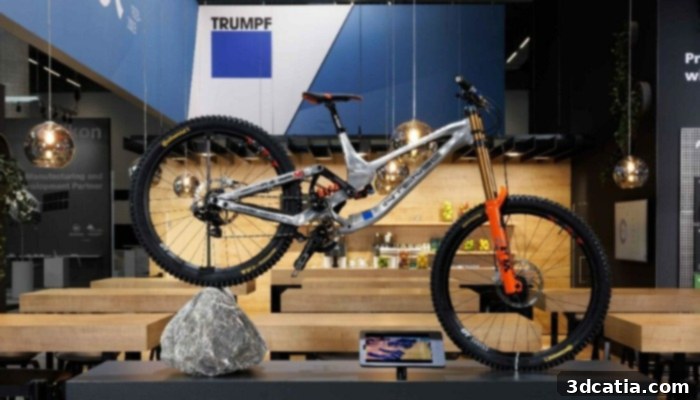
Display of the new INTENSE M1 prototype at TRUMPF’s Formnext 2023 booth, showcasing the innovative 3D printed components.
The resounding success of this project extends far beyond a single bike model; it has fundamentally paved the way for future innovations across the entire spectrum of bike frame production. This is an area where additive manufacturing has already demonstrated significant growth in recent years, with numerous manufacturers exploring its potential. Capitalizing on this pioneering achievement, INTENSE plans to fully integrate additive manufacturing into its prototyping process, accelerating design cycles and allowing for more rapid iteration and testing of new concepts. Furthermore, the company is actively exploring broader opportunities to utilize 3D printing for other production parts across its bicycle range, envisioning a future where lightweight, high-performance custom components are the norm. Parallel to this, TRUMPF is committed to increasing its usage of Elementum 3D’s advanced aluminum alloy, recognizing the profound benefits its specialized material properties offer for a wide array of high-performance 3D printing applications, extending beyond just the cycling industry. This collaboration marks a significant milestone, showcasing how advanced materials and manufacturing techniques can revolutionize product design and performance. To delve deeper into the specifics of the new M1 design and the technological breakthroughs involved, click here.
What are your thoughts on this innovative implementation of a 3D printed backbone in the new INTENSE M1? Do you believe additive manufacturing will become standard in high-performance mountain bikes? Let us know your opinions in a comment below or join the conversation on our LinkedIn, Facebook, and Twitter pages! Don’t miss out on the latest advancements in additive manufacturing – remember to sign up for our free weekly newsletter here, delivering the freshest 3D printing news straight to your inbox! You can also find all our compelling videos on cutting-edge 3D printing applications on our YouTube channel.
*All Photo Credits: Intense Cycles