
Revolutionizing Construction: NTU Singapore Pioneers 3D Printing with Recycled Glass for a Sustainable Future
In an era defined by pressing environmental concerns, the quest for sustainable manufacturing and construction solutions has become a paramount challenge across virtually every industry. Global warming, resource depletion, and burgeoning waste streams compel innovators to reimagine traditional processes and materials. In response to this critical need, a groundbreaking development has emerged from Nanyang Technological University (NTU Singapore), where a team of dedicated researchers has unveiled a novel method for utilizing recycled glass as a primary material for 3D printing. This pioneering initiative represents a significant stride towards fostering a more circular economy, offering a viable pathway to transform production paradigms and create environmentally friendly components for everyday objects and large-scale structures alike.
The NTU Singapore research team’s choice of glass as a foundational material for their additive manufacturing process is strategic and deeply rooted in its inherent sustainability. Glass stands out as a uniquely advantageous material because it can be recycled endlessly without any degradation in its quality or structural integrity. This infinite recyclability positions it as a perfect candidate for a circular economy, drastically reducing the demand for virgin resources and minimizing waste generation. The innovation directly addresses the growing global problem of sand scarcity, a critical construction material whose extraction is environmentally destructive, leading to habitat loss, coastal erosion, and significant pollution. By substituting sand with recycled glass in their 3D printing mixtures, the NTU team offers an ingenious solution that tackles both waste management and resource conservation simultaneously.
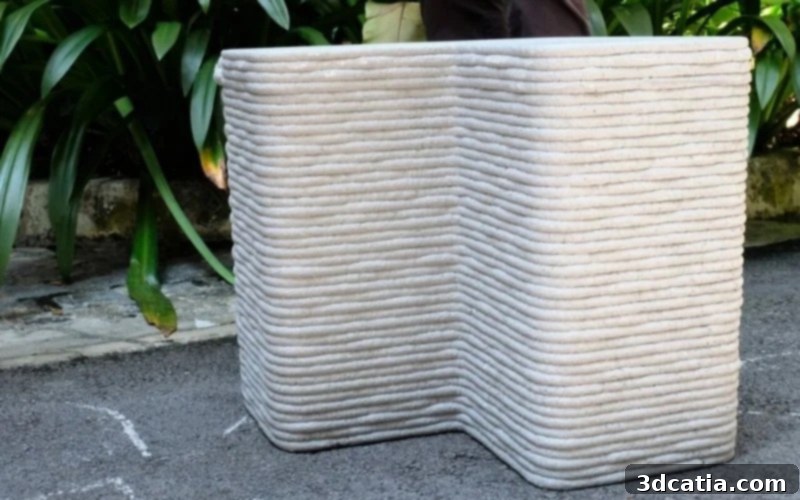
The success of their research was vividly demonstrated through the 3D printing of a sturdy L-shaped bench, a testament to the viability of their concrete-glass composite. Professor Tan Ming Jen, the lead researcher from NTU’s School of Mechanical and Aerospace Engineering (MAE), elaborated on the intricate challenges overcome during the project. He explained, “The main challenge in formulating 3D-printable concrete mixtures is to figure out just how much of each component to add to obtain a structurally sound structure with minimal defects. Our team has come up with a feasible formula, demonstrating for the first time that glass can indeed be used to 3D-print a bench with excellent structural integrity.” This statement underscores the rigorous scientific approach required to balance material properties, printability, and final product strength, marking a significant breakthrough in sustainable construction materials and additive manufacturing. The team’s meticulously developed formula not only showcases the functional potential of recycled glass but also sets a new benchmark for material innovation in construction.
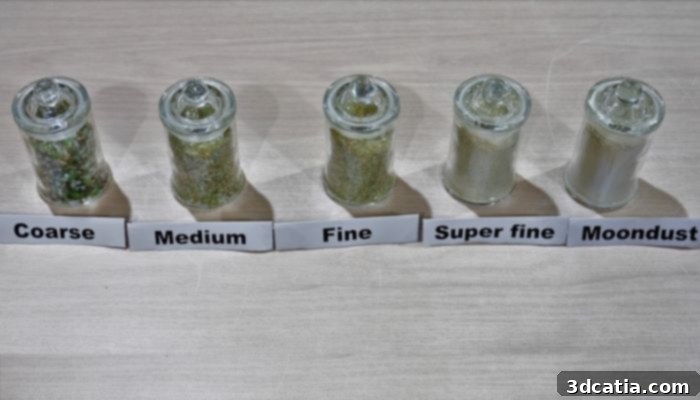
The components of the mix include recycled glass of various sizes (medium, fine and superfine), commercial cement, water and other additives (photo credits: NTU)
An Eco-Friendly Alternative to Traditional Building Materials and Practices
The primary objective of this visionary project is to fundamentally alter the composition of concrete by replacing sand, a non-renewable resource, with an abundant, recycled alternative: glass. The successful fabrication of the 3D-printed bench unequivocally proves that a complete substitution of sand is not only possible but also yields structures with impressive structural integrity. To achieve this, the researchers meticulously conducted an extensive series of tests, precisely calibrating the optimal parameters for their recycled glass concrete mix. This iterative process ensured the material’s printability, workability, and ultimately, the mechanical performance of the final product. A notable advantage of incorporating glass, beyond its recyclability, lies in its hydrophobic nature. This characteristic significantly reduces the amount of water required in the concrete mixture, a crucial factor given that conventional concrete production is highly water-intensive. Lower water content not only makes the mix more environmentally friendly but can also positively impact the curing process and reduce shrinkage, leading to more stable and durable printed structures.
The fabrication of the prototype bench leveraged a sophisticated 4-axis 3D printer, boasting a substantial printing volume of 1.2 meters by 1.2 meters by 1 meter. The choice of a 4-axis system over a standard 3-axis printer offers enhanced flexibility and precision, allowing for more complex geometries and smoother surface finishes, which are crucial for architectural and structural applications. While the initial demonstration focused on a piece of furniture, the long-term vision of the NTU scientists extends far beyond. They aspire to democratize this innovative 3D printing process throughout the entire construction sector, envisioning a future where entire buildings, infrastructure components, and various architectural elements are constructed using this sustainable method. To accelerate this ambitious goal and transition from laboratory success to industrial application, the NTU research team has forged a strategic partnership with Soda Lemon, a Singaporean start-up specializing in advanced construction technologies. This collaboration is set to focus on scaling up the process to 3D print significantly larger structures and continuously optimize the printing methodology for efficiency, cost-effectiveness, and broader material compatibility. Such partnerships are vital for translating academic breakthroughs into tangible, real-world solutions that can drive widespread adoption and impact.
The implications of this research are profound. By integrating recycled glass into 3D printable concrete, NTU Singapore is not only addressing the environmental footprint of construction materials but also paving the way for more resilient and resource-efficient building practices. The potential to reduce the reliance on virgin sand, a finite resource under immense pressure, offers significant ecological benefits, mitigating issues like riverbed degradation and marine ecosystem disruption caused by sand mining. Furthermore, the ability to repurpose vast quantities of waste glass, which would otherwise end up in landfills, transforms a linear waste model into a circular one, adding economic value to discarded materials. This innovation has the capacity to usher in a new era of green construction, where sustainability is engineered into the very foundation of our built environment. The partnership with Soda Lemon aims to refine the material properties, develop robust print path generation algorithms, and conduct comprehensive structural integrity tests on larger-scale components. This collaborative effort could significantly reduce construction waste, lower carbon emissions associated with cement production (by potentially enabling leaner mixes due to glass’s properties), and offer design freedom previously unattainable with traditional construction methods. You can find out more about this exciting development HERE.
What are your thoughts on this innovative solution from Nanyang Technological University in Singapore? Do you foresee recycled glass becoming a cornerstone material in future sustainable construction projects? We’d love to hear your insights! Let us know your opinions in a comment below or join the discussion on our Linkedin, Facebook, and Twitter pages! Don’t miss out on the latest advancements and breaking news in additive manufacturing by signing up for our free weekly Newsletter here, delivered straight to your inbox! You can also explore all our comprehensive video content and interviews on our dedicated YouTube channel.
*Cover Photo Credits: NTU Singapore – Showcasing the innovative spirit and commitment to sustainability at the university.