

Additive Manufacturing Technologies (AMT): Scaling Industrial 3D Printing Through Advanced Post-Processing Automation
The landscape of additive manufacturing is continuously evolving, driven by significant technological advancements in materials science and production processes. As 3D printing gains wider acceptance and consolidation across diverse application sectors, its potential for industrial-scale production becomes increasingly evident. However, realizing this potential hinges on overcoming a critical bottleneck: post-processing. This crucial phase, often overlooked in the early days of 3D printing, is now recognized as essential for transforming raw 3D printed parts into functional, high-performance components. Among the pioneers addressing this challenge is Additive Manufacturing Technologies (AMT). Founded in 2017, AMT specializes in innovative post-treatment systems designed to enhance the performance of 3D printed parts and enable their integration into industrial manufacturing workflows. We recently had the opportunity to speak with AMT’s visionary founder and CEO, Joseph Crabtree, to delve into their patented technologies and understand his perspective on the current state and future direction of the additive manufacturing industry.
Joseph Crabtree on the Genesis of AMT: Addressing 3D Printing’s Hidden Challenge
 Joseph Crabtree, CEO and founder of AMT, brings a unique perspective to the additive manufacturing world. A material scientist by training – a background he notes is increasingly common among 3D printing company CEOs – Crabtree spent years immersed in traditional manufacturing methods such as injection molding, CNC machining, and forging. This deep understanding of conventional production processes profoundly shaped his approach when he ventured into 3D printing in 2017. His primary motivation was to identify how 3D printing could genuinely transform into a viable, scalable manufacturing technology, rather than remaining a niche prototyping tool.
During his initial deep dive into the additive manufacturing ecosystem, Crabtree observed a clear industry trend: most companies were intensely focused on printer hardware development or expanding the range of available materials. While these areas were undeniably important, a significant void existed. “Everything after the printing process was not being discussed or addressed,” Crabtree recalls. This recurring theme highlighted a critical, yet neglected, aspect of the production chain. For Crabtree and his team, this represented an obvious and compelling opportunity to establish a company dedicated to providing comprehensive solutions for post-processing. They recognized that without effective and efficient post-treatment, the promise of industrial 3D printing would remain largely unfulfilled.
Compatibility and Focus: Empowering Thermoplastic Polymers
AMT’s post-processing solutions are primarily engineered for thermoplastic polymers, particularly those utilized in powder bed fusion processes. Crabtree explains that this strategic focus is due to powder bed fusion’s current leadership in industrializing additive manufacturing. When companies seek to produce parts in industrial volumes using AM, they predominantly turn to powder bed fusion and thermoplastic polymers because these technologies offer the necessary robustness, speed, and material properties for demanding applications.
While polymers currently constitute AMT’s core focus, the company holds extensive intellectual property (IP) and patents covering metals and thermoset polymers. This foresight suggests a future expansion into these additional material categories, underscoring AMT’s ambitious mission: to provide post-processing solutions for every single 3D-printed part, regardless of material or technology. This broad vision positions AMT as a potential universal enabler for the widespread adoption of additive manufacturing across various industries.
Comprehensive Solutions for Diverse Users: From Bureaus to Blue-Chips
AMT’s innovative post-processing technologies cater to an exceptionally wide array of customers. Their clientele spans various industries, geographical locations, and company sizes – ranging from small service bureaus that provide 3D printing services to very large, multinational blue-chip corporations. This broad appeal is a testament to the versatility and scalability of AMT’s technology portfolio, which can be tailored to meet diverse industrial requirements.
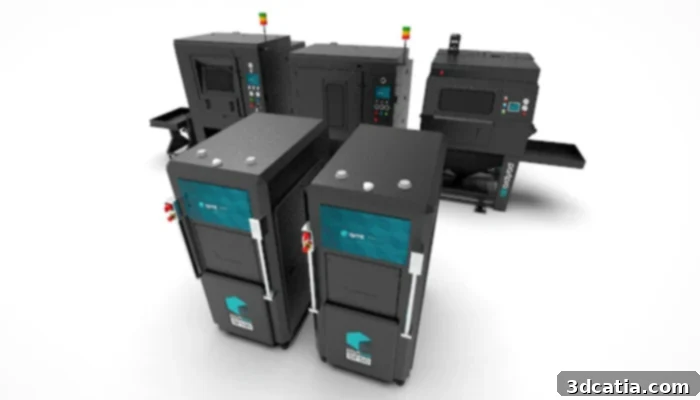
The company’s offerings are built around two core processes: depowdering (or cleaning) and chemical vapor smoothing. Crabtree describes depowdering as a “necessary evil” – an indispensable precursor to any subsequent post-processing step. Every 3D printed part, especially those produced via powder bed fusion, requires thorough cleaning to remove residual powder. Recognizing a gap in effective cleaning solutions, AMT developed its own proprietary technologies in this domain. This meticulous cleaning prepares parts for AMT’s flagship process: chemical vapor smoothing, branded as PostPro SF for Surface Finishing.
The PostPro SF technology is designed to transform a raw, porous 3D printed part into an end-use component that closely mimics the aesthetic and performance characteristics of traditionally manufactured parts, such as those produced through injection molding. It achieves this by delivering a smooth, sealed surface finish, improving mechanical properties, and enhancing overall part durability. The success of their vapor smoothing technology underscored the critical need for integrated cleaning solutions, leading to the development of their comprehensive depowdering systems. Moving forward, AMT anticipates its primary focus will be on facilitating high-volume additive manufacturing, ensuring that their solutions can meet the demands of true industrial production at scale.
Pioneering Automation: The Digital Manufacturing System (DMS)
From its inception, AMT has firmly believed that the commercial viability of 3D printing and additive manufacturing hinges on the elimination of manual steps and human intervention. This vision extends beyond post-processing to encompass the entire workflow: materials handling, the printing process itself, and subsequent post-treatment. To achieve this ambitious goal, AMT developed what they call their Digital Manufacturing System (DMS) – a comprehensive, end-to-end workflow designed for full automation. While individual modules of AMT’s technology are available, the ultimate objective is the seamless automation of the entire process from start to finish.
This vision has already become a reality, with companies across the USA, Europe, and Asia actively utilizing AMT’s fully automated systems today. Crabtree emphasizes that full automation is not a novel concept in traditional manufacturing; processes like injection molding, forging, and CNC machining are fully automated at scale. In this context, 3D printing is merely playing catch-up. AMT’s DMS represents a significant leap forward, positioning additive manufacturing to achieve the same levels of efficiency, repeatability, and cost-effectiveness that define established industrial production methods. By automating every step, AMT is helping to remove barriers to widespread industrial adoption, making 3D printing a more reliable and competitive manufacturing option.
Addressing Remaining Challenges: Education, Integration, and Standardization
Despite the remarkable progress in additive manufacturing, several significant challenges persist, particularly in the realm of post-processing. Joseph Crabtree highlights education as one of the biggest hurdles. Five years ago, post-processing was an afterthought, largely ignored or misunderstood. While it has since emerged as a critical topic of discussion and is more widely recognized, a knowledge gap still exists. Many newcomers to 3D printing mistakenly believe it’s as simple as feeding material into a printer, underestimating the complexity of achieving a final, functional part. This necessitates ongoing educational efforts to help the market and general populace fully grasp the intricacies and importance of comprehensive post-processing.
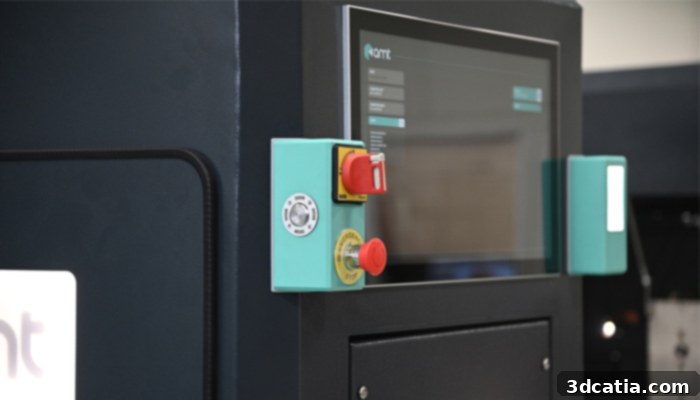
Another substantial challenge lies in the seamless integration of disparate components – physical machines, software, materials, and processes – into a cohesive system. Unlike other mature industries where integrated solutions are common, 3D printing often requires users to source multiple products from different vendors and then attempt to integrate them. This complexity is compounded when considering specific end markets such as aerospace or medical, which demand stringent specifications and rigorous validation. While extensive information and validation exist for 3D printing and materials in these sectors, post-processing often remains a “black hole” of undefined standards and processes. To address this, AMT is actively engaged with organizations like ASTM International, collaborating to establish clear industry standards and defined specifications for post-processing techniques. This commitment to standardization is crucial for driving correct technology adoption and ensuring reliability and safety in critical applications.
AMT’s Future: Real-World Automated Production Lines
Joseph Crabtree offered an exciting glimpse into AMT’s immediate future, underscoring the shift from theoretical concepts to tangible, industrial-scale implementations. The long-term vision of an end-to-end automated Digital Manufacturing System is now manifesting in significant real-world projects. One such collaboration is with Custom Color in the USA, a company developing a new consumer product involving high-volume custom figurine production. AMT is currently in the process of developing and installing complete end-to-end process lines for this venture.
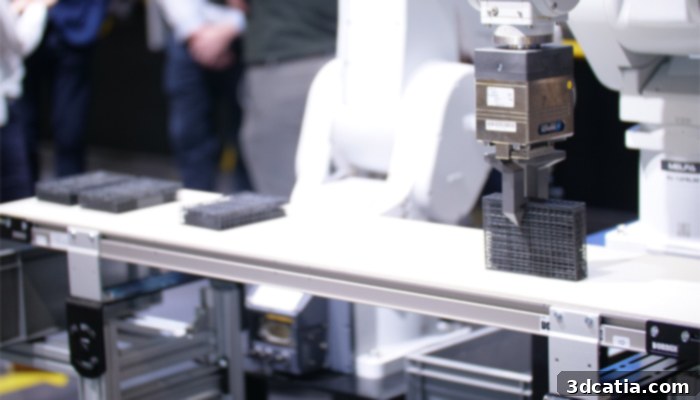
This project involves orchestrating multiple industrial HP printers, automating the entire workflow from the moment a part exits the printer to its final packaging and preparation for customer delivery. These automated lines are not merely prototypes; they are operational, demonstrating the practical application of AMT’s vision for industrial 3D printing. Furthermore, AMT is engaged in another major project closely linked to the automotive industry. This initiative involves delivering a comprehensive end-to-end system that encompasses all stages of part processing, including unpacking, depowdering, chemical vapor smoothing, coloring, precise part sorting, and thorough inspection. This advanced system is slated for delivery to automotive customers later this year.
Crabtree proudly notes that in 2022, AMT will be showcasing a fully automated end-to-end workflow – from live printing to final part collection – at industry exhibitions. This represents the culmination of six years of intensive research and development, a powerful testament to AMT’s commitment to industrializing additive manufacturing and transforming it into a seamless, high-volume production method.
The Future of 3D Printing: A Focus on Manufacturing
In his concluding remarks, Joseph Crabtree shared a profound outlook for the additive manufacturing industry over the next three years: the unequivocal focus must be on manufacturing. Having navigated various hype cycles, he believes the industry’s ultimate success lies in transcending the novelty factor of 3D printing. The goal is to elevate 3D printing to a level where it is seamlessly integrated and utilized alongside other conventional manufacturing technologies within the same factory environments.
Achieving this integration and widespread industrial adoption is, for Crabtree, the true measure of success. It signifies that the industry has collectively done its job – transforming 3D printing from an innovative curiosity into a robust, reliable, and indispensable tool in the global manufacturing landscape. As AMT continues to push the boundaries of post-processing automation and standardization, it plays a pivotal role in realizing this vision, ensuring that additive manufacturing lives up to its immense potential as a core pillar of modern industrial production. To learn more about AMT and their transformative solutions, visit their website HERE.
What are your thoughts on AMT’s innovative solutions for post-processing and the future of industrial 3D printing? Share your insights in a comment below or connect with us on our LinkedIn, Facebook, and Twitter pages! Don’t forget to sign up for our free weekly Newsletter here to receive the latest 3D printing news straight to your inbox! You can also find all our videos on our YouTube channel.
*All Photo Credits: AMT