
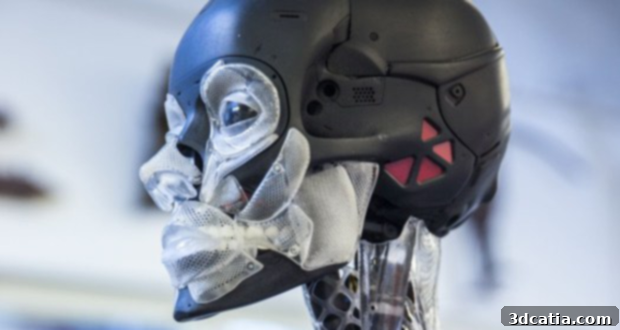
Bringing Cybernetic Dreams to Life: How 3D Printing Revolutionized Ghost in the Shell’s Iconic Robot Skeleton
The landscape of modern industry has been irrevocably reshaped by the advent of 3D printing, or additive manufacturing, which has found applications across diverse sectors, from construction and automotive to groundbreaking medical innovations. This transformative technology has enabled the creation of everything from fully functional homes and intricate prototypes to advanced components for rockets and personalized prosthetics. As the boundaries of what’s possible with 3D printing are continually pushed, its influence has begun to permeate even the most unexpected industries. It’s no surprise, then, that the magic-making realm of Hollywood has enthusiastically embraced this technology, integrating it into the production of high-profile films. A standout example of this innovative adoption is seen in the highly anticipated live-action adaptation of Masamune Shirow’s globally acclaimed manga and anime, *Ghost in the Shell*, where 3D printing played a critical role in bringing its futuristic vision to the big screen.
As the film geared up for its theatrical release, anticipation was high, especially regarding how its iconic cyberpunk aesthetic would translate into a live-action experience. For fans and industry observers alike, one of the most intriguing aspects was the creation of Major Motoko Kusanagi’s sophisticated robot skeleton, portrayed by Scarlett Johansson. Rather than relying solely on computer-generated imagery (CGI), the filmmakers, in collaboration with industry-leading special effects studio Weta Workshop, opted for a groundbreaking blend of practical effects and cutting-edge 3D printing. This strategic choice was made to imbue the Major’s cybernetic form with unparalleled realism and a tangible presence, showcasing the potential of additive manufacturing to elevate cinematic storytelling.
Adam Savage admiring Major Kusanagi’s exquisitely crafted robot skeleton, a testament to practical effects.
A Masterpiece of Practical Effects: Blending Tradition with Innovation
The meticulously engineered robot skeleton, a central element of the film, garnered high praise from none other than Adam Savage, renowned for his expertise in prop-making and his role on *MythBusters*. Savage, deeply impressed by the prop’s intricacy and realism, lauded it as a “masterpiece.” This recognition highlights a significant shift in Hollywood’s approach, moving beyond an over-reliance on purely computer-generated imagery towards a path that integrates digital fabrication with traditional craftsmanship, resulting in more lifelike and physically present effects. The skeleton itself was not a monolithic creation but a complex assembly, meticulously crafted from over 300 interconnected components. This intricate construction involved a sophisticated blend of 3D printed parts, precisely laser-cut elements, and expertly hand-modeled sections, demonstrating a multi-faceted approach to prop creation that leverages the best of both worlds.
The decision to create such a detailed physical prop, rather than relying solely on digital models, underscores a growing appreciation for practical effects in an era dominated by CGI. Practical elements provide a tangible quality that enhances the realism of a scene, allows for direct interaction with actors, and often produces a more authentic visual impact on screen. For a character like Major Kusanagi, whose existence blurs the lines between human and machine, a physical representation of her internal structure was crucial for conveying the narrative’s core themes. This blend of techniques allowed Weta Workshop to achieve an unprecedented level of detail and mechanical authenticity, pushing the boundaries of what’s achievable in contemporary film production.
Inside the Skeleton: Materials and Manufacturing Excellence
Delving into the technical specifics of this extraordinary prop, Jerad Haley, a skilled technician from Weta Workshop, offered valuable insights during his discussion with Adam Savage. He explained the diverse array of materials and manufacturing processes that contributed to the skeleton’s formidable structure and intricate aesthetics. “What you’re looking at is a collection of, basically, 3D printed objects,” Haley elaborated. “There’s clear resin, black resin; there’s laser cut components, model made components, 3D printed steel joints to keep the strength, and we 3D printed nylon for some of the limbs as well to keep the shape.” This statement reveals the strategic material selection, where each component was chosen for its specific properties to fulfill a particular functional or aesthetic requirement.
The use of different resins for 3D printing allowed for varied visual effects and structural integrity. Clear resin likely contributed to the transparent or translucent elements, hinting at the Major’s synthetic yet complex internal workings, while black resin provided solid, opaque sections. The integration of laser-cut components offered precise, flat geometries, complementing the organic curves and complex forms achievable with 3D printing. Crucially, the inclusion of 3D printed steel joints addressed the need for exceptional strength and durability in critical articulation points, ensuring the prop’s structural integrity and dynamic capabilities. For flexible or lightweight parts requiring specific contours, 3D printed nylon was employed, offering a balance of resilience and form retention for elements like the limbs. This multi-material, multi-process approach is a hallmark of advanced prop design, leveraging the strengths of each technique to create a seamless and visually stunning final product that would be difficult, if not impossible, to achieve with a single manufacturing method.
A closer, intricate look at the robot skeleton, revealing its numerous individual components and diverse material textures.
The Rigorous Design and Production Journey at Weta Workshop
The journey from concept to a tangible masterpiece was far from straightforward. The Weta Workshop team embarked on an intensive month-long period dedicated solely to testing various materials and iterating on designs before arriving at the final product. This meticulous prototyping phase was essential to ensure that the chosen materials and fabrication methods could withstand the demands of film production while achieving the desired aesthetic and mechanical functionality. Throughout this rigorous process, Director Rupert Sanders maintained a significant hands-on presence, physically overseeing much of the development. His direct involvement and oversight of every minute detail were crucial in ensuring that the prop perfectly aligned with his vision for the film and the character, maintaining creative fidelity from the initial sketches to the final assembly.
The actual 3D printing of the individual pieces required hundreds of hours of dedicated machine time, given the sheer volume and complexity of the components. With somewhere between 300 and 400 distinct parts, the additive manufacturing process was a cornerstone of the production. The Weta team utilized a sophisticated Computer-Aided Design (CAD) file, developed entirely in-house, as the blueprint for these components. This in-house CAD expertise was pivotal, allowing them to translate intricate digital designs into physical objects with incredible precision and consistency. By having complete control over the digital model, they could optimize each part for 3D printing, ensuring that their creative vision could be efficiently and accurately turned “into something that can be manufactured.” This seamless integration of digital design and advanced manufacturing techniques truly exemplifies the innovative spirit driving modern prop creation.
Beyond the Core Skeleton: Enhancing Character Silhouette with 3D Printing
The innovation didn’t stop at the intricate robot skeleton. The Weta Workshop team extended the application of 3D printing to create an entire exoskeleton for the character. This additional, full-body structure was ingeniously designed to fit within a layer of ballistic gel, which itself was also 3D printed. This layered approach served a critical purpose: to precisely sculpt and define the character’s unique silhouette for filming. The ability to 3D print both the exoskeleton and the ballistic gel offered unprecedented control over the shape, texture, and physical properties of the character’s outer shell, allowing filmmakers to achieve a specific aesthetic that would have been incredibly challenging, if not impossible, with traditional methods. This demonstrates the versatility of 3D printing, not just for internal mechanisms but for creating complex external forms that contribute significantly to a character’s visual identity and presence on screen.
Practical Effects vs. CGI: The Enduring Appeal of Tangible Realism
The creation of Major Kusanagi’s robot skeleton for *Ghost in the Shell* serves as a powerful testament to the enduring value of practical effects in an industry often seen as fully embracing CGI. While computer-generated imagery offers boundless possibilities for fantastical landscapes and impossible creatures, practical effects provide a tangible authenticity that can deeply resonate with audiences. A physical prop, crafted with such meticulous detail, brings a unique realism to the screen that even the most advanced CGI can struggle to replicate perfectly. Actors can interact directly with practical elements, lending a more natural performance, and the way light reflects off a real surface often possesses a quality that is difficult to fake digitally. For a film like *Ghost in the Shell*, which explores profound questions of identity, humanity, and the merging of flesh and machine, having a physical representation of the Major’s inner workings was crucial. It grounds the fantastical elements in a palpable reality, enhancing the audience’s immersion and emphasizing the tactile, albeit synthetic, nature of her existence. This project brilliantly showcased how 3D printing can bridge the gap between imagination and tangible reality, offering filmmakers new tools to create compelling, believable worlds.
The Future of 3D Printing in Hollywood: A New Era of Filmmaking
The successful implementation of 3D printing in *Ghost in the Shell* is more than just a single case study; it signals a potential paradigm shift in Hollywood’s approach to prop design, set fabrication, and special effects. The capabilities of additive manufacturing—such as rapid prototyping, the creation of incredibly complex geometries, customized fitting, and the use of diverse materials—are perfectly suited for the demands of film production. From intricately detailed costumes and unique weapons to bespoke creature parts and architectural miniatures, 3D printing offers speed, precision, and cost-effectiveness that can revolutionize various stages of filmmaking. Directors and prop masters can now iterate designs faster, experiment with different forms, and produce highly intricate pieces that would be prohibitively expensive or time-consuming with traditional methods. As the technology continues to advance, becoming more accessible and capable of working with an even wider range of materials, its footprint in Hollywood is only expected to grow, ushering in an exciting new era where the line between digital concept and physical reality becomes increasingly blurred.
For those eager to delve deeper into this fascinating process, check out Adam Savage’s compelling interview with the brilliant minds at Weta Workshop below:
And for an even more in-depth, behind-the-scenes look at the intricate details and overall construction of the Major’s iconic skeleton, be sure to watch the comprehensive video featurette below:
As we witness these incredible advancements, the question arises: Do you believe 3D printing is poised to become an indispensable staple in the world of Hollywood films, transforming how stories are told and visual spectacles are created? Share your thoughts and insights with us in a comment below, or join the conversation on our Facebook page and Twitter feed!