
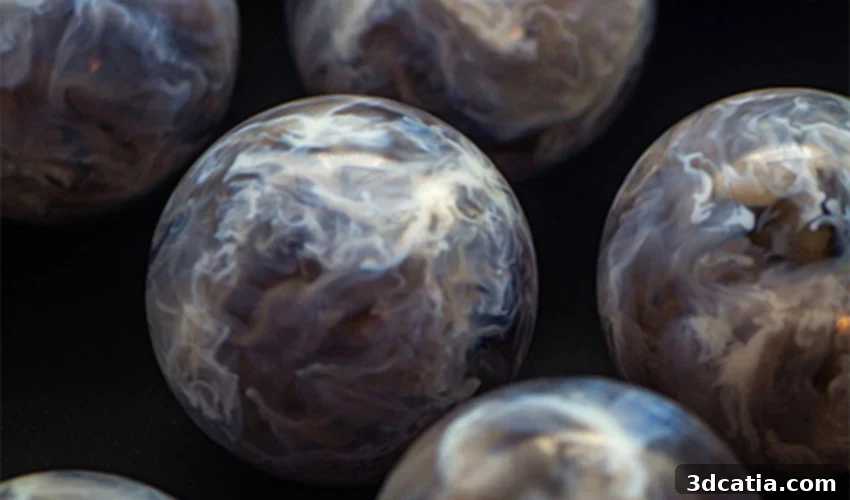
3D Printed Stellar Nurseries: Revolutionizing Star Formation Research and Space Exploration
The nexus between 3D printing and space exploration has grown increasingly strong in recent years. Additive manufacturing, with its unparalleled ability to create complex geometries and functional prototypes, has proven itself invaluable across a spectrum of interstellar applications. From fabricating critical components for spacecraft and enhancing the efficiency of satellites to the ambitious long-term vision of constructing habitats on other planets, 3D printing is at the forefront of pushing humanity’s cosmic boundaries. This transformative technology extends its reach far beyond mere hardware, now offering profound insights into the very origins of the universe itself.
In a groundbreaking application that bridges the gap between terrestrial innovation and celestial mysteries, astrophysicist Nia Imara and her dedicated team have leveraged advanced 3D technologies to meticulously study the enigmatic process of star creation. This intricate phenomenon occurs within vast cosmic structures known as molecular clouds or, more poetically, stellar nurseries. By transforming complex astrophysical data into tangible, 3D printed stellar nurseries, scientists aim to achieve an unprecedented understanding of how stars are born, the precise conditions required for their formation, and the dynamic forces that shape these spectacular cosmic events. This innovative approach promises to unlock secrets that have long eluded traditional two-dimensional visualization methods.
Bridging the Gap: From Stellar Simulations to Tangible Models
The journey to creating these intricate models began with high-resolution data derived from cutting-edge stellar nursery simulations. These simulations, often running on powerful supercomputers, generate enormous datasets that describe the density, temperature, velocity, and chemical composition of gas and dust within molecular clouds. However, interpreting this deluge of multi-dimensional data in a meaningful way has historically presented a significant challenge. Traditional visualization techniques, often confined to flat screens, struggle to convey the intricate, interwoven structures and dynamic processes inherent in these vast cosmic phenomena. Researchers frequently find themselves grappling with the limitations of projecting three-dimensional information onto a two-dimensional surface, leading to potential misinterpretations or, worse, the complete oversight of crucial details.
Nia Imara and her collaborators recognized this inherent limitation and sought a more intuitive approach. By modeling the simulation data and then translating it into physical 3D prints, they effectively broke free from the constraints of digital screens. John Forbes, an astrophysicist who played a crucial role in this project, eloquently articulated the dual benefit of these printed nurseries. He noted not only their striking aesthetic appeal but also their immense scientific utility. Forbes remarked, “Just aesthetically they are really amazing to look at, and then you begin to notice the complex structures that are incredibly difficult to see with the usual techniques for visualizing these simulations. Within the spheres, you can clearly see a two-dimensional sheet, and inside it are little filaments, and that’s mind boggling from the perspective of someone who is trying to understand what’s going on in these simulations.” This sentiment underscores the profound cognitive shift that occurs when researchers can physically hold and manipulate the very cosmic structures they are studying, perceiving connections and patterns previously obscured.
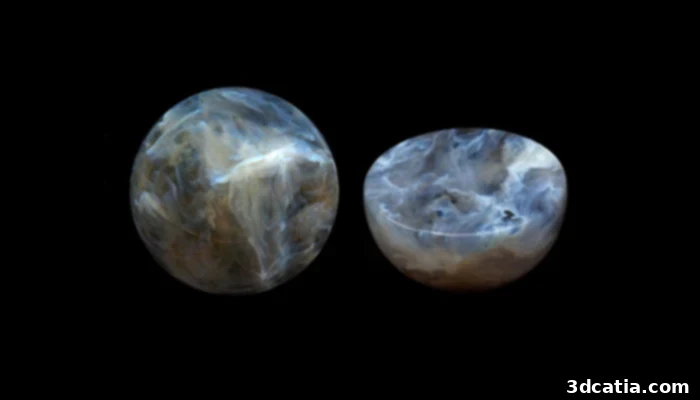
The researchers also printed half-spheres to reveal midplane data. (Photo credits: Saurabh Mhatre)
Unveiling Cosmic Secrets with Tangible Models
The tangible nature of these 3D printed stellar nursery models has enabled scientists to observe and analyze previously unseen phenomena within the complex interstellar medium. One of the most significant advantages is the ability to discern continuous structures that are virtually impossible to identify when confined to 2D projections. Imagine a winding ribbon intricately weaving through space; in a flat image, different sections of the ribbon might appear disconnected, leading researchers to mistakenly believe they are distinct entities. However, with a physical 3D model, the continuity becomes immediately apparent.
Nia Imara further elaborated on this crucial benefit: “If you have something winding around through space, you might not realize that two regions are connected by the same structure, so having an interactive object you can rotate in your hand allows us to detect these continuities more easily.” This tactile interaction is not merely a convenience; it is a fundamental shift in scientific methodology. The human brain is inherently wired to perceive and interpret three-dimensional objects, and providing a physical representation of abstract data significantly enhances pattern recognition, spatial reasoning, and the formation of new hypotheses. Researchers can rotate, examine from different angles, and even compare multiple models simultaneously, fostering a deeper, more intuitive understanding of the processes driving star formation.
The Precision of Material Jetting for Astrophysical Visualization
While the researchers did not specify the exact 3D printing process used for all models, the incredible detail and potential for multi-color representation suggest that Material Jetting technology was likely employed. Material Jetting works by precisely jetting tiny droplets of photopolymer resin onto a build tray, which are then immediately cured by UV light. This layer-by-layer deposition allows for exceptionally high resolution, enabling the reproduction of fine details and complex geometries critical for accurately representing the intricate filaments and sheets within stellar nurseries. Furthermore, its capacity for multi-material and multi-color printing means that different physical properties or data parameters (e.g., density, temperature, velocity fields) could be represented with distinct colors or even varying material textures, adding another layer of visual and tactile information for scientific analysis. This level of precision and versatility makes Material Jetting an ideal choice for translating abstract scientific data into highly informative physical models.
Beyond Research: Educational Outreach and Future Prospects
The utility of these 3D printed stellar nurseries extends far beyond the immediate realm of scientific research. Astrophysicist Nia Imara has highlighted their significant potential as invaluable educational tools. Abstract concepts like gravitational collapse, turbulence in cosmic gas, and the formation of protostellar disks are notoriously difficult to convey through diagrams or digital animations alone. However, a physical model offers a tactile, immersive experience that can dramatically enhance learning and comprehension. Students can hold these complex structures, feel their contours, and visualize the three-dimensional relationships between different regions, thereby solidifying their understanding of these fundamental astrophysical processes.
Nia Imara plans to integrate these innovative models into her upcoming university courses, offering students a unique and tangible way to engage with the subject matter. Beyond academia, these models hold immense promise for public outreach and engagement. Imagine these exquisite, 3D printed celestial objects showcased in science museums, planetariums, or educational institutions, allowing the general public to literally “touch the stars” and grasp the wonders of star formation in a way previously impossible. This accessibility can ignite curiosity and foster a deeper appreciation for astrophysics among a wider audience, inspiring the next generation of scientists and astronomers.
For those eager to delve deeper into the scientific methodologies and findings, the full article, “Touching the Stars: Using High-Resolution 3D Printing to Visualize Stellar Nurseries,” is available HERE. This publication offers a comprehensive look into the experimental setup, data processing, and the detailed scientific implications of this pioneering work.
The integration of 3D printing into astrophysics exemplifies a broader trend of cross-disciplinary innovation. By providing researchers with tangible, interactive models of complex celestial phenomena, this technology is not only accelerating the pace of discovery but also transforming how we learn about and connect with the cosmos. As additive manufacturing continues to evolve, its role in space science, from engineering robust spacecraft to deciphering the birth of stars, will only grow in significance, paving the way for unprecedented insights into the universe’s most profound mysteries.
What are your thoughts on these revolutionary 3D-printed stellar nurseries and their potential impact on space exploration and education? We invite you to share your insights in a comment below or join the discussion on our Facebook and Twitter pages. Don’t forget to sign up for our free weekly newsletter to stay updated with all the latest advancements and news in 3D printing delivered straight to your inbox!
*Thumbnail Photo Credits: Saurabh Mhatre