
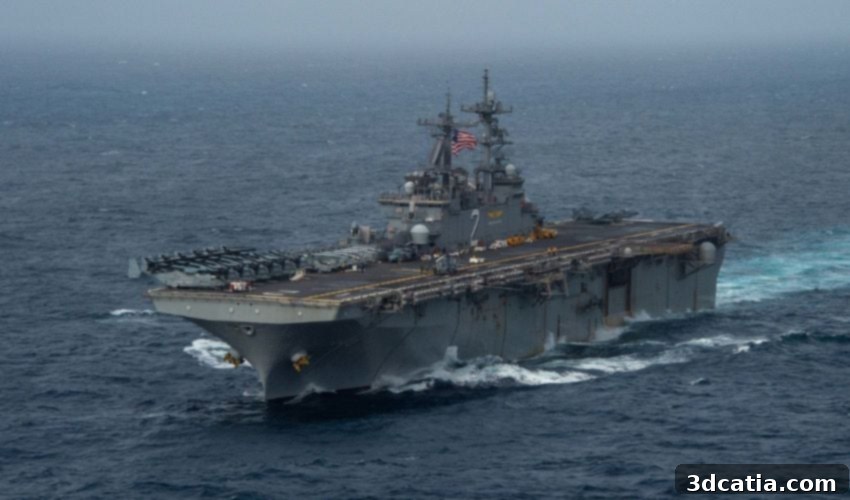
Revolutionizing Naval Readiness: USS Essex Becomes First US Warship with Onboard Xerox 3D Printer
A pivotal moment in naval logistics and defense innovation has arrived as the USS Essex (LHD 2), a Wasp-class amphibious assault ship, has become the first American warship to be equipped with an operational 3D printer while at sea. This significant deployment is the culmination of a strategic partnership between the Naval Postgraduate School (NPS) and Xerox, initially announced last year, aimed at exploring and leveraging the transformative capabilities of additive manufacturing for the U.S. Navy and Marine Corps. The installation of the Xerox ElemX 3D printer on the USS Essex, a collaborative effort with Commander, Naval Surface Force, U.S. Pacific Fleet (COMNAVSURFPAC), heralds a new era for naval self-sufficiency and expeditionary maintenance.
For years, the allure of 3D printing has captivated industries seeking faster, more cost-effective manufacturing solutions. However, for naval forces worldwide, this technology holds an even more profound strategic appeal. The long-standing vision has been to enable warships to achieve unprecedented levels of self-reliance, primarily by producing critical replacement parts on demand, even when deployed far from conventional supply chains and repair facilities. The Xerox ElemX printer was specifically chosen for this groundbreaking initiative, not merely due to the existing partnership but also for its distinctive advantages. Its unique liquid metal additive manufacturing process makes it one of the fastest metal printers currently available on the market, crucial for time-sensitive naval operations. Furthermore, the ElemX is capable of printing robust aluminum parts measuring up to 10 by 10 inches, encompassing a wide range of essential components such as heat sinks, specialized housings, fuel adapters, bleed air valves, and valve covers. This capability significantly expands the scope of what can be manufactured directly onboard, drastically reducing reliance on external logistics.
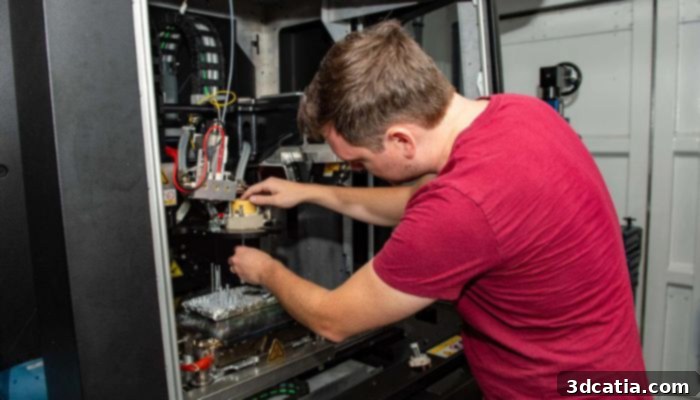
Dan Porter, a Xerox technician, assembles a 3D printer head aboard the USS Essex (Photo Credits: U.S. Navy photo by Mass Communication Specialist 3rd Class Isaak Martinez)
While the USS Essex has always possessed the capability to fabricate minor items necessary for ship operations, the introduction of the Xerox ElemX 3D printer is expected to dramatically enhance and expand its onboard manufacturing prowess. Aviation Electronics Technician 2nd Class Jonah Waage underscored this advancement, stating, “We have never been able to make something with the precision and intricacy that this new 3D printer will provide which is important because it will contribute to saving time and money for our Navy in the long run.” This newfound ability to produce complex, high-precision parts on demand is a game-changer, promising to significantly reduce maintenance timelines and associated costs. The immediate objective of this pioneering project is to rigorously test and evaluate the 3D printer’s performance and reliability under challenging underway (at-sea) conditions. This critical assessment will determine its long-term viability and effectiveness for naval operations, a vision the Navy has pursued for many years. As the inaugural vessel to participate in this cutting-edge research, the USS Essex is paving the way, and it is highly anticipated that other ships within the fleet will soon follow suit, integrating additive manufacturing into their operational framework.
A New Era for Naval Logistics and Readiness
The application of additive manufacturing in maritime contexts is not an entirely novel concept; the U.S. Navy and other global naval forces have progressively explored and embraced this technology for various shore-based and experimental purposes. However, the deployment of a fully operational 3D printer on a U.S. Navy warship while it is underway represents a monumental step forward. This development distinguishes itself from earlier endeavors, such as the 2019 instance where a 3D printer was briefly utilized aboard the French aircraft carrier “Charles de Gaulle.” The permanent integration onto the USS Essex underscores a profound shift in operational philosophy, demonstrating how naval powers are increasingly recognizing the undeniable advantages of onboard manufacturing, especially in terms of enhancing “readiness” for ships operating far from established ports and robust supply chains. The next critical phase of this project involves comprehensive training for sailors aboard the USS Essex, empowering them to effectively operate, maintain, and troubleshoot the advanced equipment, ensuring its seamless integration into daily naval operations.
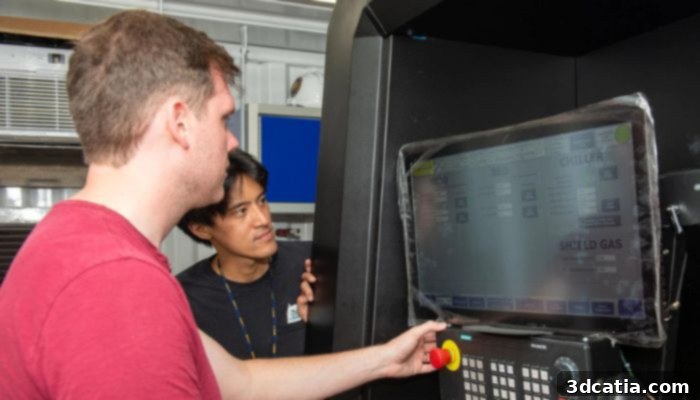
Dan Porter, a Xerox technician, left and Andrew Wong, right, Emergency Ship Salvage Material (ESSM), conduct diagnostics of a 3D printer on the USS Essex (photo credits: U.S. Navy photo by Mass Communication Specialist 3rd Class Isaak Martinez)
Lt. Cmdr. Nicolas Batista, the Aircraft Intermediate Maintenance Department (AIMD) officer aboard Essex, eloquently summarized the overarching strategic impact: “Having this printer aboard will essentially accelerate, enhance and increase our warfighting readiness. Additive Manufacturing (AM) has become a priority and it’s evident that AM will provide a greater posture in warfighting efforts across the fleet and will enhance expeditionary maintenance that contributes to our Surface Competitive Edge.” This statement highlights how onboard 3D printing directly contributes to a more agile, resilient, and formidable naval force. By enabling rapid, on-demand part fabrication, ships can minimize downtime, maintain higher operational tempos, and ensure mission continuity even in the most challenging and remote environments. Expeditionary maintenance, crucial for forward-deployed units, is significantly bolstered, allowing immediate repairs and adaptations without requiring resupply convoys or port visits. This capability provides a distinct “Surface Competitive Edge,” equipping the U.S. Navy with unparalleled flexibility and responsiveness in global naval operations. You can find out more details in the official press release HERE.
Strategic Implications of Onboard Additive Manufacturing
The deployment of the Xerox ElemX on the USS Essex signifies a profound shift in naval logistics and defense strategy. Traditionally, naval operations are heavily reliant on complex global supply chains, often stretched thin across vast oceans. This dependence can create vulnerabilities, especially during long deployments or in contested environments where resupply might be challenging or delayed. Onboard additive manufacturing directly addresses these issues by enabling ships to create critical replacement parts precisely when and where they are needed. This capability drastically reduces lead times for parts that might otherwise take weeks or months to procure and deliver, significantly enhancing a ship’s endurance and operational independence. It transforms the concept of naval readiness, moving from a reactive model of waiting for parts to a proactive one of instant fabrication.
Beyond immediate tactical advantages, the economic benefits are substantial. The ability to print parts on demand means a potential reduction in the vast inventories of spare parts that navies typically maintain in warehouses worldwide and on ships themselves. This not only frees up valuable storage space but also leads to considerable cost savings in procurement, shipping, and inventory management. Furthermore, for older ships or those with unique components, manufacturing parts in-house can circumvent obsolescence issues and reduce reliance on specialized, often expensive, third-party manufacturers. This internal capability ensures that vital components remain accessible, extending the operational life of naval assets and optimizing maintenance budgets.
The Xerox ElemX: A Game Changer for Naval Applications
The choice of the Xerox ElemX printer for this demanding naval environment is no coincidence. Its liquid metal printing process stands apart from traditional powder-bed fusion methods, offering several distinct advantages particularly suited for shipboard use. Unlike powder-based systems, which can be sensitive to vibrations and require complex environmental controls for safety and material integrity, the ElemX’s liquid metal jetting process is inherently more robust and less prone to disruption in a dynamic marine setting. This leads to increased reliability and faster printing cycles, crucial for maintaining operational tempo. The printer’s ability to utilize standard aluminum wire as feedstock further simplifies logistics, as aluminum is a common and vital material for numerous structural and functional components on naval vessels due to its strength-to-weight ratio and corrosion resistance. Being able to print common components such as heat sinks, specialized housings, fuel adapters, and critical valve parts directly onboard ensures that the USS Essex can address a broad spectrum of maintenance needs without external assistance.
Operating sophisticated machinery like a 3D printer on a warship presents unique engineering challenges, including managing power fluctuations, mitigating vibrations, and ensuring safe material handling in confined spaces. The ElemX, designed with industrial reliability in mind, is well-positioned to meet these challenges. Its robust construction and user-friendly interface are essential for integration into a naval environment where space is at a premium and operational demands are constant. This deliberate selection underscores a commitment by NPS and Xerox to deploy technology that is not only advanced but also practical and resilient for military applications, ensuring that the promise of onboard additive manufacturing can be fully realized even in the harshest conditions.
Looking Ahead: The Future of 3D Printing in the Fleet
The successful integration and evaluation of the Xerox ElemX on the USS Essex will undoubtedly serve as a blueprint for the wider adoption of additive manufacturing across the U.S. Navy fleet and potentially other branches of the military. This pioneering effort is expected to catalyze further research and development into new materials suitable for naval applications, as well as the creation of a standardized digital library of printable parts. Over time, 3D printing could influence future ship design, allowing for more modular and adaptable components. It could also revolutionize maintenance doctrines, shifting from scheduled part replacements to condition-based, on-demand manufacturing, leading to a more efficient and responsive support system for naval assets globally. This initiative aligns perfectly with broader Department of Defense strategies to embrace advanced manufacturing technologies to enhance readiness, improve efficiency, and maintain a technological edge.
This step represents more than just placing a new machine on a ship; it signifies a strategic pivot towards a more self-sufficient, resilient, and technologically advanced naval force. The ability to produce critical components at the point of need empowers sailors and marines, reduces logistical burdens, and ultimately strengthens national defense capabilities. As the USS Essex embarks on this exciting journey, the eyes of defense strategists and manufacturing innovators worldwide will be watching, eager to see how this project advances and reshapes the future of naval operations.
What are your thoughts on the strategic placement of a Xerox 3D printer on the USS Essex? How do you envision this project advancing naval capabilities in the coming years? Let us know in a comment below or on our Linkedin, Facebook, and Twitter pages! Don’t forget to sign up for our free weekly Newsletter here, the latest 3D printing news straight to your inbox! You can also find all our videos on our YouTube channel.