
Revolutionizing Waste Management: How 3D Printing and Smart Technology Power Daniel Lloyd’s Wae System
The global challenge of waste management has reached a critical juncture, with societies worldwide grappling with the immense environmental and economic impact of discarded materials. Despite widespread recycling initiatives and public awareness campaigns, the volume of household waste continues to grow at an alarming rate. According to a compelling study from Columbia University, residents in the United States alone generate approximately seven pounds of material per person per day, much of which ends up in landfills. This unsustainable trend highlights an urgent need for innovative solutions that can fundamentally alter our relationship with consumption and disposal.
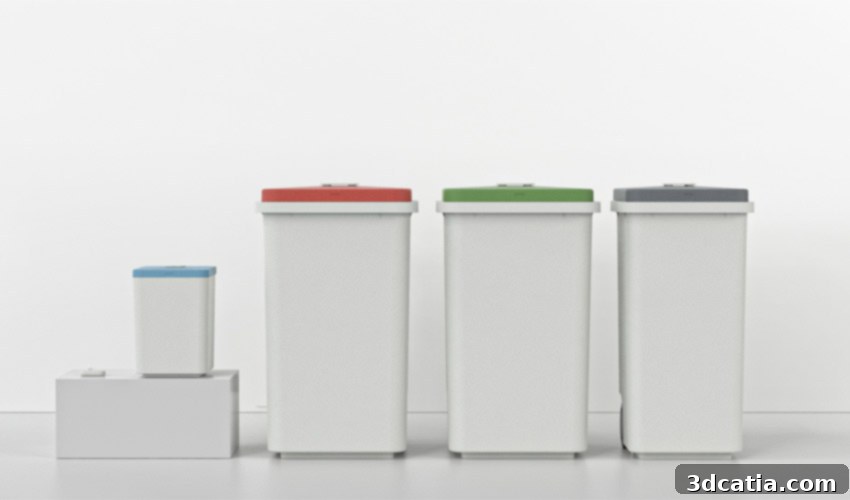
Addressing this pressing issue, visionary designer Daniel Lloyd has conceptualized a groundbreaking new waste management system called Wae. Designed with sustainability at its core, Wae leverages the power of additive manufacturing, specifically stereolithography, to create a functional and aesthetically pleasing device. More than just a bin, Wae integrates advanced sensors and a smart meter to provide users with real-time, actionable insights into their waste habits. The primary objective is clear: to significantly reduce the amount of waste produced daily and to substantially increase recycling rates by empowering individuals with knowledge and responsibility. This innovative approach offers a promising pathway towards more sustainable living, transforming mundane waste disposal into an informed, conscious act.
The Synergy Between Additive Manufacturing and Environmental Stewardship
The connection between 3D printing, also known as additive manufacturing, and environmental sustainability has steadily strengthened over recent years. This technological advancement is increasingly being recognized as a key enabler for promoting a truly circular economy, where resources are kept in use for as long as possible, extracting the maximum value from them whilst in use, then recovering and regenerating products and materials at the end of each service life. Numerous initiatives have emerged that demonstrate the profound potential of 3D printing to tackle environmental challenges head-on.
For instance, machines like the ProtoCycler offer a micro-factory solution, allowing users to recycle their plastic waste directly into high-quality 3D printing filaments right from their homes or workshops. This not only diverts plastic from landfills but also reduces the energy and emissions associated with manufacturing and transporting new materials. Another inspiring example is the Million Waves Project, which actively cleans plastic bottles from beaches, transforming this harmful marine debris into life-changing 3D printed prostheses for those in need. Such projects exemplify how 3D printing can turn waste into valuable resources, creating tangible positive impacts.
Beyond these specific applications, additive manufacturing inherently contributes to sustainability in several broader ways. Its ability to create complex geometries with minimal material waste, often referred to as “design for additive manufacturing,” significantly reduces scrap compared to traditional subtractive manufacturing methods. On-demand production capabilities minimize overproduction and inventory waste, ensuring that only what is needed is manufactured. Furthermore, 3D printing facilitates localized manufacturing, cutting down on transportation costs and carbon emissions associated with global supply chains. The Wae system, while distinct in its direct application, aligns perfectly with this ethos, contributing to a holistic approach for better, more informed waste management and a healthier planet.
Wae’s Prototype Development: Precision and Functionality with 3D Resin Printing
Bringing an innovative concept like Wae to life requires a robust and iterative design process, where prototypes play a pivotal role. Designer Daniel Lloyd understood this implicitly, opting for advanced 3D technologies to develop a fully functional prototype. This choice was critical, as additive manufacturing offers unparalleled speed, cost-effectiveness for multiple iterations, and the ability to produce highly complex geometries that would be challenging or impossible with conventional methods. For a product designed to integrate smart technology and withstand daily use, precise functional testing was paramount.
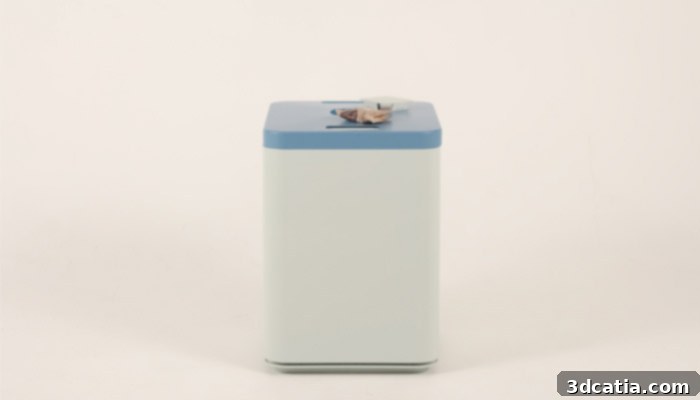
To translate his vision into a physical model, Daniel collaborated with Ogle, a renowned rapid prototyping company. Ogle’s expertise was instrumental in refining the initial designs, ensuring they were optimized for additive manufacturing. This involved meticulously creating the model using advanced CAD software, a crucial step to ensure compatibility with 3D printing parameters. During this phase, critical engineering considerations were addressed. For instance, the wall thickness of the Wae unit needed to be robust enough to support the weight of accumulated waste without compromising structural integrity. Equally important were the functional characteristics, such as ensuring the lid mechanism could operate smoothly and reliably through repeated use, and that all internal components, including the sensors, could be seamlessly integrated.
A significant decision in the prototyping phase was the selection of stereolithography (SLA) for manufacturing the initial prototype. SLA, a resin-based 3D printing technology, was chosen for its exceptional ability to produce parts with incredibly high resolution, intricate detail, and remarkably smooth surface finishes. These qualities were crucial for Wae, as it is designed to be a sleek, modern appliance for the home. The prototype was produced on an Ipro 8000 from 3D Systems, a professional-grade resin 3D printer known for its large build volume (650 x 750 x 550 mm). This generous printing capacity allowed Ogle to produce all the individual components of the Wae system simultaneously, streamlining the prototyping process and ensuring consistency across parts. The superior surface quality offered by stereolithography also meant that minimal post-processing was required, saving time and resources. After printing, the dedicated team at Ogle meticulously finished the prototype, applying a custom paint palette and expertly assembling the various components to create a polished, market-ready appearance.
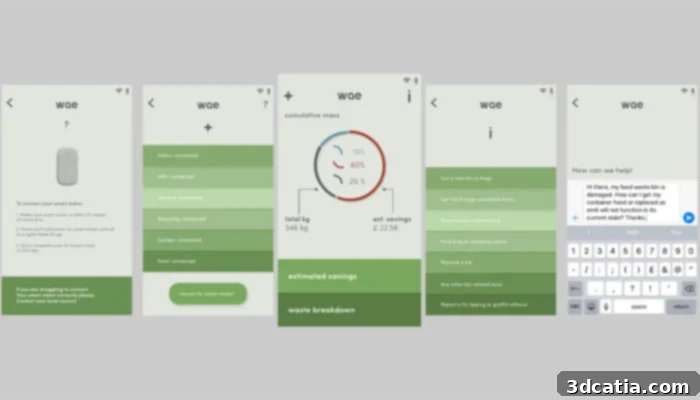
Wae sends notifications to the user to better manage its waste
Wae’s Intelligent Core: Driving Behavioral Change Through Data
Daniel Lloyd emphasizes that the overarching goal of the Wae project transcends mere technological innovation; it is fundamentally about fostering a shift in human behavior. He insightfully notes, “The overall objective of this project is to reduce waste and increase recycling. Research clearly shows that lack of knowledge and responsibility is one of the main factors affecting all household waste. Wae solves this problem by providing easily accessible data.” This statement encapsulates the core philosophy behind Wae: transforming passive waste disposal into an active, informed process.
The “smart” capabilities of Wae are what truly set it apart. The system is equipped with an array of sophisticated sensors designed to meticulously monitor household waste. These sensors accurately measure waste according to both its mass and volume, providing quantitative data that was previously unavailable to the average household. This raw data is then fed into Wae’s integrated smart meter, which acts as the system’s intelligent core. The smart meter’s algorithms process and interpret this complex data, translating it into a format that is easily understandable and highly informative for users.
Imagine knowing not just the total weight of your household waste, but also the precise percentage of each type of waste – plastics, paper, organic matter, glass, and so on. Wae delivers these “key facts” directly to the user, potentially through a dedicated mobile application, a display on the unit itself, or personalized weekly reports. This level of granular detail allows households to clearly see their consumption patterns and understand where most of their waste is coming from. For instance, if a family discovers they are generating an unexpectedly high proportion of single-use plastic, this tangible feedback can motivate them to make conscious changes in their purchasing habits, opting for reusable alternatives or products with less packaging.
Beyond simple categorization, the smart meter generates a comprehensive set of analyses designed to inform and educate users, guiding them towards more sustainable practices. These analyses could include comparisons to local or national average waste generation, the estimated carbon footprint of their waste, or even potential cost savings achieved through improved recycling and waste reduction. By providing continuous, personalized feedback, Wae taps into principles of behavioral economics. It creates a powerful feedback loop, turning an abstract environmental problem into a personal, measurable challenge. This ongoing education encourages users to set personal goals, track their progress, and ultimately cultivate a deeper sense of responsibility, leading to significant and lasting changes in behavior over time. Wae empowers users not just to dispose of waste, but to understand and actively manage their environmental footprint, making smarter choices for a greener future.
The potential impact of such a system extends beyond individual households. Aggregated, anonymized data from Wae units could provide invaluable insights for municipal waste management services, helping them to better understand community-wide waste trends, optimize collection routes, and even tailor public awareness campaigns more effectively. This data-driven approach fosters a collective effort towards greater sustainability, with each Wae system contributing to a larger pool of knowledge that can drive systemic change.
The Future of Sustainable Living: Wae’s Potential Impact
The Wae system represents a forward-thinking step in the evolution of smart home technology and sustainable living. Daniel Lloyd’s vision anticipates a future where every household is equipped with the tools and information necessary to make responsible environmental choices. The decision to offer Wae with five different cover colors speaks volumes about this vision – it’s not just a functional appliance, but a thoughtfully designed part of the modern home. Aesthetics play a crucial role in consumer adoption, and by making sustainability appealing and integrated into everyday life, Wae increases its potential for widespread impact.
The journey from functional prototype to commercial product involves numerous challenges, including securing funding, scaling up production, and navigating market entry. However, the potential societal and environmental benefits of Wae are immense. As smart home ecosystems become more interconnected, Wae could seamlessly integrate with other devices, offering an even more holistic approach to resource management. Imagine a scenario where Wae’s data could communicate with smart refrigerators to reduce food waste, or even inform grocery shopping lists to minimize packaging. The possibilities for cross-functional synergy are vast.
We eagerly anticipate the day when this young designer will be able to market his first systems, and we are confident that they will continue to integrate 3D printed parts, leveraging the advantages of additive manufacturing for rapid innovation and customizability. The Wae system is more than just a smart bin; it’s a testament to how creative design, cutting-edge technology, and a commitment to sustainability can converge to create meaningful change. It offers a tangible pathway for individuals to actively participate in the global effort to reduce waste and foster a healthier planet for generations to come.
What are your thoughts on the innovative Wae system and its potential to transform household waste management? We’d love to hear your perspective! Share your comments below or engage with us on our Facebook and Twitter pages. For the latest updates in the world of 3D printing and sustainable technology, don’t forget to sign up for our free weekly Newsletter here, delivering cutting-edge news directly to your inbox!