
BMW’s New Additive Manufacturing Campus: Driving the Future of Automotive Production with 3D Printing
The global automotive industry is undergoing a profound transformation, with technological innovation at its core. Leading this charge is BMW, which has just unveiled its state-of-the-art Additive Manufacturing Campus in Oberschleissheim, situated north of Munich. First announced in 2019, this significant opening marks a pivotal moment for the German automotive giant, signaling an accelerated adoption of additive manufacturing across all facets of its operations. From rapid prototyping to full-scale series production, this €15 million investment is set to redefine how BMW designs, engineers, and manufactures its vehicles.
More than just a production facility, the Additive Manufacturing Campus is a vibrant hub dedicated to pioneering research into cutting-edge 3D printing technologies. It also focuses on developing comprehensive training programs, essential for the seamless global integration of tool-less production methods. BMW’s strategic vision is clear: to solidify its position as an undisputed leader in advanced 3D printing technologies within the automotive sector, pushing the boundaries of what is possible in vehicle manufacturing.
BMW’s Longstanding Commitment to Additive Manufacturing
BMW’s journey with additive manufacturing is far from new. The company boasts a rich history spanning over 25 years in this innovative field, consistently yielding highly promising results. By the end of 2018, BMW proudly announced that it had 3D printed more than one million parts, a testament to its early foresight and sustained investment in the technology. This extensive experience has allowed BMW to integrate 3D printed components into numerous groundbreaking projects, most notably exemplified by the iconic BMW i8 Roadster. In this model, additive manufacturing was instrumental in producing lightweight, complex parts that would be challenging and costly to achieve with traditional manufacturing techniques, showcasing the practical advantages of the technology in real-world applications.
Milan Nedeljković, a distinguished member of the BMW AG Board of Directors and the executive responsible for production, underscores the strategic importance of this development. He states, “Additive manufacturing is already an integral part of our global production system today, and is established in our digitisation strategy. In the future, new technologies of this kind will further reduce production times and enable us to exploit the potential of tool-free manufacturing even more fully.” This statement highlights BMW’s commitment to not just adopting, but truly embedding additive manufacturing within its overarching digital transformation strategy. The company’s success in this arena is also bolstered by robust partnerships with industry leaders such as Carbon and Desktop Metal, collaborative efforts that continuously push the envelope of what 3D printing can achieve in automotive applications.
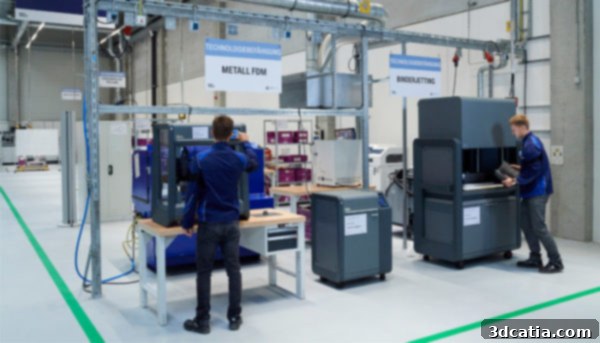
BMW’s significant investment includes advanced Desktop Metal machines, bolstering its metal additive manufacturing capabilities. | Credits: BMW
Inside BMW’s Cutting-Edge Additive Manufacturing Campus
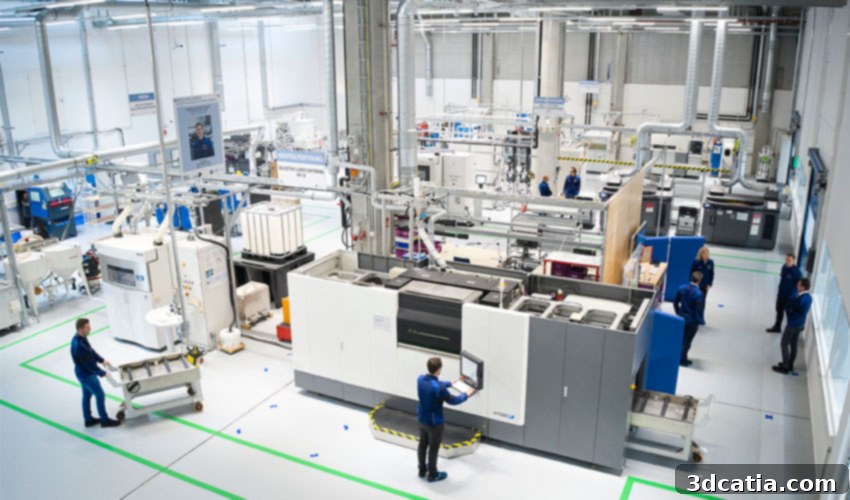
The new Additive Manufacturing Campus is an impressive testament to BMW’s dedication to innovation. It currently houses a dedicated team of 80 specialists, all working at the forefront of additive manufacturing. The campus is equipped with an extensive array of approximately 50 industrial 3D printing solutions, capable of processing both polymers and metals. This diverse fleet of machines allows for unparalleled flexibility and capability in addressing a wide range of manufacturing needs. In addition to these, BMW strategically deploys another 50 3D printers across its global network, ensuring that additive manufacturing capabilities are integrated throughout its worldwide production system.
The advanced machinery at the campus includes state-of-the-art systems from renowned manufacturers such as HP Multi Jet Fusion, EOS, SLM, Carbon, Desktop Metal, and Nexa3D. Each of these technologies brings unique strengths to BMW’s additive manufacturing toolkit, enabling the production of parts with varying material properties, complexities, and scales. Daniel Schäfer, Senior Vice President, Production Integration and Pilot Plant Integration at the BMW Group, articulates the strategic imperative behind this extensive setup: “Our goal is to increasingly industrialise 3D printing methods for automotive production and to implement new automation concepts in the process chain. This will enable us to streamline the manufacture of components for series production and accelerate development.”
He further emphasizes the collaborative nature of this initiative: “At the same time, we are collaborating with vehicle development, component production, purchasing and the supplier network, as well as with various other areas of the company to systematically integrate the technology and use it efficiently.” This holistic approach ensures that additive manufacturing is not an isolated technology but a fully integrated component of BMW’s entire value chain, fostering innovation from design conception to final vehicle assembly. The sheer volume and diversity of printing solutions available at the BMW Additive Manufacturing Campus are designed to facilitate higher production volumes, enable the creation of more geometrically complex parts, and ultimately drive the innovative design of the vehicles of tomorrow.
Pioneering Research and Development Initiatives
Beyond its significant production and rapid prototyping capabilities, a core mission of the BMW Additive Manufacturing Campus is dedicated to intensive research and optimization. A specialized unit within the campus focuses on exploring new materials, refining existing technologies, and streamlining processes. The overarching objective for the German group is to automate the additive manufacturing process as extensively as possible. This ambitious goal aims to enhance the long-term viability and economic efficiency of 3D printing, transforming it from a niche technology into a cornerstone of industrial manufacturing.
To realize this vision, BMW has embarked on two highly strategic projects: IDAM and POLYLINE.
The IDAM Project: Industrializing Additive Manufacturing for Automotive Series Production
The Industrialisation and Digitisation of Additive Manufacturing for Automotive Series Production (IDAM) project is a groundbreaking initiative designed to revolutionize how BMW approaches large-scale additive manufacturing. This ambitious project aims to meticulously reproduce the entire production chain of additive manufacturing, from the initial stages of digital production preparation to the actual manufacturing process and subsequent reprocessing of components. By simulating and optimizing every step, BMW seeks to create a fully automated and integrated workflow for 3D printed parts.
The tangible goal for the IDAM project is impressive: to achieve an annual production of at least 50,000 series components. Furthermore, it targets the production of over 10,000 individual and spare parts annually. This significant output demonstrates BMW’s commitment to moving beyond bespoke prototypes and truly integrating additive manufacturing into its high-volume production lines. The success of IDAM will set a new benchmark for industrial additive manufacturing, promising enhanced efficiency, reduced lead times, and increased flexibility in producing complex automotive parts.
The POLYLINE Project: Advancing Mass Production of Plastic Parts
Complementing IDAM, the POLYLINE project is specifically focused on advancing the mass production of plastic parts using additive manufacturing. This initiative tackles the unique challenges associated with producing high volumes of plastic components with consistent quality. The primary objective of POLYLINE is to develop a robust and consistent quality assurance methodology that spans the entire process chain of plastic additive manufacturing. This includes everything from material selection and pre-processing to printing and post-processing. Additionally, POLYLINE aims to establish a seamless digital link between all process steps, creating a fully integrated and transparent production environment.
The expected outcome of the POLYLINE project is remarkable: a significant reduction in manufacturing costs by up to 50%. This cost-efficiency, combined with enhanced quality control and streamlined digital integration, will make additive manufacturing an even more attractive and competitive option for producing a wide array of plastic components in BMW vehicles. Both IDAM and POLYLINE underscore BMW’s holistic approach to advancing additive manufacturing across both metal and polymer applications, thereby optimizing production processes and enabling new design possibilities.
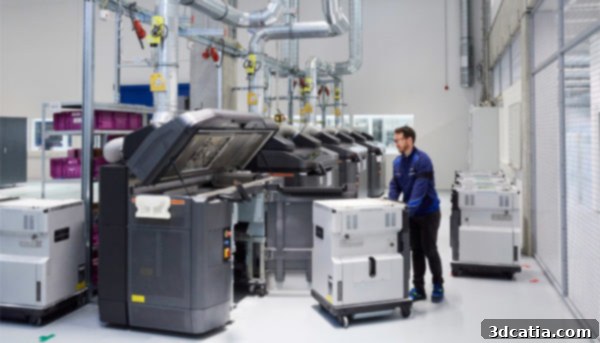
The HP Multi Jet Fusion system at BMW’s additive manufacturing campus offers advanced polymer printing capabilities. | Credits: BMW
Cultivating a Skilled Workforce: Training and Future Talent
Recognizing that advanced technology is only as effective as the people who wield it, the Additive Manufacturing Campus places a strong emphasis on continuous learning and talent development. The center offers extensive training courses in 3D printing to its employees, ensuring that all personnel across various departments can become proficient and comfortable with this transformative technology. This commitment to upskilling the workforce is crucial for a successful and widespread deployment of additive manufacturing across the BMW Group.
Jens Ertel, the esteemed Director of the Additive Manufacturing Campus, eloquently summarizes the importance of this human element: “To successfully deploy these technologies, we need well-trained colleagues throughout the network who fully understand the benefits and features. To use them, designers will need to adopt a new way of thinking and an entirely new approach when designing the next components.” He further elaborates on the liberating potential of the technology: “3D printing makes it possible to produce almost any shape, paving the way for new designs and features.” This perspective highlights that additive manufacturing is not just about new machines, but about fostering a new design philosophy and engineering mindset, enabling unprecedented levels of innovation in vehicle aesthetics and functionality.
The Future of Automotive Manufacturing is Here
The inauguration of BMW’s Additive Manufacturing Campus is more than just the opening of a new facility; it represents a bold statement about the future of automotive production. By centralizing expertise, investing heavily in advanced equipment, fostering strategic partnerships, and committing to continuous research and development, BMW is poised to solidify its leadership in the integration of 3D printing into the automotive sector.
This campus will not only accelerate the production of prototypes and series parts but also drive innovation in material science and process automation. The IDAM and POLYLINE projects are clear indicators of BMW’s ambition to achieve true industrial scale for additive manufacturing, promising significant reductions in costs and production times while enhancing design freedom and product quality. Furthermore, the focus on training ensures that BMW’s workforce is equipped with the necessary skills to navigate and excel in this evolving landscape.
Ultimately, BMW’s Additive Manufacturing Campus is a critical stepping stone towards a future where vehicle design is less constrained by traditional manufacturing limitations, where customization becomes more accessible, and where production processes are significantly more agile and sustainable. It’s a testament to BMW’s unwavering commitment to innovation, setting new standards for the global automotive industry. For a deeper dive, find the full official press release HERE.
What are your thoughts on BMW’s ambitious new Additive Manufacturing Campus and its potential impact on the automotive industry? Share your insights in a comment below or join the conversation on our Facebook and Twitter pages! Don’t forget to sign up for our free weekly Newsletter to receive all the latest news on advancements, research, and entrepreneurial ventures in the world of 3D printing directly in your inbox!