
The Future of Sports Medicine: How a Custom 3D Printed Brace Propelled Eva de Goede to EuroHockey Glory
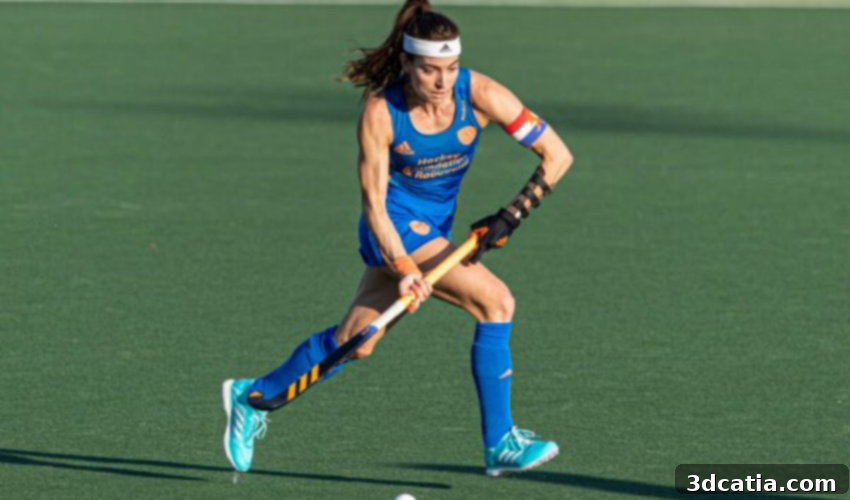
In the fiercely competitive world of elite sports, injuries can be devastating, often sidelining athletes at critical moments and jeopardizing their careers. Such was the challenge faced by Eva de Goede, a formidable three-time Olympic field hockey champion for the Netherlands. Just weeks before the highly anticipated 2021 European Championship, a fractured wrist threatened to bench one of her team’s most vital players and captain. The prospect of losing such a pivotal figure was unthinkable for the Dutch national team, prompting a desperate search for an innovative solution that would allow de Goede to recover swiftly and rejoin her teammates on the field. The answer arrived not through conventional medical approaches alone, but through the cutting-edge capabilities of 3D printing: a custom-designed, 3D printed brace. Fitted precisely after surgery, this revolutionary device enabled Eva de Goede to make a remarkable return, leading her team to a triumphant victory in the championship, defying expectations and showcasing the immense potential of additive manufacturing in sports medicine.
This pivotal moment is far from an isolated incident. Additive manufacturing, commonly known as 3D printing, has been increasingly integrated into the world of sports across various disciplines. From optimizing performance in cycling with lightweight components to crafting highly responsive footwear for long-distance running, and even developing specialized protective gear for soccer players, 3D printing is revolutionizing how athletes train, recover, and compete. Its core advantage lies in the ability to create devices, accessories, or equipment that are entirely custom-tailored to an individual’s unique morphology, whether they are a professional athlete or an enthusiastic amateur. This level of personalization translates directly into enhanced comfort, superior fit, and ultimately, significantly improved performance and protection, pushing the boundaries of what is possible in athletic endeavor.
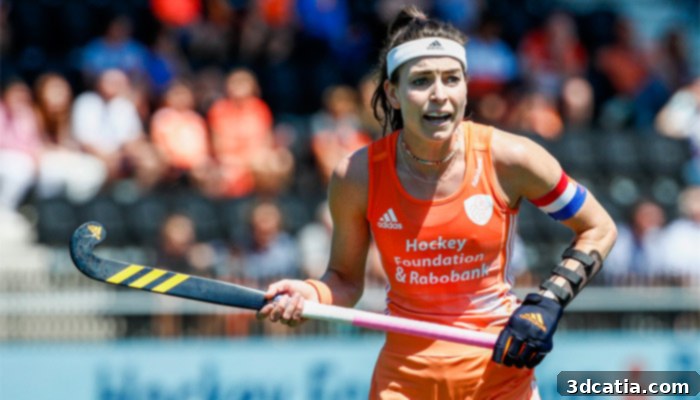
Eva de Goede and her 3D printed brace
A Collective Effort: Collaboration Paves the Way for Rapid Recovery
The rapid development and successful implementation of Eva de Goede’s custom wrist brace were the result of an impressive collaborative effort involving several specialized entities. The journey began with the crucial step of obtaining a precise digital model of the athlete’s injured hand. This was expertly handled by the Dutch company Centrum Orthopedie (CO), renowned for its advanced orthopedic services. Utilizing state-of-the-art 3D scanning technology, CO meticulously captured every contour and dimension of de Goede’s hand and wrist, ensuring that the subsequent brace would offer an unparalleled, perfect fit. This digital scan, a foundational piece of data, was then securely transmitted to Artus 3D, a company specializing in innovative 3D printed hand orthotics.
Artus 3D took the digital scan and transformed it into a sophisticated 3D model of the proposed brace. They didn’t start from scratch; instead, they leveraged a proprietary and highly effective design known as the “Sizoo dynamic wrist brace 2.0.” This particular design had been carefully developed in 2020 through a successful collaboration between Artus 3D and Saskia Sizoo, an expert in orthotics and rehabilitation. The Sizoo dynamic wrist brace 2.0 is specifically engineered to address recurring wrist problems, focusing on accelerating the rehabilitation process by providing optimal support while allowing controlled movement vital for recovery. This pre-existing, proven design significantly streamlined the development of Eva de Goede’s custom medical device, allowing for rapid iteration and personalization based on her unique scan data. The synergy between CO’s precise scanning capabilities and Artus 3D’s specialized design expertise was instrumental in crafting a brace that was not only structurally sound but also perfectly adapted to the athlete’s anatomy and specific rehabilitation needs.
With the 3D model finalized and optimized for Eva de Goede’s wrist, the next critical step was the physical production of the brace. This task fell to Beamler, a leading 3D printing service known for its efficiency and capability in rapid prototyping and manufacturing. What truly set this project apart was the unprecedented speed of production: the custom brace was printed and ready for use in an astonishingly short timeframe—just one single day. This rapid turnaround was absolutely crucial given the impending European Championship and highlights the agility and responsiveness that advanced 3D printing services can offer. Armed with her brand new, perfectly fitting brace, the Dutch team captain was able to return to the courts in exceptional form, demonstrating her resilience and leadership. Her presence, undoubtedly boosted by the confidence in her new orthosis, contributed significantly to the team’s success as they decisively beat Germany 2-0 in the final, securing their eleventh EuroHockey title. This victory marked their third consecutive win, an extraordinary and historic achievement for the Dutch women’s team, made possible by a blend of athletic prowess and cutting-edge technology.
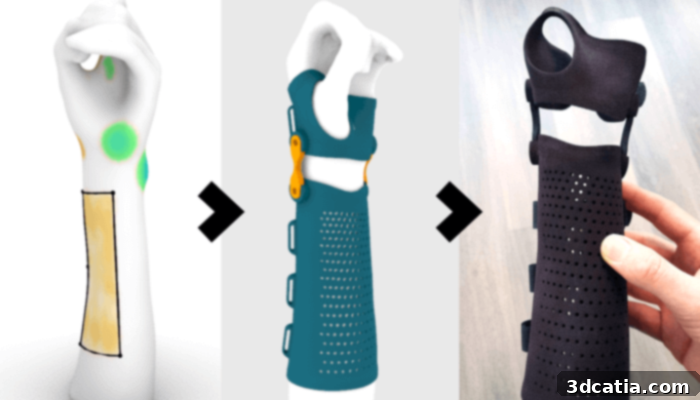
From scanning to modeling to printing the splint (photo credits: Artus 3D)
A Daring but Successful Gamble: Engineering Excellence in Sports Rehabilitation
The design and fabrication of Eva de Goede’s wrist brace presented a unique set of engineering challenges that pushed the boundaries of traditional orthotics. A brace intended for an elite athlete engaged in a high-impact sport like field hockey needs to strike a delicate balance: it must be flexible enough to ensure the wearer’s comfort during intense physical activity, allowing for a necessary range of motion, yet simultaneously possess robust mechanical properties to restrict unwanted movement of the injured joint. This precise combination of flexibility, durability, and controlled support is paramount for both protection and effective rehabilitation. Conventional materials and manufacturing methods often struggle to achieve this nuanced balance without compromising on one aspect or another.
The material that ultimately fulfilled these demanding characteristics was TPU (Thermoplastic Polyurethane). TPU is a highly versatile and durable elastomer, celebrated in the additive manufacturing industry for its unique blend of properties. It offers exceptional elasticity, meaning it can deform under stress and return to its original shape without permanent damage, which is crucial for comfort and impact absorption. Furthermore, TPU boasts excellent abrasion resistance, tear strength, and chemical resistance, ensuring the brace’s longevity under rigorous athletic use. Its biocompatibility also makes it suitable for prolonged skin contact. These qualities made TPU the ideal choice for Eva de Goede’s brace, providing the necessary give for comfort while maintaining the structural integrity required to protect her healing wrist during competitive play.
Equally critical to the project’s success was the selection of the right 3D printing process. Multi Jet Fusion (MJF) technology was chosen for its distinct advantages, particularly its ability to deliver rapid production without compromising on part quality. MJF operates by selectively applying a fusing agent to a powder bed of material, followed by a detailing agent, and then fusing layers with infrared energy. This process allows for the production of highly detailed, functional parts with excellent mechanical properties and a clean, consistent visual appearance. Unlike some other 3D printing methods, MJF is known for its speed, enabling the quick creation of multiple parts or, in this case, a single complex device in record time. Furthermore, it offers a relatively affordable production cost compared to many high-performance additive manufacturing techniques, making personalized medical devices more accessible. The combination of TPU and Multi Jet Fusion was a strategic decision that directly contributed to the swift design and production of the athlete’s brace, proving that innovation could indeed overcome seemingly insurmountable obstacles.
For Eva de Goede, the outcome was nothing short of a dream come true. Voted player of the tournament, the Dutch midfielder expressed immense gratitude and joy, capturing the emotional impact of her journey: “It was an amazing experience to be able to play, and to win on Dutch soil with a live audience! I am so grateful we were able to achieve this, it’s one of my more precious victories. I owe this gold medal to the quick rehabilitation process with Saskia and the fast orthosis production.” Her words underscore not only the personal triumph but also the critical role played by the personalized brace and the accelerated rehabilitation it facilitated. The team, relieved and invigorated by their success, could now channel their focus and confidence towards their next major challenge: the highly anticipated Tokyo Olympics, secure in the knowledge that innovation had their back.
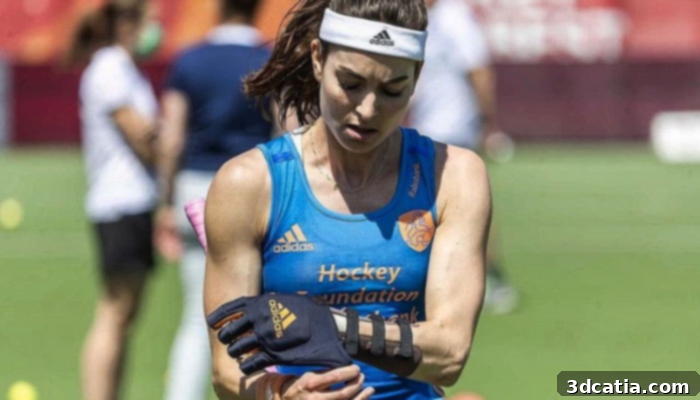
The 3D printed brace allowed Eva de Goede to play at her best during matches (photo credit: Instagram @degoedeeva)
The remarkable story of Eva de Goede’s 3D printed wrist brace is more than just a tale of athletic comeback; it’s a powerful testament to the transformative potential of additive manufacturing in sports medicine and beyond. This instance demonstrates how bespoke medical devices can significantly reduce recovery times, enhance performance, and provide athletes with the confidence needed to return to the field at their peak. As technology continues to advance, we can anticipate even greater integration of 3D printing in creating highly personalized protective gear, performance-enhancing equipment, and rapid rehabilitation aids across all sports. The era of generic, off-the-shelf solutions is giving way to a future where every athlete, regardless of their level, can benefit from equipment tailored precisely to their needs, ensuring both safety and optimal performance.
What are your thoughts on this incredible 3D printed brace and its impact on elite sports? We’d love to hear your perspective! Share your comments below or engage with us on our Facebook and Twitter pages. For those keen to stay informed on the latest innovations and breakthroughs in the world of 3D printing, don’t forget to sign up for our free weekly newsletter, delivering all the essential news straight to your inbox!