
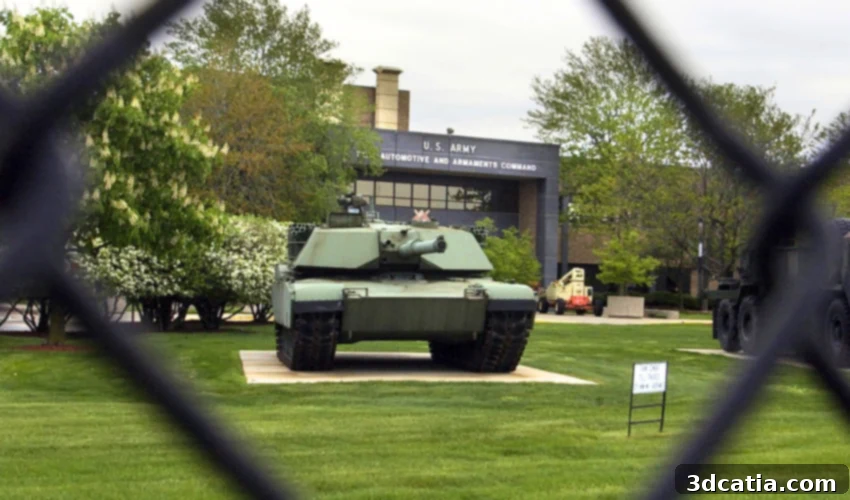
3D Printing Revolutionizes Infrastructure: Detroit Arsenal’s Energy-Efficient Retrofit with Additive Manufacturing
The landscape of infrastructure upgrades is witnessing a groundbreaking transformation, thanks to the innovative application of large-scale 3D printing. A pioneering collaborative pilot project at the U.S. Army’s Detroit Arsenal, strategically located in Warren, Michigan, is poised to demonstrate how this advanced manufacturing technique can revitalize aging infrastructure with unprecedented efficiency and minimal disruption. This ambitious undertaking brings together a consortium of leading organizations: the National Renewable Energy Laboratory (NREL), Ameresco, a renowned energy efficiency and renewable energy company, and Branch Technology, specialists in large-scale additive manufacturing. Their collective expertise will be channeled into retrofitting a historic 1940-era building at the Arsenal using state-of-the-art, robot-printed insulation panels. This initiative marks a significant step forward in sustainable building practices, offering a scalable model for modernizing facilities across the nation, enhancing their operational efficiency and reducing their environmental footprint.
The specific focus of this transformative project is Building 25, a substantial structure spanning approximately 16,250 square feet within the Detroit Arsenal complex. This building, a relic from an earlier era, currently grapples with the pervasive challenges of outdated insulation and severely inefficient thermal performance. These inherent issues not only contribute to excessive energy consumption, leading to higher utility bills, but also incur substantial operational costs for the U.S. Army, impacting their budget and sustainability goals. Through the strategic integration of new 3D printed exterior panels, the project aims to dramatically enhance the building’s energy efficiency. The U.S. Army has officially projected a remarkable reduction in the building’s heating and cooling load by nearly 65%. This significant improvement will not only curtail direct energy expenditure but also serve as a crucial cost-saving measure by considerably lessening the operational burden on the existing HVAC (Heating, Ventilation, and Air Conditioning) system, extending its lifespan and reducing maintenance needs. Beyond immediate savings, this project exemplifies a commitment to long-term sustainability, resource optimization, and the adoption of cutting-edge technology within federal facilities.
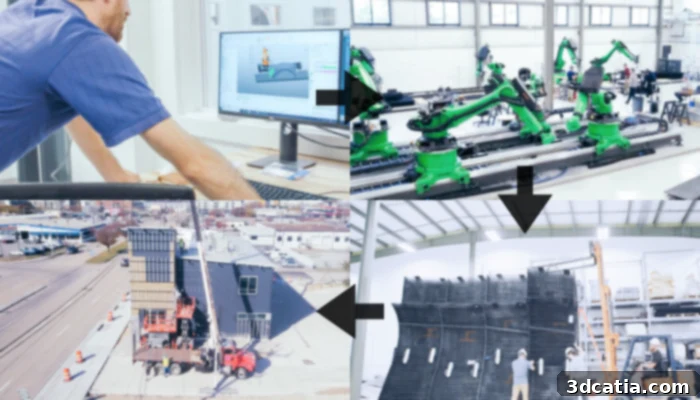
An example of Branch Technology’s Cellular Fabrication (C-Fab®) Process for design, printing, and application. (Credit: Branch Technology)
What truly sets this innovative retrofit project apart from conventional renovation methodologies is Branch Technology’s pioneering approach, which adeptly sidesteps the extensive interior modifications or outright demolition often associated with traditional methods. The company will leverage a sophisticated strategy involving precision off-site fabrication coupled with swift on-site installation. This methodology significantly minimizes disruption to the building’s occupants and ongoing operations, a critical consideration for active federal facilities that must maintain continuous functionality. To ensure absolute precision and a seamless, bespoke fit, Branch Technology plans to utilize advanced laser scans of Building 25’s exterior. These highly accurate digital models will enable each insulation panel to be custom-tailored to the building’s unique surface contours and exact dimensions, ensuring optimal performance and aesthetic integration. Following the meticulous scanning process, each bespoke panel will be precisely printed using Branch Technology’s proprietary Cellular Fabrication, or C-Fab®, system. This groundbreaking large-scale robotic extrusion process is capable of creating intricate, fiber-reinforced polymer lattice structures. These open-cell lattice frameworks form the robust core of the eight-inch thick panels, which are then expertly filled with cellulose foam – a sustainable, high-performance insulation material. Once completed, these advanced 3D printed panels will be installed to form a new, high-performance thermal envelope around the building, drastically improving its insulating capabilities and overall energy footprint for decades to come.
The C-Fab® process itself represents a paradigm shift in construction and insulation technology, offering advantages that traditional methods simply cannot match. Unlike conventional manufacturing techniques that often rely on rigid molds, fixed forms, or subtractive processes that generate waste, robotic extrusion allows for unparalleled design freedom, material optimization, and geometric complexity. The fiber-reinforced polymer lattices are not just structurally sound; they are meticulously engineered for optimal thermal performance, providing a lightweight yet incredibly robust framework that can be customized for specific R-values and structural demands. The strategic choice of cellulose foam as an infill material further underscores the project’s deep commitment to environmental sustainability. Cellulose, primarily derived from recycled paper products, offers exceptional thermal resistance and superior sound dampening properties, making it an environmentally conscious, non-toxic, and highly effective insulation solution. This potent combination of advanced robotic fabrication and eco-friendly, high-performance materials not only dramatically enhances the building’s energy performance but also aligns perfectly with broader federal initiatives for green building, reduced carbon emissions, and resource circularity. Furthermore, the off-site fabrication approach inherently minimizes disturbances at the actual installation site, leading to less noise pollution, reduced dust, and significantly decreased construction waste, all contributing to the project’s overarching promise of low-disruption and enhanced safety.
One of the most compelling and strategically appealing aspects of this innovative project is its inherent non-invasive nature coupled with remarkable cost-effectiveness for the U.S. Army. This powerful dual benefit is particularly attractive and crucial for federal buildings and military installations, which frequently operate continuously and demand minimal interruption to their critical functions and national security missions. Traditional, heavy-duty renovations can be prohibitively expensive, time-consuming, and highly disruptive, often necessitating temporary relocation of personnel, significant operational downtime, or even partial facility closures. The 3D printed insulated panels offer a smarter, more agile, and significantly less impactful solution. Upon successful installation, these advanced panels are projected to elevate Building 25’s thermal resistance to an estimated R-value of 50. To truly contextualize this achievement, an R-value of 50 is substantially higher than current standard construction rates across the industry and represents a level of thermal performance rarely, if ever, achieved through typical, less innovative retrofitting processes. This exceptional insulation will translate directly into significantly lower energy bills, a more stable and comfortable indoor climate for personnel, and substantially enhanced operational resilience. Jason Vass, Vice President of Clean Technology at Ameresco, eloquently summarized the project’s far-reaching significance: “This project highlights the crucial role additive manufacturing can play in dramatically enhancing energy performance without causing major disruption. It’s a compelling model for how we might strategically approach hundreds of similar upgrades across the military, other governmental sectors, and beyond.” This powerful statement underscores the immense and transformative potential for this technology to scale rapidly and effectively address the widespread challenge of aging, inefficient infrastructure across various critical sectors.
The profound implications of achieving an R-value of 50 in a retrofit project cannot be overstated. A higher R-value directly correlates to significantly less heat transfer through the building envelope, meaning a drastically reduced reliance on energy-intensive heating and cooling systems throughout the year. This not only results in substantial savings on energy consumption and associated costs but also critically reduces the carbon footprint linked to the building’s operation, contributing to broader climate goals. For military facilities, maintaining continuous operational readiness is absolutely paramount, and the ability to minimize disruption during essential infrastructure upgrades provides an unparalleled strategic advantage. This project unequivocally demonstrates that state-of-the-art energy efficiency can be achieved without compromising mission continuity or operational effectiveness. Furthermore, the inherent ability to custom-print panels for existing, often irregularly shaped, and historically significant structures provides a level of adaptability and precision that traditional construction methods struggle to match. This highly tailored approach ensures optimal performance and virtually eliminates the material waste often associated with off-the-shelf, one-size-fits-all solutions. The Detroit Arsenal initiative thus serves as a powerful and inspiring testament to how smart design, advanced materials science, and cutting-edge robotic fabrication can converge seamlessly to create truly sustainable, economically viable, and future-proof building solutions for the 21st century and beyond.
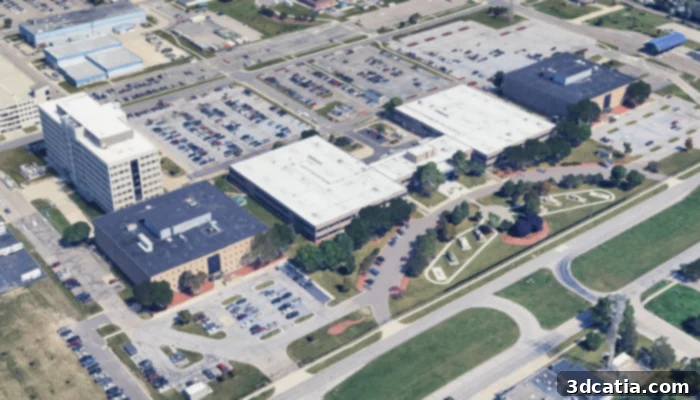
An aerial view of the Detroit Arsenal, where 3D printed panels will be installed by 2027. (Credit: Google Earth)
This visionary project is receiving crucial financial backing and strategic support from the Department of Defense’s Environmental Security Technology Certification Program (ESTCP). ESTCP’s endorsement is a clear indicator of the DoD’s unwavering commitment to actively exploring, rigorously testing, and ultimately implementing innovative, environmentally sound solutions that not only enhance environmental performance but also significantly reduce operational costs across its vast and complex portfolio of facilities. The anticipated success of this pilot program at the Detroit Arsenal holds immense promise, potentially serving as a pivotal benchmark and a highly scalable example for countless future applications across other federal buildings, military bases, and critical infrastructure sites throughout the United States. To meticulously ensure the robustness, efficacy, and long-term viability of the technology, a comprehensive test installation is already successfully underway at the National Renewable Energy Laboratory (NREL) in Colorado, providing invaluable real-world data, facilitating continuous refinement opportunities, and validating performance metrics. The culmination of this ambitious and collaborative effort, the finalized project at Detroit Arsenal, is strategically slated for completion by 2027. In an era increasingly marked by persistent budget constraints, escalating energy costs, and a heightened global awareness of climate change, public agencies are under continuous and immense pressure to identify and swiftly adopt scalable, low-carbon solutions for their extensive, often sprawling, and undeniably aging infrastructure. The precisely fabricated, 3D printed panels destined for Detroit Arsenal could very well emerge as a pivotal and transformative component of a comprehensive national strategy, expertly combining unprecedented levels of energy efficiency, accelerated deployment speed, and cutting-edge innovation, all powered by the revolutionary capabilities of additive manufacturing.
As we look towards the immediate and long-term future, the implications and potential impact of projects like the Detroit Arsenal retrofit extend far beyond the confines of a single building or military base. This groundbreaking initiative profoundly highlights the immense, untapped potential of 3D printing, or additive manufacturing, to fundamentally transform the entire construction industry, from conception to completion. From creating highly customized architectural components with intricate designs to rapidly deploying emergency shelters in disaster zones, the inherent flexibility, unparalleled precision, and material efficiency offered by robotic fabrication can unlock entirely new possibilities for sustainable, resilient, and significantly more cost-effective building practices. The unique ability to produce complex geometries and optimally utilize material, as masterfully demonstrated by Branch Technology’s C-Fab system, promises a future where buildings are not only dramatically more energy-efficient but also faster to construct, inherently more adaptable to evolving environmental standards, and crucially, built with a reduced environmental footprint. This pioneering project at Detroit Arsenal serves as a compelling and undeniable case study, unequivocally proving that advanced manufacturing technologies are no longer confined to specialized industries but are unequivocally ready to play a central, transformative role in modernizing critical infrastructure, drastically reducing our collective energy footprint, and paving the way for a more sustainable, innovative, and resilient built environment for generations to come.
What are your thoughts on these revolutionary 3D printed panels being installed at the Detroit Arsenal? How do you envision 3D printing playing an even greater, more impactful role in reducing energy consumption, combating heat loss, and advancing sustainable construction practices globally? We invite you to share your valuable insights, perspectives, and questions in a comment below or join the vibrant conversation on our LinkedIn or Facebook pages! For those eager to stay abreast of the very latest and most exciting developments in additive manufacturing, don’t forget to sign up for our free weekly Newsletter to get essential 3D printing news, insights, and analyses delivered directly to your inbox. You can also explore all our compelling and informative videos on our dedicated YouTube channel. Furthermore, for more in-depth coverage of 3D printing news specifically within the dynamic and rapidly evolving aerospace and defense sectors, we strongly encourage you to check out our dedicated page HERE.
*Cover Photo Credits: U.S Army