
Revolutionizing Industries: This Week’s Top 3D Printing Innovations and Breakthroughs
Welcome to our comprehensive overview of the most impactful advancements and exciting developments in the world of 3D printing from the past week. The additive manufacturing landscape continues to evolve at an astonishing pace, bringing forth innovations that promise to reshape various sectors, from civil engineering and interior design to DIY projects and advanced research. This week’s curated compilation delves into groundbreaking projects that exemplify the versatility and transformative power of 3D printing technology. We’ll start with a monumental achievement in infrastructure, witnessing India’s first 3D printed bridge. Following this, we explore the synergistic relationship between artificial intelligence and 3D printing, revolutionizing furniture design and production. We then transition to the exciting world of personal fabrication, where a powerful 3D printed bow and arrow comes to life. Further on, we take a fascinating virtual tour through an advanced manufacturing center, showcasing its cutting-edge capabilities. Finally, we conclude with a practical application of 3D printing as a beloved TV personality teams up to assemble a functional 3D printed padlock, while also introducing an exciting new platform for enthusiasts. Join us as we uncover these remarkable strides in additive manufacturing!
Top 1: India’s Pioneering 3D Printed Bridge – A Leap in Construction
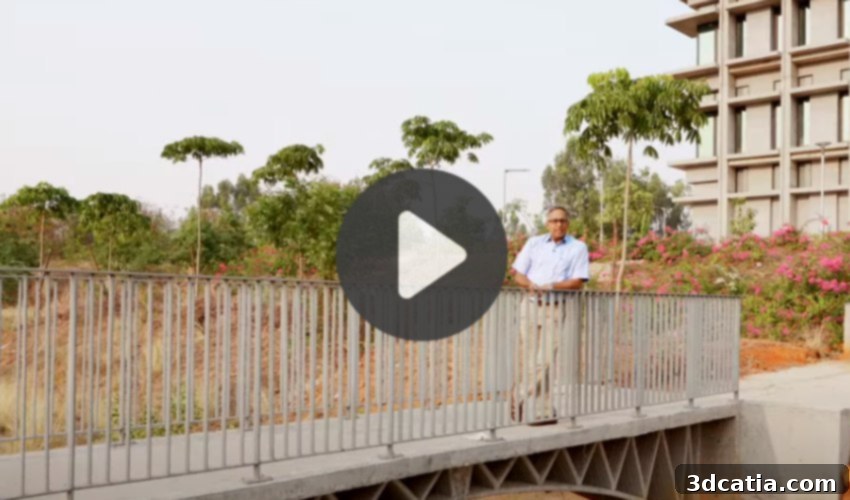
Leading our highlights this week is an extraordinary engineering feat from IIT Hyderabad: the unveiling of India’s very first 3D-printed bridge, situated prominently on the IIT Hyderabad campus. This project is more than just a bridge; it’s a tangible testament to the immense potential of additive manufacturing in civil infrastructure. Spanning an impressive 7.5 meters, the bridge was meticulously designed and printed in two distinct halves, demonstrating how large-scale structures can be modularly fabricated. A core principle guiding its design was the innovative concept of “material follows force.” This advanced structural optimization technique ensures that material is strategically deposited only where it is most needed to withstand stress, resulting in an exceptionally efficient and robust structure. Areas subjected to higher stress receive more material, while less-stressed zones utilize less, thereby minimizing waste and optimizing material usage. This approach not only enhances structural integrity but also significantly contributes to sustainability by reducing the overall material footprint. The successful execution of this prototype was a collaborative effort with Simply Forge Creations Limited, an emerging startup specializing in robotic arm-based 3D printing solutions. This partnership highlights the crucial role of innovative startups in pushing the boundaries of what’s possible with additive manufacturing. This pioneering bridge is envisioned to serve as a crucial prototype, paving the way for the widespread adoption of 3D printing technology in India’s rapidly developing infrastructure, particularly for structures requiring swift deployment and efficient material utilization in transportation networks.
Top 2: AI and 3D Printing Redefine Interior Design & Home Décor
Next, we delve into a fascinating intersection of cutting-edge technologies presented by the AI Waves Channel. This insightful video explores how the powerful combination of artificial intelligence (AI) and 3D printing is fundamentally transforming furniture design and manufacturing. The integration of AI allows for unprecedented levels of customization and efficiency, moving beyond traditional mass production towards a future of personalized interior solutions. One of the primary benefits highlighted is the ability to create bespoke, personalized designs that are precisely tailored to individual styles, aesthetic preferences, and the unique spatial requirements of any home or office. AI algorithms can generate complex geometries and ergonomic shapes that would be incredibly challenging, if not impossible, to produce using conventional manufacturing methods. Furthermore, the video emphasizes the eco-friendly aspects of this technological fusion. 3D printing, by its very nature, is an additive process, meaning it builds objects layer by layer, significantly reducing material waste compared to subtractive manufacturing. When combined with AI-driven optimization, this results in even more resource-efficient production methods. Real-world examples further illustrate this transformative potential: OpenAI’s ventures into customizable pieces showcase how AI can empower consumers with unique, adaptable furniture, while Forust’s innovative approach highlights furniture made from recycled wood waste, demonstrating a powerful commitment to circular economy principles. These examples underscore the immense innovative applications of AI in tandem with additive manufacturing (AM) technology, revealing a powerful synergy that promises a future of sustainable, personalized, and intelligently designed living spaces.
Top 3: The Art of Crafting a Functional 3D Printed Bow – A DIY Masterpiece
Third in our exciting lineup, we journey into the engaging world of do-it-yourself (DIY) projects and personal fabrication with 3DJake, who masterfully showcases the intricate build process of his 3D printed bow. This video is a fantastic demonstration of how 3D printing empowers hobbyists and makers to create functional, complex objects from their own workshops. Jake’s journey begins with the widely popular PETG filament, known for its strength and ease of printing. However, his quest for enhanced performance and durability leads him to experiment with various other advanced filament types, including PCTG and carbon fiber-infused variants. These materials are chosen for their superior mechanical properties, offering increased rigidity, impact resistance, and tensile strength—all critical for a functional bow. The video meticulously details the iterative design and testing process, a hallmark of effective engineering. Using an old luggage scale for in-depth evaluations, Jake rigorously assesses the draw weight and overall durability of each iteration, pushing the limits of the printed components. This process is not without its challenges; he encounters and openly discusses breakages at critical stress points, such as the riser, which serves as a valuable learning experience for aspiring 3D printers. Despite these hurdles, the final result is nothing short of remarkable: a surprisingly durable and powerful bow, demonstrating the incredible potential of consumer-grade 3D printers to produce high-performance, custom sporting equipment. This project not only entertains but also educates viewers on material science, design iteration, and the satisfying process of bringing a complex functional object to life through additive manufacturing.
Top 4: A Virtual Expedition into the AMCen Fabrication and Prototyping Laboratory
Our fourth highlight offers a privileged look behind the scenes, as AM Central Techtube provides an insightful virtual tour of the Advanced Manufacturing Center (AMCen) Fabrication and Prototyping Laboratory. This comprehensive tour showcases a facility at the forefront of additive manufacturing research and development, designed to push the boundaries of what 3D printing can achieve. Viewers are guided through various workshops, each equipped with an impressive array of advanced 3D printers and high-precision scanners. What truly sets this laboratory apart is its exceptional capability to print with an incredibly diverse range of materials. Beyond conventional plastics, the center boasts technologies capable of fabricating objects from various ceramics, offering unparalleled heat resistance and mechanical strength for specialized applications. It also handles a wide spectrum of polymers, from flexible elastomers to rigid composites, catering to diverse industrial needs. Critically, the lab features sophisticated metal additive manufacturing systems, enabling the creation of intricate, high-performance metal components for aerospace, medical, and automotive sectors. Perhaps most fascinatingly, the tour reveals capabilities in printing with even food-grade materials, hinting at future innovations in personalized nutrition and culinary design. Such a facility plays a pivotal role in accelerating innovation, enabling rapid prototyping for new product development, and conducting cutting-edge research across multiple disciplines. It serves as a vital hub for industry collaboration, academic research, and the training of the next generation of additive manufacturing engineers and designers, driving forward technological advancements that will shape future industries.
Top 5: Engineering a Durable 3D Printed Padlock with Adam Savage and Bill Doran
Finally, wrapping up our weekly highlights, we join two iconic figures in the maker community, Adam Savage and Bill Doran, as they collaborate to assemble a fully functional and durable 3D-printed padlock. This engaging segment is not just about building; it’s a deep dive into practical design considerations for additive manufacturing and an introduction to their exciting new venture, Gizmo Thrill. Gizmo Thrill is dedicated to providing high-quality, meticulously designed 3D printable models for enthusiasts and creators, aiming to make complex projects accessible. During the assembly process, Savage and Doran emphasize the paramount importance of creating designs that are not only aesthetically pleasing but also inherently easy to print and assemble. This means minimizing the need for extensive post-processing work, such as sanding, filing, or complex gluing, which can often deter hobbyists. They discuss critical design choices, such as reducing friction between moving parts to ensure smooth operation and precise alignment of components for reliable functionality. Achieving these goals requires careful attention to tolerances, material properties, and print orientation during the design phase. The duo showcases how thoughtful engineering can result in a robust and reliable mechanism, even when produced with a desktop 3D printer. This project beautifully illustrates the potential for 3D printing to create useful, everyday objects with customized features and enhanced durability. Their discussion offers invaluable insights into the intricacies of designing for additive manufacturing, providing practical tips for anyone looking to create functional mechanical parts using their 3D printer, while also demonstrating the exciting community and resource that Gizmo Thrill aims to foster for makers worldwide.
We hope this week’s dive into the world of 3D printing has been as inspiring and informative for you as it was for us! From monumental infrastructure projects to innovative home décor and engaging DIY creations, these highlights underscore the relentless pace of innovation in additive manufacturing. Which of these groundbreaking videos resonated most with you this week? Were you surprised by the capabilities demonstrated by India’s first 3D printed bridge, or perhaps captivated by the synergy of AI and 3D printing in furniture design? We’d love to hear your thoughts and insights! Share your favorite moment or your familiarity with these incredible projects in a comment below, or connect with us on our vibrant LinkedIn, Facebook, and Twitter pages. Don’t miss out on the latest advancements and breaking news in the additive manufacturing sector; make sure to sign up for our free weekly newsletter here to get essential 3D printing updates delivered straight to your inbox! You can also explore our extensive library of compelling content and all these featured videos, and more, directly on our YouTube channel. Stay curious, keep innovating, and continue exploring the endless possibilities of 3D printing!
*Cover Photo Credits: IIT Hyderabad