
Unleash Innovation: The Top 5 3D Printing Videos Driving the Future of Manufacturing
Welcome to our exclusive weekly roundup where we dive into the most compelling and innovative advancements in the world of additive manufacturing. Each week, we scour the digital landscape to bring you a curated selection of videos that highlight the incredible versatility and transformative power of 3D printing technology. From groundbreaking military applications to fostering creativity in children, and from cutting-edge scientific research to the preservation of ancient history, 3D printing continues to push the boundaries of what’s possible. Join us as we explore the week’s TOP 5 videos, designed to inform, inspire, and demonstrate the ever-expanding potential of this revolutionary field. We encourage you to watch, learn, and then share your thoughts! Tell us which video captivated you the most in the comments below, or connect with us on our Facebook and Twitter pages. Don’t forget to share these incredible innovations with your friends and colleagues, helping to spread awareness of how 3D printing is shaping our future.
TOP 1: U.S. Marines Pioneers Battlefield Additive Manufacturing with Mobile 3D Printing Laboratory
The United States military continues to demonstrate its significant interest in leveraging the strategic advantages of additive manufacturing, and the Marine Corps is at the forefront of this innovation. Their latest groundbreaking experimentation involves the deployment of a fully stand-alone, mobile 3D printing laboratory, aptly named X-FAB. This cutting-edge mobile unit is designed to provide an unprecedented operational advantage to marines operating in diverse and often challenging environments. The X-FAB empowers troops with on-demand manufacturing capabilities, allowing them to rapidly produce critical parts, tools, and experimental components directly in the field. This significantly reduces reliance on lengthy and complex supply chains, which can be vulnerable in combat zones. The ability to fabricate custom solutions for immediate needs – from repairing vital equipment to creating specialized prototypes for specific missions – enhances tactical flexibility, improves readiness, and ultimately saves time and resources. This mobile additive manufacturing facility represents a crucial step towards a more agile and resilient military, capable of adapting swiftly to unforeseen circumstances and maintaining operational superiority through localized production.
TOP 2: Sparking Young Imaginations: The Toybox 3D Printer for Kids
In a world increasingly driven by technology, introducing children to innovative tools from an early age is paramount. The Toybox 3D printer steps up to this challenge, designed specifically as a kid-friendly device that unleashes a torrent of creativity and imagination. This revolutionary printer transforms abstract ideas into tangible objects, allowing children to bring their wildest concepts to life with ease. What truly sets the Toybox apart is its intuitive mobile application, a vibrant digital playground that is continuously updated with an expanding catalog of exciting new toys and objects ready for printing and customization. Beyond simply selecting pre-designed items, the app empowers both children and their parents with the unique opportunity to design and print their very own original creations. This fosters essential STEM skills, encouraging problem-solving, design thinking, and an understanding of engineering principles in a fun and engaging way. The Toybox isn’t just a printer; it’s a gateway to discovery, nurturing the next generation of innovators and makers by making complex 3D printing technology accessible and enjoyable for the entire family. It’s a brilliant tool for education and play, providing endless possibilities for creative expression right from the comfort of home.
TOP 3: The Unseen World: Advanced X-ray Technology Enhances 3D Printing Reliability
The future of industrial 3D printing hinges on precision, reliability, and the consistent production of high-quality parts. Addressing these critical needs, scientists at the National Laboratory of Argonne, one of the United States’ most prestigious and largest research facilities, are pioneering groundbreaking techniques to revolutionize additive manufacturing. Their innovative approach involves utilizing incredibly powerful X-rays to observe and analyze the physical functioning of the 3D printing process in unprecedented real-time detail. This advanced X-ray imaging system boasts an astonishing resolution of 50,000 images per second, providing an almost microscopic view of material behavior during each deposition layer. This unparalleled visibility allows researchers to detect the formation of minute defects, anomalies, and structural inconsistencies as they occur, rather than after the print is complete. By understanding the real-time dynamics of material fusion and solidification, scientists can identify the root causes of common printing flaws. This technology promises to be a game-changer for various industries, enabling them to optimize printing parameters, develop more robust materials, and ultimately produce highly reliable and structurally sound parts. The goal is to move beyond mere experimentation, delivering a future where industrial additive manufacturing consistently yields flawless components for critical applications in aerospace, medical, automotive, and beyond, significantly reducing waste and increasing product safety.
TOP 4: Robogami: Crafting Custom Robots with Foldable 3D Printed Designs
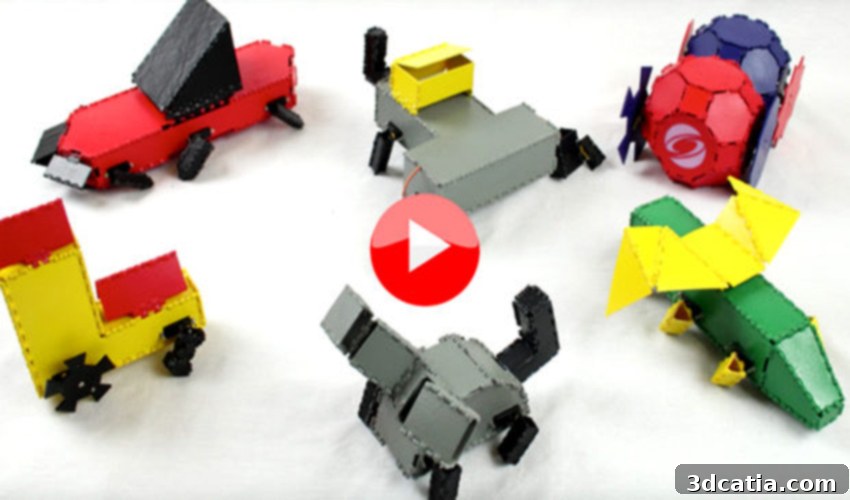
The field of robotics is rapidly evolving, demanding greater flexibility, customization, and ease of assembly. The Computer Science and Artificial Intelligence Laboratory (CSAIL) at MIT is pushing these boundaries with its revolutionary “Robogami” system, which makes the customization and creation of robots more accessible and efficient than ever before. Inspired by the traditional Japanese art of origami, Robogami leverages advanced computational design and 3D printing to create complex robots from simple, foldable components. The system developed by the CSAIL lab empowers users to design and assemble a diverse range of robots from a comprehensive catalog of pre-existing, modular parts. This approach drastically simplifies the prototyping process, allowing for rapid iteration and experimentation without the need for intricate engineering expertise or specialized manufacturing equipment. Users can select and combine different body segments, actuators, and sensors, then 3D print these components which are designed to fold into complex three-dimensional structures. This innovative method not only reduces manufacturing complexity and cost but also opens up new avenues for educational robotics, rapid development of specialized robots for niche applications, and even personalized robotics for home or professional use. Robogami represents a significant leap towards democratizing robot design and manufacturing, making sophisticated robotic solutions achievable for a wider audience.
TOP 5: Bridging Millennia: 3D Printing Recreates Ancient Han Dynasty Swords
3D printing is not just about forging the future; it’s also a powerful tool for reconnecting with and preserving the past. This week’s final highlight comes from China, where a dedicated sword collector faced a unique challenge. In his possession were exquisite jade pieces that once adorned ancient swords dating back to the illustrious Han Dynasty, a period of immense cultural and technological advancement that began approximately 2,000 years ago. While the jade ornaments provided a glimpse into the artistry of the era, the collector was left with a profound curiosity: what would these magnificent swords have looked like in their complete, original form? To transform this historical intrigue into a tangible reality, the collector turned to the remarkable capabilities of 3D printing technology. By meticulously scanning the existing jade components and leveraging historical research and archaeological data, specialists were able to digitally reconstruct the full dimensions and intricate details of the missing sword blades and hilts. Subsequently, these digital models were brought to life through 3D printing, creating accurate and breathtaking replicas of the ancient weapons. This project beautifully illustrates how additive manufacturing can play a pivotal role in cultural heritage preservation, archaeological reconstruction, and educational outreach. It allows us to experience history in a new dimension, bringing artifacts that would otherwise remain incomplete back to their original splendor and providing invaluable insights for historians, enthusiasts, and the public alike. Check out the incredible transformation below.