
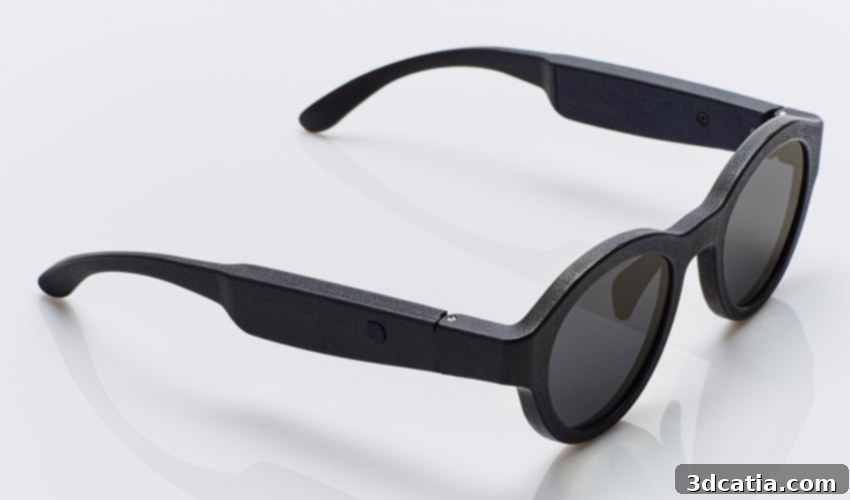
Abeye’s Lexilens Glasses: Revolutionizing Dyslexia Support Through Advanced 3D Printing
Emerging from the vibrant French medtech landscape, Abeye is a dynamic young company, significantly bolstered by the established expertise of Atol Les Opticiens. This innovative startup is dedicated to enhancing individual well-being through cutting-edge electronic glasses. Following the remarkable success of its inaugural product, Spectalert – a revolutionary device designed to detect falls in elderly individuals – Abeye has once again pushed the boundaries of assistive technology with its latest offering: Lexilens. These groundbreaking glasses are specifically engineered to significantly ease the reading experience for people living with dyslexia, addressing a challenge that affects millions globally.
The development of Lexilens, and its profound implications for accessibility, garnered significant attention from 3Dnatives due to Abeye’s strategic reliance on additive manufacturing. This advanced production method proved indispensable, not only in accelerating the critical prototyping phase but also in enabling the efficient industrialization of the initial production units. This choice highlights a growing trend where innovative medical technology startups are harnessing the power of 3D printing to bring complex solutions to market with unprecedented speed and precision.
Abeye’s Vision: Bridging Technology and Well-being
Abeye’s foundational philosophy centers on leveraging technological advancements to solve real-world problems that impact daily life and overall well-being. Their journey began with Spectalert, a clear demonstration of their commitment to practical, life-improving solutions. Spectalert’s success in providing peace of mind and enhanced safety for the elderly population laid a strong groundwork for the company’s subsequent innovations. This focus on tangible, user-centric benefits is a hallmark of Abeye’s approach, positioning them as a key player in the evolving medtech sector.
With Lexilens, Abeye tackles an entirely different, yet equally pressing, challenge: dyslexia. This learning difficulty affects how individuals process written language, often leading to significant struggles with reading comprehension, speed, and overall academic or professional performance. Traditional interventions often involve extensive therapy and coping strategies. Lexilens offers a direct, technological solution designed to alleviate one of the most common visual distortions experienced by dyslexic readers.
Lexilens: A New Horizon for Dyslexia
The core functionality of Lexilens glasses is remarkably simple yet incredibly effective. With a mere push of a button, users can activate a specialized filter embedded within the lenses. This filter works to eliminate the “mirror images” or visual distortions that many individuals with dyslexia perceive when reading. These distortions often manifest as letters appearing to move, overlap, or flip, making it incredibly difficult to decipher text. By neutralizing these visual interferences, Lexilens aims to provide a clearer, more stable reading experience, thereby reducing the cognitive load and frustration associated with reading for dyslexic individuals.
The implications of such a device are far-reaching. For children struggling with dyslexia, Lexilens could transform their educational journey, fostering greater confidence and participation in learning. For adults, it promises improved efficiency in professional settings and enhanced enjoyment of everyday activities like reading books or navigating digital content. By making reading more accessible and less strenuous, Abeye is not just offering a visual aid; they are opening doors to greater independence, educational attainment, and overall quality of life for millions who have historically faced significant barriers in the literate world. The development of Lexilens represents a significant leap forward in assistive technology, showcasing the potential of innovative engineering to address deeply personal and pervasive challenges.
The Crucial Role of Additive Manufacturing in Innovation
The journey from concept to a tangible, market-ready product like Lexilens is often fraught with design complexities, iterative improvements, and the need for rapid validation. This is precisely where additive manufacturing, commonly known as 3D printing, proved to be an indispensable asset for Abeye. Unlike traditional manufacturing methods such as injection molding, which require expensive tooling and lengthy production cycles for each design change, 3D printing allows for unparalleled design freedom and agility. This capability was critical for Abeye, enabling them to rapidly iterate on various frame designs and internal component layouts for the Lexilens glasses without prohibitive costs or delays.
3Dnatives had the exclusive opportunity to delve deeper into the manufacturing process of these innovative glasses by meeting with Michaël Kodochian, the visionary founder and CEO of Abeye. His insights underscored the vital role that additive manufacturing played throughout the entire research and development lifecycle of Lexilens. The ability to quickly produce physical prototypes from digital designs meant that Abeye could test, refine, and optimize the ergonomic and functional aspects of the glasses at an accelerated pace. Each iteration brought them closer to the ideal balance of comfort, durability, and technological integration, a process that would have been significantly more time-consuming and expensive using conventional techniques.
Partnership with ERPRO and HP Multi Jet Fusion
To bring Lexilens to life, Abeye forged a strategic partnership with ERPRO, a renowned 3D printing service bureau known for its extensive expertise and state-of-the-art facilities. This collaboration was instrumental, leveraging ERPRO’s deep knowledge to navigate the complexities of advanced additive manufacturing. ERPRO’s team guided Abeye through every phase of the manufacturing journey, from the critical initial selection of the most suitable 3D printing technology to the intricate details of post-processing, ensuring that the final product met stringent quality and performance standards. Their comprehensive support was key to translating Abeye’s innovative vision into a manufacturable reality.
The technology chosen for the production of Lexilens was HP’s Multi Jet Fusion (MJF). This sophisticated 3D printing process was particularly well-suited for the project due to its unique combination of benefits. MJF offers exceptional productivity, allowing for the rapid production of multiple parts simultaneously, which was crucial for both prototyping and the initial pre-series industrialization. Furthermore, it delivers high dimensional precision, a non-negotiable requirement for medical devices like glasses where fit, alignment, and comfort are paramount. The ability of MJF to produce parts with excellent mechanical properties and fine feature detail also meant that the complex internal components of the Lexilens frame could be realized with the necessary integrity and functionality.
Nicolas Aubert, the Director of 3D Printing for HP France, elaborated on the technical achievement behind Lexilens. He stated, “The manufacture of Lexilens 3D printed glasses is exceptional since it is the first multi-component product printed with such complexity of assembly. No less than 9 components!” This statement underscores the engineering marvel achieved through the collaboration. To have nine distinct components, each precisely designed and intricately integrated into a single, functional eyewear frame, using additive manufacturing, is a testament to the advanced capabilities of HP Multi Jet Fusion technology and the expertise of ERPRO. This level of complexity would be incredibly challenging, if not impossible, to achieve efficiently and cost-effectively with traditional manufacturing techniques.
From Concept to Reality: The Manufacturing Journey
The journey of Lexilens from an innovative idea to a tangible, life-changing product exemplifies the transformative power of modern manufacturing and collaborative partnerships. Abeye, with its pioneering vision, recognized the need for a solution that directly addresses the visual challenges of dyslexia. Their initial concepts were brought to ERPRO, whose expertise as a leading 3D printing service was critical. ERPRO’s role extended beyond mere production; they were strategic partners, advising on material selection, design optimization for additive manufacturing, and ensuring the seamless integration of all nine complex components into a cohesive, functional frame.
The implementation of HP Multi Jet Fusion technology by ERPRO allowed Abeye to not only accelerate its product development cycle but also to achieve significant cost optimizations. By designing components specifically for 3D printing, it was possible to consolidate parts, reduce material waste, and streamline assembly processes. This efficiency was pivotal in enabling Abeye to move from rapid prototyping to reliable pre-series production, ensuring that the initial units of Lexilens could be manufactured consistently and to a high standard. The synergy between Abeye’s innovative design, ERPRO’s manufacturing prowess, and HP’s advanced technology created a powerful ecosystem that brought this complex medical device to market with unprecedented speed and precision. More detailed information can be found on the official Abeye website HERE.
The Future of Assistive Technology: Beyond Lexilens
Abeye’s current offering of Lexilens is specifically tailored for children, addressing a critical need during formative years of education. However, the startup’s vision extends far beyond this initial model. Abeye is actively developing plans to introduce an adult-sized version of Lexilens, acknowledging that dyslexia impacts individuals across all age groups and continues to pose challenges in professional and personal life. This expansion underscores their commitment to providing comprehensive solutions that cater to a broader demographic, ensuring that the benefits of their innovative technology are accessible to everyone who needs them.
The success of Lexilens also serves as a powerful testament to the transformative potential of combining medtech innovation with advanced manufacturing techniques like 3D printing. This approach allows for the creation of highly specialized, personalized devices that would be impractical or prohibitively expensive to produce using traditional methods. As 3D printing technology continues to evolve, we can anticipate even more sophisticated and integrated medical solutions emerging, pushing the boundaries of what is possible in assistive technology and patient care. Abeye is at the forefront of this exciting revolution, demonstrating how agility, technological foresight, and strategic partnerships can lead to products that genuinely improve lives.
The journey of Abeye and Lexilens highlights a significant shift in how medical devices can be conceived, developed, and brought to market. By embracing the flexibility and efficiency of additive manufacturing, Abeye has not only created a ground-breaking product for dyslexia but has also set a precedent for future innovations in the medtech sector. The potential for customized, highly functional, and cost-effective solutions for various medical conditions is immense, and Abeye is proudly leading the charge in this exciting new era.
We encourage you to watch the insightful report embedded above for a more visual and in-depth look at Abeye’s incredible work and the manufacturing process of Lexilens. Your thoughts and feedback are invaluable to us! Let us know what you think in a comment below, or connect with us on our Facebook, Twitter, and LinkedIn pages. To stay updated with the very latest in 3D printing news and innovations, sign up for our free weekly Newsletter here, delivered straight to your inbox!