
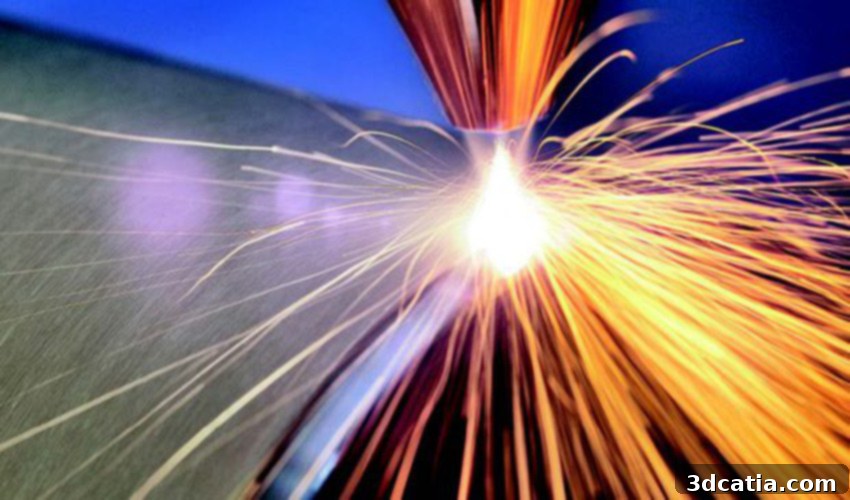
TRUMPF’s EHLA System: Revolutionizing High-Speed Metal Coating and Industrial Additive Manufacturing
TRUMPF’s latest innovation, the EHLA laser-metal coating system, marks a monumental leap forward in industrial surface technology, epitomized by two critical advancements: “faster” and “more efficient.” Developed in collaboration with the esteemed Fraunhofer Institute for Laser Technology (ILT) in Aachen, Germany, this groundbreaking system boasts a processing speed up to 100 times greater than conventional laser deposition welding (LDW) processes. This dramatic acceleration doesn’t just represent an incremental improvement; it fundamentally redefines possibilities for the German manufacturing powerhouse, enabling cost-effective series production and opening vast new applications across diverse industries at unparalleled speeds. This development firmly positions TRUMPF at the forefront of additive manufacturing, particularly in the realm of high-performance metal coating and repair, promising significant advancements in industrial efficiency and component longevity.
At its core, EHLA stands for ‘Extreme High-Speed Laser Deposition Welding’ – a name that aptly captures its primary distinction. It builds upon the well-established principles of laser deposition welding, which is widely recognized as one of the most robust and versatile methods for applying high-quality metal coatings. LDW creates exceptionally strong, metallurgical bonds between the applied material and a substrate, allowing for durable and functional layers on components made from a broad spectrum of metals and alloys. Traditionally, this technology has been employed for repairing high-value parts, modifying surfaces for enhanced wear or corrosion resistance, and adding functional features to existing components. However, a significant hurdle for widespread adoption, especially for large-area coatings or high-volume production, has always been the relatively slow deposition rates inherent in the conventional process.
The conventional laser deposition welding method involves using a precisely focused laser beam to create a molten pool on the surface of a component. Simultaneously, a metal powder is meticulously fed into this molten pool, where it melts and fuses with the substrate material, building up a new layer. While highly effective for creating dense, high-quality deposits with minimal heat input into the base material, the rate at which these layers can be applied has limited its throughput. Covering large surfaces or processing numerous parts often proved time-consuming and, consequently, expensive. TRUMPF’s EHLA innovation directly addresses this limitation, achieving unparalleled deposition rates of more than 250 cm² per minute – a remarkable achievement that transcends previous industry benchmarks and firmly establishes TRUMPF as a leader in industrial metal additive manufacturing solutions for advanced surface technology.
The EHLA system is 100 times faster than other processes that currently exist
This extraordinary increase in processing speed and efficiency was made possible by a clever and fundamental adjustment to the traditional laser deposition welding process. In conventional LDW, the laser’s primary role is to create and maintain a molten pool on the component’s surface, into which the powder is then fed and melted. EHLA, however, reconfigures this dynamic. Instead of relying solely on the melt pool to fuse the powder, the EHLA system uses the laser to pre-heat the metal powder filler material *above* the actual weld spot, even before it makes contact with the substrate. This crucial pre-heating step drastically lowers the energy required for the powder to melt once it enters the weld pool, effectively accelerating the entire deposition process and enhancing energy efficiency.
By pre-melting the powder mid-air, EHLA significantly reduces the time it takes for the material to achieve a molten state and fuse with the base material. This innovative approach allows for much higher feed rates of powder and faster traverse speeds of the laser head across the component’s surface, directly contributing to the phenomenal 100-fold increase in processing speed compared to conventional methods. The result is a highly efficient and rapid coating process that maintains the exceptional quality and metallurgical bonding characteristics of traditional laser deposition welding, but without the associated time penalties. This technological breakthrough is a testament to sophisticated laser control and material science, pushing the boundaries of what is achievable in advanced metal surface treatment and additive manufacturing for industrial applications.
Beyond its exceptional speed, the EHLA method introduces another critical advantage: the ability to produce significantly thinner layers than previously thought possible with laser deposition welding. While traditional LDW typically yields minimum layer thicknesses around 500 micrometers (half a millimeter), EHLA can achieve remarkable layer thicknesses ranging from a mere 10 micrometers up to 300 micrometers. This leap in precision opens up entirely new avenues for applications where fine features, minimal material addition, or superior surface finish are paramount, making it suitable for a wider array of high-tech components and designs.
The capacity to deposit such thin layers has multiple profound implications for industrial manufacturing. Firstly, it allows for greater geometric accuracy and the creation of highly detailed functional surfaces with improved topographical characteristics. Secondly, it drastically reduces the amount of material that needs to be removed during post-processing operations like machining or grinding. In many cases, the “near-net-shape” quality of EHLA-coated parts can minimize or even eliminate the need for extensive finishing, leading to significant cost savings, reduced production time, and less material waste. This enhanced precision not only makes the process more economical and environmentally sustainable but also expands its suitability for high-precision components in demanding sectors like aerospace, medical technology, and micro-electromechanical systems (MEMS), where surface quality and dimensional accuracy are non-negotiable.
TRUMPF has already incorporated EHLA into some of their 3D printers
TRUMPF’s strategic vision is to seamlessly integrate this revolutionary EHLA development into their existing and future production systems, making this advanced technology accessible to a broad range of industrial users. Antonio Candel-Ruiz, a laser specialist at TRUMPF, highlighted this commitment, explaining that the company has already ensured compatibility with a series of their well-established machines. This forward-thinking approach means that manufacturers can leverage the benefits of EHLA within familiar and proven hardware platforms, minimizing the learning curve and accelerating adoption for high-volume production and complex repair tasks.
Among the systems already compatible with the EHLA process are TRUMPF’s highly regarded TruLaser Cell 3000 and TruLaser Cell 7000. The TruLaser Cell 3000 is renowned for its precision and flexibility in processing small and medium-sized parts, making it ideal for intricate coating applications or the repair of delicate components where fine detail and accuracy are paramount. Conversely, the TruLaser Cell 7000 is engineered for large-scale parts, demonstrating EHLA’s scalability and its potential to coat expansive surfaces or repair substantial industrial machinery efficiently and economically. TRUMPF further stated that the new EHLA technique is not limited to these specific models but can also be adapted and added to other 3D printing and laser processing systems, underscoring its versatility and potential for widespread adoption across the additive manufacturing landscape.
The implications for various industries are immense, offering solutions for enhanced durability, performance, and sustainability. In the **automotive sector**, EHLA can be used for applying highly wear-resistant coatings to engine components, brake discs, or transmission parts, significantly extending their lifespan, enhancing performance, and reducing maintenance costs. For the **aerospace industry**, where component repair and lightweighting are critical, EHLA offers a fast and precise method for rebuilding worn-out turbine blades or applying corrosion-protective layers to structural elements, reducing costly replacements and improving operational safety. The **tool and mold making industry** can benefit immensely from EHLA by coating tools and molds with harder, more durable materials to increase their resistance to wear and friction, thereby extending tool life, improving product quality, and minimizing costly downtime in production lines. Moreover, in general **mechanical engineering**, EHLA presents a sustainable and efficient solution for repairing expensive industrial components, turning damaged parts into like-new condition, thus supporting the principles of a circular economy and significantly reducing material waste and carbon footprint. This ability to deposit functional materials precisely and rapidly makes EHLA a truly transformative technology for industrial surface enhancement and advanced additive repair across a multitude of applications.
The introduction of TRUMPF’s EHLA system marks a pivotal moment in the evolution of metal surface technology and additive manufacturing. By dramatically increasing processing speed while simultaneously enhancing precision and material efficiency, EHLA addresses many of the long-standing challenges associated with industrial-scale metal coating and component repair. This innovation not only boosts productivity and reduces costs for manufacturers but also opens the door to developing entirely new products and applications that were previously impractical due to technical or economic limitations. It sets a new standard for how quickly and precisely metal surfaces can be modified or restored.
As industries increasingly embrace digitalization and advanced manufacturing techniques, technologies like EHLA will play a crucial role in shaping the factories of the future. TRUMPF’s commitment to continuous innovation, exemplified by this collaboration with the Fraunhofer Institute, reinforces its position as a global leader in high-tech solutions for industrial production. The EHLA process is more than just a faster way to coat metals; it’s a catalyst for innovation, promising a future where durable, high-performance components can be produced and maintained with unprecedented speed, efficiency, and sustainability, driving forward the capabilities of modern manufacturing.
What do you think of the EHLA process? Let us know in a comment below or on our Facebook or Twitter page! Don’t forget to sign up for our free weekly Newsletter, with all the latest news in 3D printing delivered straight to your inbox!