
Revolutionizing Maritime Defense: Al Seer Marine’s 3D Printed Hydra USV Propels Naval Innovation
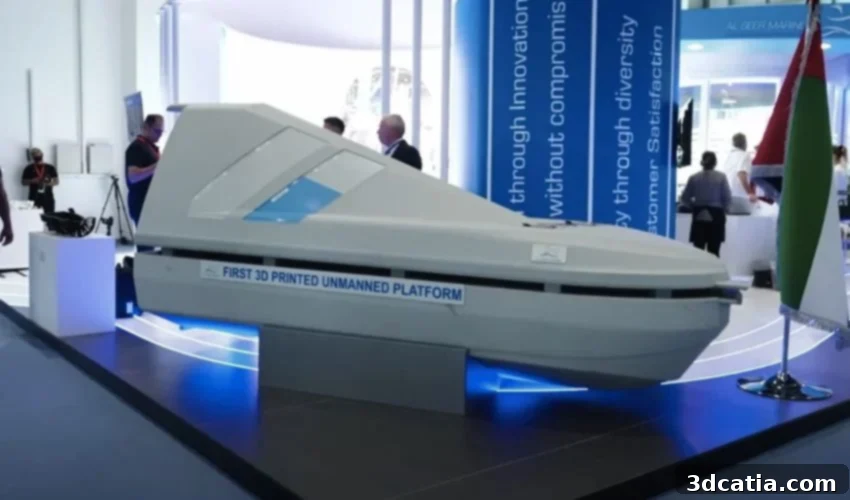
Al Seer Marine, a distinguished leader in marine equipment manufacturing headquartered in the strategically vital city of Abu Dhabi, United Arab Emirates, has recently embarked on a groundbreaking journey into the world of advanced manufacturing. This innovative leap sees the company leveraging the transformative power of 3D printing to develop Hydra, a pioneering 3D printed unmanned surface vessel (USV). While currently presented as a visionary concept, Hydra has already captured global attention, being hailed as the first such advanced model to be publicly unveiled. Its grand debut took place at the prestigious NAVDEX 2023 exhibition in Abu Dhabi, a pivotal international event that congregates key stakeholders from the maritime and defense industries. This platform provided the ideal stage for Al Seer Marine to showcase its commitment to cutting-edge technology and future-proofing naval capabilities. The vessel, meticulously designed and engineered by Al Seer Marine, boasts a length of 5 meters and an impressively lightweight structure, weighing in at just 350 kg. This remarkable feat of engineering is widely believed to have been achieved within the company’s own state-of-the-art 3D printing factory, signaling a significant in-house additive manufacturing capability.
The realization of the Hydra project was made possible through a strategic collaboration with the Dutch 3D printer manufacturer CEAD, a specialist renowned for its large-scale additive manufacturing solutions. CEAD supplied Al Seer Marine with a sophisticated composite 3D printing system, which was instrumental in fabricating integral parts of the vessel. This partnership saw Al Seer Marine benefit immensely from CEAD’s innovative AM Flexbot technology. The AM Flexbot is a highly flexible robotic solution specifically engineered for large-scale additive manufacturing applications, enabling the rapid and precise production of substantial components. This technology allows for unprecedented design freedom and material efficiency, crucial for developing advanced maritime platforms. Although Al Seer Marine, a proud UAE-based entity, has maintained a level of discretion regarding the specific components of Hydra that incorporate 3D-printed elements, the application of such technology often targets complex geometries, lightweight structures, and parts requiring rapid prototyping and iteration. CEAD’s expertise in this domain is well-established, with a notable track record in the automotive sector, exemplified by the ZEM. The ZEM is an eco-friendly car featuring 3D printed parts that notably captures more carbon dioxide than it produces, underscoring CEAD’s commitment to sustainable and innovative manufacturing practices across diverse industries.
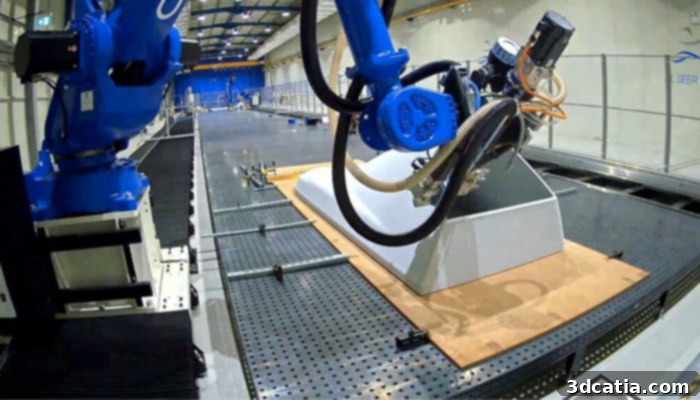
CEAD’s Flexbot technology was used to 3D print the vessel (photo credits: Al Seer Marine)
Accelerated Innovation: Hydra’s Five-Day Genesis Through Additive Manufacturing
One of the most compelling aspects highlighting the transformative impact of 3D printing on the manufacturing of this unmanned vessel is the astonishing speed of its construction. In a testament to the efficiency of additive manufacturing, Al Seer Marine proudly announced that the physical fabrication of Hydra was accomplished in an extraordinary five days. This rapid turnaround time stands in stark contrast to traditional shipbuilding methods, which often entail lengthy and complex processes stretching over months or even years. The expedited production timeline for Hydra includes the initial design conceptualization and intricate engineering work, demonstrating the unparalleled agility and iterative capabilities that 3D printing brings to complex projects. This allows for faster prototyping, quicker design validation, and a significantly reduced development cycle, crucial for staying ahead in rapidly evolving technological landscapes like autonomous maritime systems.
Currently, Hydra exists as a proof-of-concept prototype, serving as a dynamic platform for ongoing research and development. Al Seer Marine is actively engaged in refining and expanding the capabilities of the system provided by CEAD. Their objective is to produce an even greater proportion of 3D printed parts for integration into future iterations of the vessel. This continuous development strategy underscores the company’s long-term vision for adopting and perfecting additive manufacturing techniques to enhance performance, reduce weight, optimize structural integrity, and explore novel design possibilities that are virtually impossible with conventional manufacturing. The ability to quickly iterate designs and integrate improvements directly into the manufacturing process provides a strategic advantage, allowing Al Seer Marine to adapt rapidly to emerging operational requirements and technological advancements in the unmanned systems domain. This forward-thinking approach ensures that Hydra, and subsequent vessels, will embody the pinnacle of modern marine technology.
Hydra’s Strategic Role and Future Enhancements in Autonomous Maritime Operations
Attendees at the NAVDEX 2023 exhibition were treated to an immersive experience, observing Hydra in simulated action through a compelling video presentation released by Al Seer Marine. This visual showcase provided valuable insights into the USV’s potential operational dynamics and capabilities. Building on this momentum, representatives from the company revealed exciting future plans, including the development of an even lighter and more advanced unmanned drone boat model, which will also extensively utilize 3D printing technologies in its construction. This commitment to continuous innovation highlights Al Seer Marine’s ambition to push the boundaries of what is possible in autonomous maritime systems, particularly in areas of stealth, speed, and endurance.
Further enhancing Hydra’s strategic profile, the Emirates-based company confirmed that future versions of the vessel would feature an integrated mast, meticulously printed using additive manufacturing techniques. This integrated design not only optimizes the vessel’s hydrodynamics and reduces its radar cross-section, contributing to its stealth capabilities, but also allows for a more streamlined and efficient installation of sensors and communication equipment. Furthermore, Hydra will be powered by advanced electric motors, underscoring a commitment to environmental sustainability, reduced acoustic signatures for covert operations, and enhanced operational efficiency. The adoption of electric propulsion systems aligns with global trends towards greener maritime solutions and provides significant tactical advantages for unmanned platforms requiring prolonged stealth and minimal logistical footprint. Once fully developed and operational, Hydra is envisioned to serve as a high-tech stealth ship, primarily designated for critical intelligence, surveillance, and reconnaissance (ISR) missions. Its autonomous nature, combined with advanced sensor payloads and covert operational capabilities, will make it an invaluable asset for maritime security, border protection, environmental monitoring, and tactical data collection in challenging and sensitive environments. The ability to deploy such a sophisticated platform rapidly and cost-effectively through 3D printing positions Al Seer Marine at the forefront of naval technology, ready to meet the evolving demands of modern maritime defense and security.
The introduction of Hydra represents a significant milestone not just for Al Seer Marine and the UAE, but for the global maritime and defense sectors. It demonstrates the immense potential of additive manufacturing to accelerate development cycles, optimize design, and create high-performance, specialized vessels with unprecedented efficiency. This shift towards 3D printed unmanned platforms is set to redefine how naval assets are designed, produced, and deployed, offering advantages in cost, lead time, and adaptability. As nations increasingly invest in autonomous systems for diverse applications, Al Seer Marine’s pioneering work with Hydra serves as a compelling case study for the integration of advanced manufacturing into critical defense capabilities. For more detailed information about Al Seer Marine’s diverse portfolio and future initiatives, please visit their official website by clicking HERE.
Engage with the Future of Maritime Technology
What are your thoughts on Hydra, Al Seer Marine’s groundbreaking 3D printed unmanned surface vessel? Do you believe additive manufacturing will revolutionize the future of maritime defense and exploration? We invite you to share your insights and opinions in the comments section below. Join the conversation and connect with us on our professional LinkedIn, engaging Facebook, and dynamic Twitter pages! Stay ahead of the curve with the latest advancements in additive manufacturing by signing up for our free weekly Newsletter here, delivering cutting-edge 3D printing news directly to your inbox. Additionally, explore a wealth of video content and expert interviews on our dedicated YouTube channel, where innovation comes to life.
*Cover photo credits : Naval News