
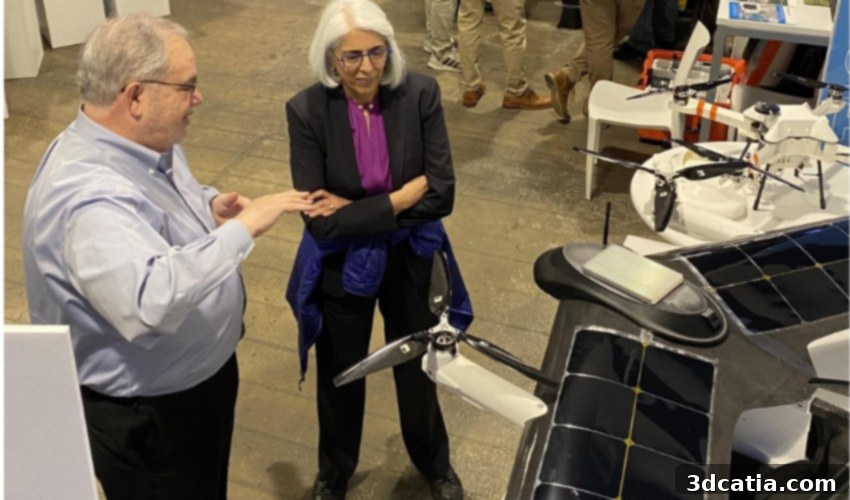
Hopper Drone: Pioneering Autonomous Maritime Surveillance with Advanced 3D Printing and Swarm Technology
In a groundbreaking collaboration, MITRE, a leading US federally funded research and development organization specializing in defense, has teamed up with the Office of Naval Research (ONR) to unveil a remarkable innovation in maritime defense and research: the Hopper drone. This small, uncrewed aerial vehicle (UAV) represents a significant leap forward, engineered to operate autonomously at sea for extended periods. The Hopper is not just another drone; it’s a testament to advanced engineering, set to redefine surveillance capabilities, marine research methodologies, and defense strategies across vast ocean expanses. Its development underscores a commitment to integrating cutting-edge technology to enhance national security and scientific exploration without risking human lives or incurring prohibitive costs.
Revolutionizing Design and Production with 3D Printing
A cornerstone of the Hopper project’s success lies in its pioneering adoption of advanced 3D printing technology, also known as additive manufacturing. Engineers at MITRE have skillfully leveraged this transformative process to fabricate the drone’s airframe and intricate components with unprecedented speed, precision, and cost-effectiveness. This modern approach to manufacturing drastically accelerates the prototyping and production cycles, allowing for rapid iterations and quick deployment of modified designs. Unlike traditional manufacturing methods, 3D printing enables the creation of complex geometries and lightweight structures that are ideally suited for aerial vehicles, optimizing aerodynamic performance and structural integrity while minimizing overall weight.
While specific details regarding the exact 3D printing technology employed for the Hopper drone remain undisclosed, the industry commonly utilizes various methods for similar applications. Technologies such as Fused Deposition Modeling (FDM) are popular for their versatility and ability to print with a wide range of thermoplastic materials, offering a balance of strength and flexibility. Selective Laser Sintering (SLS), on the other hand, excels in producing highly durable and complex parts from powdered materials like nylon, often used for demanding aerospace components due to its superior mechanical properties. The choice of additive manufacturing not only facilitates rapid fabrication but also supports material optimization, allowing engineers to select specific polymers or composite materials that offer optimal strength-to-weight ratios and resistance to harsh maritime conditions, including saltwater exposure and extreme temperatures.
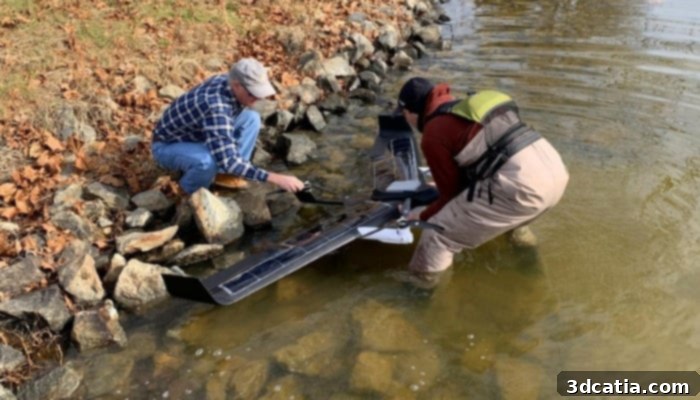
MITRE engineers Dave Sheffler and Tyler Paige prepare to deploy Hopper at Lake Anna State Park in Virginia.
This innovative manufacturing strategy extends the drone’s utility far beyond traditional military applications, opening doors to a multitude of civil activities. The ability to quickly customize and adapt drone designs allows for tailored solutions in various scenarios, from humanitarian aid to environmental protection. For instance, the Hopper can be rapidly configured for specialized search and rescue missions, equipped with specific sensors to detect survivors or locate distress signals. Its adaptability also makes it invaluable for monitoring meteorological events, providing real-time data on atmospheric conditions and oceanographic changes, crucial for weather forecasting and climate research. Furthermore, its discreet and persistent surveillance capabilities make it an effective tool in combating illicit activities such as illegal fishing, drug trafficking, and piracy, offering a vigilant eye over vast and often unmonitored maritime territories.
Key Features of the Hopper Drone
The Hopper drone is distinguished by a suite of advanced features that collectively position it as a game-changer in maritime operations. These innovations address long-standing challenges in persistent ocean surveillance and data collection, offering solutions that are both cost-effective and highly efficient.
Unprecedented Autonomy Through Solar Power
One of the Hopper drone’s most impressive attributes is its remarkable autonomy, primarily enabled by its exclusive reliance on solar power. This design choice grants the UAV the capability to operate independently for significantly extended durations at sea, potentially spanning weeks or even months, without the need for human intervention or frequent refueling. Integrated solar panels efficiently convert sunlight into electrical energy, charging onboard batteries that power the drone’s propulsion, sensors, and communication systems. This continuous energy replenishment ensures an uninterrupted operational presence, drastically reducing logistical burdens and operational costs associated with traditional crewed or fuel-dependent uncrewed assets. The solar-powered endurance allows the Hopper to conduct prolonged surveillance missions, maintain persistent monitoring of specific areas, and undertake long-range reconnaissance, effectively expanding the reach and duration of maritime intelligence gathering.
Advanced Swarm Capability for Expansive Coverage
Another prominent and transformative feature of the Hopper drone is its “swarm” capability. By leveraging advanced algorithms and communication protocols, these drones are designed to operate not as single entities, but in coordinated groups. This enables them to cover vast areas of the ocean with unprecedented efficiency and precision, far surpassing the capabilities of individual UAVs. Swarm intelligence allows the drones to share data, adapt to changing environmental conditions, and collaboratively execute complex missions. For instance, if one drone encounters an anomaly, it can alert others in the swarm, directing them to converge for closer inspection. This collective intelligence ensures that the drones can stay on station and accurately navigate challenging marine environments, including rough waves, strong winds, and severe storms, maintaining stable flight and mission effectiveness even under adverse conditions. The swarm approach provides redundancy, as the loss of one unit does not cripple the overall mission, and enhances the robustness of data collection across broad patrol zones.
“This technology works primarily to augment existing maritime surveillance platforms. Where normally you’d have to risk a crewed asset or an expensive uncrewed asset to maintain cognizance over a wide ocean area, Hopper can do so at a fraction of the cost and free up those other assets.”
As Conor Mahoney, MITRE’s expeditionary group leader, aptly states, the Hopper drone is fundamentally designed to enhance and complement existing maritime surveillance infrastructure. By offering a low-cost, high-endurance alternative, it liberates more expensive, crewed, or larger uncrewed assets from routine, long-duration surveillance tasks. This strategic reallocation allows for more efficient use of resources, ensuring that critical personnel and high-value equipment can be deployed for missions requiring specific human expertise or more intensive capabilities, while the Hopper swarm maintains persistent oversight over expansive oceanic regions.
Integrated Sensors and Real-time Communication
Like most modern drones, the Hopper is equipped with a sophisticated array of sensors and robust communication systems, enabling it to gather and transmit critical data in real-time. These sensor payloads can include electro-optical/infrared (EO/IR) cameras for day and night imaging, radar systems for object detection and tracking in adverse weather, and various environmental sensors to measure parameters such as sea surface temperature, salinity, and current speeds. The ability to collect diverse data types provides a comprehensive picture of the maritime environment. Furthermore, advanced communication links, potentially utilizing satellite connectivity or mesh networking within the swarm, ensure that this invaluable information is relayed instantly to command centers or research facilities, allowing for immediate analysis and informed decision-making. This real-time data streaming is vital for rapid response scenarios, whether in defense operations, environmental monitoring, or disaster management.
Diverse Applications Beyond Defense
While the Hopper drone excels in maritime surveillance and reconnaissance, its versatility makes it an indispensable tool for a wide range of applications extending far beyond traditional military use. Its unique combination of autonomy, endurance, and swarm capability makes it highly adaptable to various civilian and scientific domains, promising to deliver significant benefits and efficiencies.
In disaster response, the Hopper can be rapidly deployed to assess damage in coastal areas following hurricanes or tsunamis, providing aerial imagery and data to first responders. It can help locate survivors, identify areas requiring immediate aid, and map safe routes for rescue teams. For scientific research, these drones offer an unprecedented platform for oceanographic and atmospheric studies. They can collect long-term data on ocean currents, marine ecosystems, and climate patterns, offering insights previously unattainable or too costly to acquire. In the realm of maritime safety, the Hopper can monitor shipping lanes for potential hazards, assist in navigation by providing real-time weather updates, and even track vessels in distress, significantly enhancing response times for search and rescue operations.
Meteorology stands to benefit immensely from the Hopper drone’s capabilities. Its ability to operate for extended periods in remote ocean areas allows it to gather continuous data on atmospheric pressure, temperature, humidity, and wind speeds – critical inputs for more accurate weather forecasting, particularly for predicting the formation and trajectory of severe weather systems like hurricanes. Furthermore, in environmental protection, the Hopper can monitor marine protected areas, detect pollution spills, and track wildlife populations, contributing significantly to conservation efforts. Its persistent presence acts as a deterrent against illegal activities, making it a valuable asset for maintaining ecological balance and enforcing environmental regulations across vast and vulnerable oceanic regions.
The Future of Autonomous Maritime Missions
Looking ahead, the dedicated research and engineering team at MITRE is continuously exploring avenues to further enhance the already impressive capabilities of Hopper drones. Future iterations are expected to incorporate even more sophisticated sensor technology, allowing for higher resolution imaging, more precise environmental data collection, and improved object detection. Advancements in communication systems will ensure more resilient and higher-bandwidth data transfer, even from the most remote oceanic locations. Enhanced autonomy, driven by artificial intelligence and machine learning, will enable the drones to make more complex decisions independently, adapt to unforeseen circumstances, and collaborate more effectively within a swarm, requiring even less human oversight.
The ultimate vision for the Hopper project speaks volumes about its potential: a drone capable of autonomously traversing vast distances, such as from San Diego to Hawaii, without any human intervention. Such a feat would not only be a monumental achievement in UAV technology but would also fundamentally transform global maritime logistics, defense posture, and scientific exploration. It would enable unprecedented persistent surveillance of critical sea lanes, support long-duration oceanographic research missions, and provide vital intelligence for naval operations across entire ocean basins. The implications for defense, commercial shipping, and environmental monitoring are immense, promising a future where autonomous aerial systems play a central, indispensable role in safeguarding our oceans and expanding our understanding of them. The Hopper drone is not just an incremental improvement; it is a harbinger of a new era in autonomous maritime operations.
What are your thoughts on the transformative capabilities of the Hopper drone? We invite you to share your insights in a comment below or join the conversation on our LinkedIn, Facebook, and Twitter pages! Don’t miss out on the latest advancements in 3D printing and drone technology – sign up for our free weekly Newsletter here to receive top stories straight to your inbox! You can also explore all our in-depth video content on our YouTube channel.