
Spain Dismantles Europe’s First Illegal 3D Printed Weapons Workshop: A New Era of Security Threats Unveiled
In a significant breakthrough against the proliferation of illicit firearms, a collaborative operation led by the Spanish National Police and the Tax Agency has successfully dismantled what is believed to be the first illegal workshop in Europe dedicated to manufacturing 3D printed weapons. The groundbreaking raid, conducted on September 14, 2020, in Santa Cruz, Tenerife, resulted in the arrest of a suspect and the seizure of a substantial arsenal of weapons and explosives. While the operation itself occurred months prior, authorities chose to withhold the public announcement until yesterday, underscoring the sensitivity and strategic importance of the investigation. This crucial intervention highlights the escalating global challenge posed by easily accessible additive manufacturing technologies, marking a new frontier in the battle against organized crime and extremist activities. The discovery of the workshop was a testament to vigilant internet monitoring teams, whose detection of suspicious online activities proved instrumental in tracing and apprehending the individual responsible.
The implications of this raid extend far beyond the Spanish borders, serving as a stark reminder of how rapidly technological advancements are reshaping the landscape of national security. The ease with which individuals can now acquire designs and materials to produce functional firearms at home presents unprecedented challenges for law enforcement agencies worldwide. This operation in Spain serves as a critical precedent, demonstrating the proactive measures required to counter these emerging threats and prevent 3D printed weapons from falling into the wrong hands. The suspect’s ability to not only possess but actively manufacture such dangerous items underscores a disturbing trend, emphasizing the urgent need for robust legislative frameworks and enhanced surveillance capabilities to adapt to this evolving criminal paradigm.
Uncovering an Arsenal: From 3D Printers to Extremist Symbols
The sheer volume and nature of the items seized during the raid painted a grim picture of the workshop’s capabilities and the suspect’s affiliations. Beyond the functional weapons, authorities uncovered compelling evidence linking the workshop to supremacist groups, amplifying the severity of the threat. Among the incriminating items were two flags featuring a triskele, a symbol frequently co-opted by various far-right and neo-Nazi organizations, along with a gun holster emblazoned with the emblem of the German National Socialist Army. These findings strongly suggest a dangerous ideological motivation behind the illicit manufacturing operation, raising concerns about potential connections to broader extremist networks that seek to arm themselves outside conventional channels.
Further deepening these concerns, the arrested individual was found in possession of over thirty comprehensive manuals, meticulously detailing a range of illicit activities. These manuals covered everything from “terrorist, urban guerrilla, military, homemade explosives manufacturing,” to specialized guides on “the use and handling of firearms and one on the manufacture of firearms through 3D printing.” The possession of such a vast library of instructional material underscores a concerted effort to not only create weapons but also to potentially train others in their use and fabrication, posing a significant threat to public safety and national security. The combination of extremist ideology and the means to produce untraceable weapons represents a formidable challenge that law enforcement agencies must confront head-on.
A 3D Model of a Firearm.
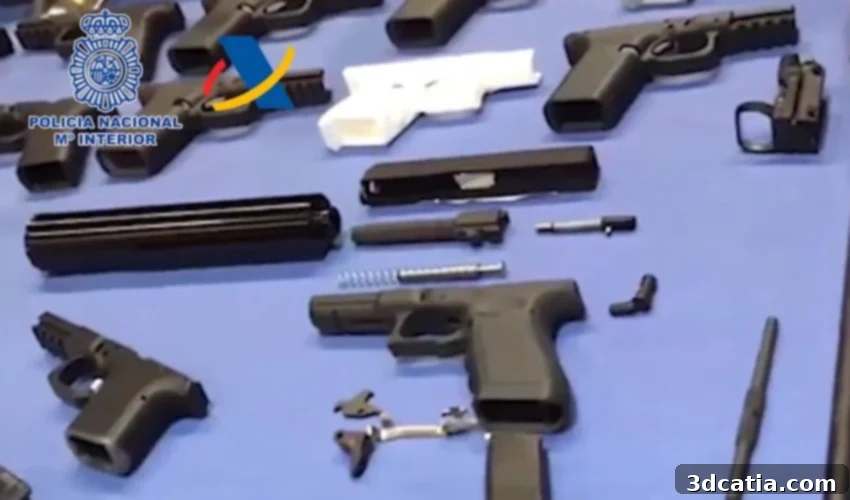
The inventory of seized items from the workshop was extensive and chilling. Police reports confirmed the discovery of two advanced 3D printers, alongside 11 spools of filament – the raw material for 3D printing – and numerous computer devices that were evidently used for designing and facilitating the manufacturing process. Crucially, the raid yielded 19 short gun frames, all of which had been produced using 3D printing technology. Additionally, officers seized nine magazines, two silencers, two unnumbered short gun slides (making them untraceable), two pieces specifically designed for rifling barrels (a critical step in making firearms more accurate), and two firing pins.
The arsenal extended beyond individual components to include fully assembled or nearly complete weapons. An AR-15 Airsoft assault rifle replica, a carbine equipped with a telescopic sight, and several metal tubes intended for crafting barrels were also confiscated. A holographic scope and a plastic mold for creating frames, along with various other short gun parts, rounded out the extensive list of firearm-related seizures. The workshop also housed a disturbing collection of non-firearm weapons, including two taser pistols, five knives, a machete, and even a katana. While the police did not specify if these non-firearm weapons were additively manufactured, their presence further underscores the dangerous intentions of the individual operating the illegal facility. The sheer scale and diversity of the seized items highlight a sophisticated operation capable of producing a wide array of dangerous tools.
Additive Manufacturing: A “Disruptive Technology” in the Wrong Hands
In their official press release, the Spanish police articulated a profound concern regarding the capabilities of additive manufacturing, describing it as “a disruptive technology that exponentially increases the danger of the proliferation of firearms, facilitating access to them by criminal or terrorist groups.” This characterization is not an overstatement but a direct recognition of how 3D printing has fundamentally altered the paradigm of weapon production. Traditionally, manufacturing firearms required specialized machinery, extensive technical knowledge, and significant capital investment, placing it largely beyond the reach of individuals or small illicit groups. However, 3D printing shatters these barriers, enabling virtually anyone with access to a printer, digital blueprints, and raw materials to produce functional weapon components, or even entire firearms, from the privacy of their home.
The “disruptive” nature of this technology lies in its ability to circumvent conventional supply chains and regulatory controls. These “ghost guns,” often lacking serial numbers, become untraceable by law enforcement, complicating investigations and hindering efforts to curb gun violence. The rapid advancements in 3D printing technology, particularly in the quality of resin 3D printers and the increasing accessibility of metal 3D printers, have further exacerbated this issue. While earlier 3D printable gun files often required some non-3D printed parts to become fully functional, authorities noted with alarm that the arrested man in Tenerife was capable of manufacturing a small but fully functional firearm. Reports from the incident even claimed that the suspect possessed the capability to print the barrel of a gun within minutes, signifying a leap in illicit manufacturing efficiency and effectiveness that poses a critical challenge to existing security frameworks. The ability to quickly and clandestinely produce key functional components dramatically lowers the entry barrier for those intent on acquiring weapons, including criminal organizations and extremist cells.
Navigating the Complex Legal Landscape of 3D Printed Firearms
Global Regulatory Challenges
The legality surrounding the manufacture and possession of 3D printed guns varies significantly across different countries, reflecting a global struggle to keep pace with rapid technological advancements. This fragmented legal landscape creates significant challenges for international cooperation and enforcement, as what might be strictly illegal in one nation could be permissibly ambiguous in another.
The United Kingdom’s Stance
In the United Kingdom, while there are no specific laws explicitly targeting additively manufactured firearms, these weapons fall under the comprehensive scope of the Firearms Act of 1968. This foundational legislation strictly prohibits the manufacturing of guns and gun parts without explicit government approval, ensuring that any 3D printed firearm or component is treated with the same severity as conventionally manufactured illegal weapons. The existing legal framework, though not designed for 3D printing, has been interpreted to encompass these emerging threats, illustrating a flexible approach to an evolving challenge. However, the ease of access to digital blueprints and 3D printers still presents a significant enforcement hurdle.
Singapore’s Proactive Approach
Singapore has taken a particularly proactive and stringent approach. Earlier this year, the nation passed a groundbreaking Bill that criminalizes the mere possession of digital blueprints for a gun or gun part without a valid license. This forward-thinking legislation recognizes that the threat doesn’t just lie in the physical weapon but also in the digital files that enable its creation. By targeting the digital design phase, Singapore aims to nip the problem in the bud, preventing the manufacturing process before it even begins. This regulatory stance also extends to other 3D printed weapons, reflecting a comprehensive strategy against additive manufacturing being misused for illicit purposes.
Canada’s Strict Licensing Regime
Similarly, Canada maintains a strict regulatory environment. It is unequivocally illegal to manufacture or possess a 3D printed firearm without the appropriate licenses and registration. Canadian law treats 3D printed weapons with the same rigorous scrutiny as traditional firearms, requiring individuals to navigate a complex system of permits and background checks for any involvement with weapon production. This consistent application of existing firearms legislation aims to prevent the illicit proliferation of these easily produced weapons.
The United States: A Shifting Legal Battleground

A 3D printed gun known as the “Liberator”
The legal situation in the United States, however, presents a considerably different and often more contentious picture, largely in line with its generally looser legal restrictions on firearms. While 3D printed guns were indeed banned until 2018, this prohibition was controversially revoked by the Trump administration. This decision opened the door for individuals to legally manufacture 3D printed firearms, often referred to as “ghost guns” due to their lack of serial numbers, without federal oversight.
Despite this broader legality, there remains a critical caveat: it is illegal in the U.S. to possess 3D printed guns that lack metal parts. This specific restriction is in place because such weapons violate the Undetectable Firearms Act, which mandates that all firearms must contain enough metal to be detectable by standard metal detectors. The intent behind this act is to prevent firearms from being smuggled through security checkpoints unnoticed. The “Liberator,” one of the most famous early examples of a largely 3D printed firearm, notably faced this challenge due to its plastic construction. The ongoing debate in the U.S. revolves around balancing Second Amendment rights with public safety concerns, creating a complex and evolving legal landscape for 3D printed firearms. For a more comprehensive historical and current overview, you can refer to our detailed article on 3D printed guns HERE.
The Broader Implications for Security and Society
The dismantling of Spain’s first illegal 3D printed weapons workshop serves as a potent wake-up call, highlighting the profound implications of additive manufacturing for national security and public safety worldwide. The ease of access to digital blueprints and relatively affordable 3D printers means that the barrier to entry for illicit weapon manufacturing has been dramatically lowered. This poses significant challenges for law enforcement agencies, who must now contend with “ghost guns” that are untraceable, difficult to detect, and can be produced covertly in residential settings. The task of monitoring and regulating the vast, decentralized flow of digital files for weapon designs is monumental, making traditional methods of arms control increasingly obsolete.
The connection of this particular workshop to extremist groups further underscores the critical danger. For radical organizations, 3D printing offers a way to arm themselves and their sympathizers without reliance on official or black-market arms dealers, reducing their exposure to law enforcement and potentially increasing their operational capabilities. This phenomenon necessitates a collaborative international response, fostering information sharing, standardizing legislation, and developing advanced detection technologies to identify 3D printed components. Beyond the immediate security concerns, this incident also prompts deeper ethical considerations about the responsible development and dissemination of advanced technologies. As 3D printing continues its wider expansion across various sectors, the imperative to balance innovation with robust regulatory frameworks to prevent its misuse becomes ever more urgent.
Conclusion: A Call for Vigilance and Adaptability
The successful operation in Santa Cruz, Tenerife, is a pivotal moment in the fight against illicit firearms, marking the dismantling of Europe’s inaugural illegal 3D printed weapons workshop. It underscores the urgent need for law enforcement agencies and governments globally to adapt swiftly to the evolving capabilities of additive manufacturing. The ease with which functional firearms can now be produced from digital designs by individuals, coupled with disturbing links to extremist ideologies, presents an unprecedented threat to public safety and national security.
As 3D printing technology continues to advance, so too must our legal frameworks and surveillance capabilities. The lessons learned from Spain’s experience emphasize the critical importance of proactive internet monitoring, robust intelligence gathering, and international cooperation to prevent the proliferation of untraceable “ghost guns.” This incident serves as a stark reminder that while technology offers immense benefits, it also demands vigilant oversight and adaptive strategies to mitigate its potential for misuse. The future of firearm control will increasingly rely on our ability to regulate digital spaces as effectively as physical ones.
You can read the full press release from the Spanish police HERE. What do you think about 3D printed weapons? Let us know in a comment below or on ourFacebook,Twitter andLinkedIn pages! Sign up for our free weeklyNewsletter here, the latest 3D printing news straight to your inbox!
*Cover photo credits: Spanish National Police