
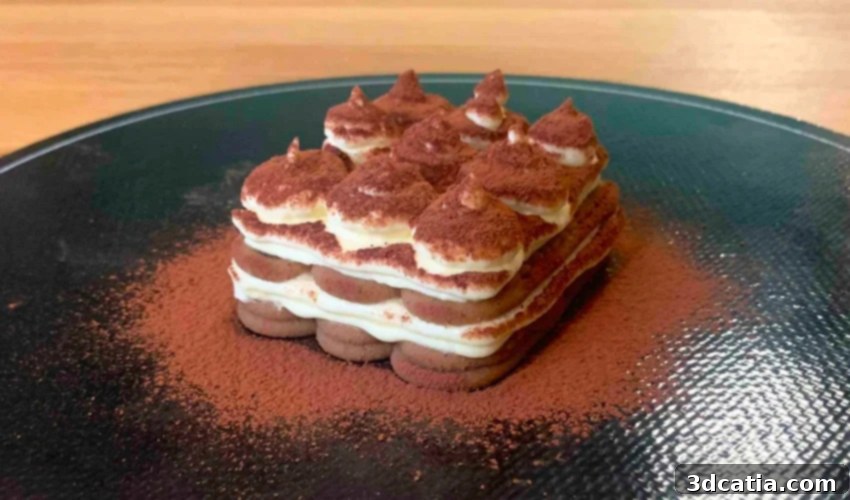
Unveiling Culinary Innovation: The World’s Best Tiramisu is Now 3D Printed
Indeed, what was once unimaginable has now become a delicious reality: the world’s best tiramisu can now be precisely crafted using advanced 3D printing technology. This groundbreaking achievement is not just a culinary novelty; it represents a significant step forward in gastronomic innovation. This incredible dessert was meticulously recreated as an exact replica of the winning entry from the latest edition of the prestigious Tiramisù World Cup (TWC). The location for this momentous occasion was Treviso, a city in northern Italy renowned as the historical birthplace of tiramisu, making the experiment all the more symbolic. The intricate dessert was brought to life using Natural Machines’ state-of-the-art 3D food printer, Foodini. This visionary project, which first began last year when the Spanish company Natural Machines presented its innovative initiative to the organizers of the celebrated culinary competition, is proudly supported by the European Union, underscoring its importance in fostering technological advancements within the food sector across the continent.
As we observe the evolving landscape of gastronomy, 3D food printing continues to steadily make its mark. While still an emerging field, this revolutionary technology is gradually integrating itself into various aspects of culinary arts. Today, the market offers a diverse array of sophisticated solutions for creating custom 3D printed dishes, ranging from intricate confectionery designs to personalized pasta shapes and elaborate garnishes. A growing number of avant-garde restaurants and innovative chefs are already embracing 3D food printing as a complementary and highly valuable method in their kitchens, utilizing it to enhance presentation, achieve unparalleled consistency, and explore new creative avenues. However, despite its promising potential, the future of this additive manufacturing method in food production is not without its discussions and even some controversy, particularly concerning applications like 3D printed vegan meat substitutes, which challenge traditional perceptions of food. Yet, in this specific instance, additive manufacturing has been elegantly employed to faithfully reproduce an iconic and beloved Italian dessert. The successful recreation of the Tiramisù World Cup winner through 3D printing sets a new benchmark, yielding what many are now hailing as an authentic and undeniably world-class tiramisu experience.
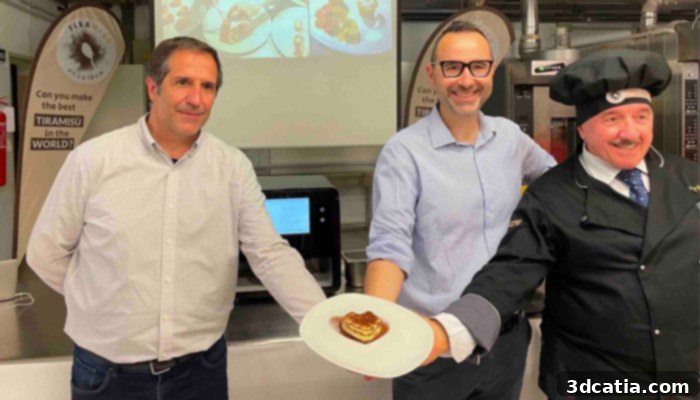
The organizers of the TWC competition with the 3D printed tiramisu
The Art and Science Behind the 3D Printed Tiramisu
Crafting Perfection Layer by Layer
The exquisite 3D printed tiramisu, an ingenious creation, was conceived by the talented Italian pastry chef Stefano Serafini. Bringing his vision to life was a meticulous process, involving numerous experiments and the careful testing of various recipes to achieve the perfect texture, consistency, and flavor profile suitable for additive manufacturing. The core of this innovative project lies in harnessing the advanced 3D printing capabilities of the Foodini machine, developed by Natural Machines. This cutting-edge technology allows for the precise, layer-by-layer application of different mixtures and characteristic textures – from the creamy mascarpone to the coffee-soaked ladyfingers and the dusting of cocoa – until the quintessential Italian dessert is flawlessly assembled. Emilio Sepulveda, CEO and co-founder at Natural Machines, articulates the broader objective behind integrating this technology into the TWC, stating: “The main objective is the promotion of tiramisu within the competition environment and Italian gastronomy, as well as giving it a greater reach via 3D printing.” This initiative not only celebrates a classic dessert but also elevates its global presence through technological innovation.
To ensure an authentic replication, Chef Serafini generously provided his proprietary cream recipe, a crucial component that imbues his original tiramisu with its signature taste. The Natural Machines 3D printer then meticulously utilizes these exact same high-quality ingredients to develop the desired design – in this case, a charming heart-shaped dessert – thereby faithfully reproducing the pastry chef’s original, award-winning recipe. Francesco Redi, the esteemed founder of the Tiramisù World Cup, enthusiastically highlights the transformative role of 3D technology in this context, emphasizing that it “allows you to make a recipe from anywhere in the world that is very similar to the original.” This capability opens up exciting possibilities for culinary enthusiasts globally, enabling them to experience authentic flavors regardless of geographical barriers. Further elaborating on the capabilities of their revolutionary device, Emilio Sepulveda aptly defines his 3D printer as a “miniature food factory.” He clarifies a common misconception, commenting: “our machine does not alter the taste or quality of the ingredients that you put and you don’t need those ingredients to be special for the machine.” This underscores the versatility and user-friendliness of the Foodini, making sophisticated culinary creation accessible without requiring specialized ingredients. For those eager to delve deeper into the competition and its innovations, more information can be found on the TWC competition website HERE.
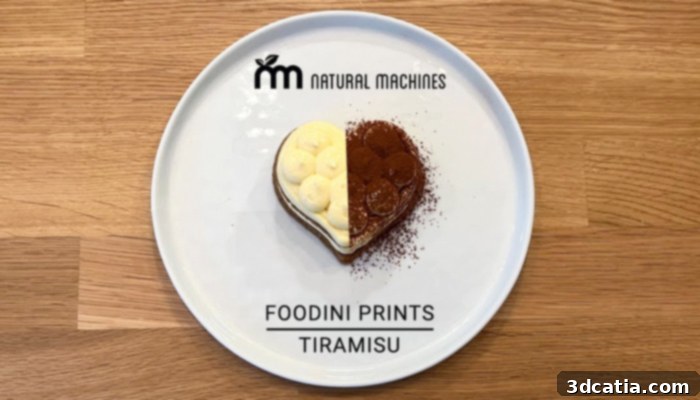
Natural Machines is the company behind the Foodini machine
Beyond Tiramisu: The Broader Impact of Food 3D Printing on Gastronomy
The successful 3D printing of the Tiramisù World Cup winner is more than just a sweet triumph; it’s a powerful demonstration of the expansive potential of food 3D printing across the entire gastronomic landscape. This technology paves the way for unprecedented customization, allowing chefs and home cooks alike to tailor dishes to specific dietary requirements or individual preferences with remarkable precision. Imagine gluten-free or sugar-free versions of complex desserts, precisely layered and perfectly portioned, accessible to everyone without compromising on visual appeal or taste. Food 3D printing also unlocks new dimensions of artistic expression in the kitchen. Chefs can design and print intricate structures, delicate garnishes, and unique presentations that would be impossible or incredibly time-consuming to achieve through traditional methods. This pushes the boundaries of culinary artistry, transforming plates into edible masterpieces.
Furthermore, the consistency and standardization offered by 3D food printers are invaluable assets, particularly in professional kitchens. Restaurants can ensure that every plate served maintains the exact same quality, portion size, and aesthetic, significantly enhancing customer experience and operational efficiency. Beyond the commercial realm, this technology holds immense educational potential, serving as a dynamic tool for culinary schools to teach students about food science, design, and innovative preparation techniques. As the technology evolves, it could also contribute to more sustainable food production practices by enabling precise portion control and reducing food waste, as ingredients are dispensed exactly as needed. The convergence of traditional recipes with cutting-edge additive manufacturing signifies a new era where culinary heritage is preserved and propagated through technological advancement.
Bridging Tradition and Technology: A New Culinary Frontier
This pioneering project beautifully illustrates how the rich tapestry of Italian culinary heritage can not only coexist with but also be enhanced by advanced technological innovation. The Tiramisù World Cup’s decision to embrace 3D printing for its winning dessert is a testament to an open-minded approach that seeks to honor tradition while simultaneously pushing the boundaries of what’s possible. It represents a fascinating dialogue between the artisan skill of pastry chefs and the sophisticated engineering of modern machinery. This fusion inspires a new generation of culinary professionals and technologists to think differently about food creation, envisioning a future where creativity is unbound by conventional methods.
The ability to replicate a world-class tiramisu with such fidelity and precision ensures that the legacy of this iconic Italian dessert can be shared and appreciated more broadly than ever before. It democratizes access to culinary excellence, allowing a wider audience to experience the taste of a champion’s creation. The blend of precision, customization, and ingredient integrity offered by machines like the Foodini suggests a future where bespoke culinary experiences are not just for the elite but are an accessible reality. This marks the dawn of a new culinary frontier, where the warmth of tradition meets the cool precision of technology, promising an exciting and delicious journey ahead for food enthusiasts worldwide.
What are your thoughts on this revolutionary 3D printed tiramisu? Do you believe this technology will become a staple in future kitchens? Let us know your insights in a comment below or join the conversation on our Linkedin, Facebook, and Twitter pages! Don’t forget to sign up for our free weekly Newsletter here to receive the latest 3D printing news straight to your inbox! You can also find all our engaging videos and more innovative content on our YouTube channel.