

AECC’s 3D-Printed Micro Turbojet Engine: Revolutionizing China’s Aerospace Innovation
The Aero Engine Corporation of China (AECC) has marked a significant milestone, announcing the triumphant maiden flight of its groundbreaking 3D-printed micro turbojet engine. This achievement represents a monumental first for the Chinese aerospace sector, signaling a new era of innovation and technological advancement. The engine, aptly named the Minimalist Lightweight Micro Turbojet, underwent rigorous testing in the vast and challenging environment of the Inner Mongolia Autonomous Region in northern China. This successful flight not only demonstrates AECC’s formidable engineering prowess but also underscores China’s rapidly growing capabilities in advanced manufacturing and aerospace propulsion systems, setting a new benchmark for future developments in the global aviation industry. This critical step forward highlights the potential of additive manufacturing to transform engine design and production, promising more efficient, powerful, and sustainable aerial platforms for various applications.
Unpacking AECC’s Performance Claims: A Deep Dive into Innovation
The successful maiden flight of AECC’s 3D-printed micro turbojet engine is backed by impressive performance metrics that highlight the transformative potential of additive manufacturing in aerospace. These claims offer a glimpse into the capabilities of this cutting-edge propulsion system and its implications for future aerial platforms, demonstrating how advanced technologies can deliver exceptional results in a compact package.
-
Maximum Thrust: The engine boasts a remarkable maximum thrust of 160 kg. For a micro turbojet engine, this level of thrust is exceptionally powerful, pushing the boundaries of what is typically achievable with engines of this size. This significant power output makes the Minimalist Lightweight Micro Turbojet ideal for a range of advanced applications, including high-performance unmanned aerial vehicles (UAVs), sophisticated reconnaissance drones, and even small experimental aircraft requiring robust and efficient propulsion. The ability to generate such substantial thrust from a compact and lightweight unit opens up new possibilities for extended flight durations, increased payload capacities, and enhanced maneuverability in various aerial missions. This performance positions it as a key enabler for next-generation drone technology, where power-to-weight ratio is paramount.
-
Altitude Capability: Tested successfully at an impressive altitude of 4,000 meters (approximately 13,123 feet), the engine demonstrates its resilience and operational effectiveness in challenging atmospheric conditions. Operating at such altitudes requires robust design and material integrity to withstand lower air densities, significantly colder temperatures, and reduced oxygen levels, all of which pose substantial engineering challenges for any propulsion system. This capability is crucial for surveillance drones, high-altitude research platforms, and military applications that often need to operate above conventional air traffic or adverse weather. The successful performance at 4,000 meters confirms the engine’s reliability and its readiness for deployment in diverse operational environments, extending the reach and utility of platforms it will power across various strategic scenarios.
-
Pioneering Technology: 3D Printing in Aerospace: At the very core of this innovation is the extensive and sophisticated use of 3D printing technology, more formally known as additive manufacturing. While AECC has maintained a degree of discretion regarding the exact process, aerospace experts and industry observers widely believe it to be laser powder bed fusion (LPBF). LPBF is a highly advanced additive manufacturing technique that involves using a powerful laser to selectively melt and fuse metallic powder layers, building complex parts layer by layer from the ground up. This method is particularly advantageous for aerospace components due to its unparalleled ability to produce intricate geometries, sophisticated internal cooling channels, and lightweight lattice structures that are virtually impossible to create with traditional subtractive manufacturing techniques. The inherent flexibility of 3D printing facilitates the creation of highly integrated engine components, drastically reducing the overall part count, simplifying assembly processes, and ultimately enhancing the engine’s holistic performance, durability, and reliability. This strategic technological choice is pivotal to the engine’s minimalist design, exceptional power-to-weight ratio, and robust operational capabilities.
-
Advanced Software: Topological Optimization: Complementing the cutting-edge additive manufacturing process, AECC strategically utilized topological optimization software during the critical engine design phase. Topological optimization is a sophisticated design method that employs advanced computational algorithms to intelligently determine the most efficient and optimal material distribution within a predefined design space. This optimization is carried out based on a set of specified mechanical loads, boundary conditions, and performance constraints. This iterative design process generates highly efficient, structurally sound, and often organically shaped structures that meticulously maximize performance parameters while simultaneously minimizing material usage. For the Minimalist Lightweight Micro Turbojet, this meant designing engine components with ideal strength-to-weight ratios, ensuring robust structural integrity precisely where it is needed, and judiciously removing unnecessary material elsewhere to achieve significant weight savings. The powerful synergy between topological optimization and 3D printing is absolutely crucial, as additive manufacturing possesses the unique capability to accurately and precisely reproduce the complex, optimized geometries that traditional manufacturing methods simply cannot achieve.
-
Significant Weight Reduction: A direct and profoundly beneficial outcome of integrating both advanced additive manufacturing techniques and sophisticated topological optimization software is the dramatic and substantial reduction in the engine’s overall weight. Weight is an overwhelmingly critical factor in aerospace engineering, directly impacting numerous performance metrics such as fuel efficiency, operational range, available payload capacity, and dynamic flight characteristics. By meticulously leveraging these advanced technologies, AECC has expertly crafted an engine that is significantly lighter than its conventionally manufactured counterparts. This substantial weight saving translates directly into substantial performance gains across the board, allowing aerial platforms to fly further, carry heavier payloads, or consume considerably less fuel, thereby reducing operational costs, extending mission capabilities, and significantly minimizing environmental footprint. This unwavering focus on lightweighting positions the Minimalist Lightweight Micro Turbojet as a highly competitive, economically viable, and environmentally responsible propulsion solution for the next generation of advanced aerial systems and platforms.
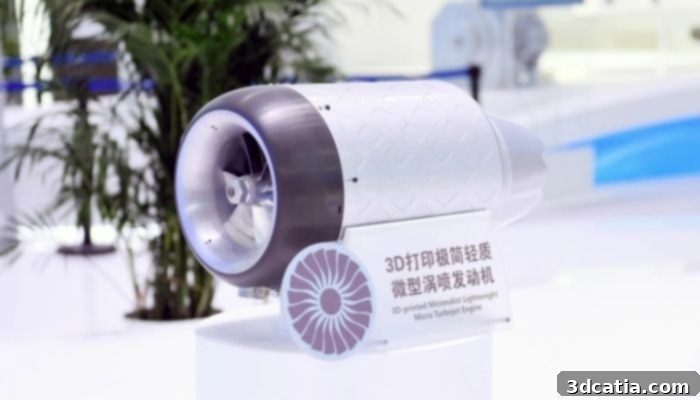
The micro turbojet engine created by additive manufacturing, marking a significant aerospace advancement for AECC.
The Strategic Imperative: Additive Manufacturing’s Growing Role in Aerospace
Additive manufacturing, often referred to as 3D printing, is rapidly transforming from a niche, experimental technology into a cornerstone of the global aerospace sector. Its inherent advantages offer groundbreaking solutions to some of the industry’s most enduring and complex challenges, driving unprecedented innovation and efficiency across every stage of design, production, and operation. The widespread adoption of AM by leading aerospace firms and national agencies worldwide emphatically underscores its strategic importance, promising the development of more capable, cost-effective, and ultimately more sustainable aerial and space platforms for the future.
- Reduced Component Weight: This is arguably the single most critical advantage of additive manufacturing in the aerospace domain. Every kilogram saved on an aircraft, spacecraft, or engine translates directly and profoundly into improved fuel efficiency, increased payload capacity, and significantly enhanced performance metrics such as operational range, speed, and maneuverability. AM empowers engineers to create incredibly intricate internal structures, such as complex lattice designs, and precision-engineered hollow components that maintain robust structural integrity while simultaneously using significantly less raw material. This dramatic weight reduction not only lowers immediate operational costs but also contributes to a substantially smaller carbon footprint, aligning perfectly with global efforts for sustainable aviation and environmental responsibility.
- Design of Complex Geometries: Traditional manufacturing methods, including casting, forging, and conventional machining, are inherently limited in the complexity of shapes and internal structures they can efficiently produce. Additive manufacturing shatters these long-standing limitations, enabling engineers to design and precisely produce highly intricate geometries and consolidated parts that were previously considered impossible or prohibitively expensive. This includes single, integrated components that effectively consolidate what were once multiple individual parts into one, eliminating the need for complex and time-consuming assemblies. It also allows for the creation of optimized internal cooling channels within critical engine parts for superior thermal management, and aerodynamically optimized surfaces for improved efficiency and performance. Such unparalleled design freedom fosters radical innovation in both engine and airframe design, leading directly to superior performance characteristics and expanded functional capabilities.
- Shorter Production Cycles: In the intensely competitive and fast-paced aerospace industry, time-to-market is an absolutely critical competitive advantage. Additive manufacturing significantly shortens both prototyping and full-scale production cycles, offering an unprecedented level of agility. Engineers can rapidly iterate on design concepts, moving from a digital concept to a physical prototype in a matter of days or weeks, rather than the months typically required by traditional methods. This unparalleled agility allows for quicker design validation, faster identification and rectification of potential flaws, and ultimately, a much more efficient development pathway for new components and complex systems. Furthermore, for low-volume, high-value parts, AM can move directly to final production, effectively bypassing expensive, laborious, and time-consuming tooling and mold-making processes.
- Optimization of Operating Costs: The multifaceted benefits of additive manufacturing extend far beyond initial production, profoundly impacting the long-term operational costs of aerospace systems. The overall weight reduction of components and the functional integration, which cleverly consolidates multiple discrete parts into single, more efficient units, lead directly to fewer parts needing to be individually manufactured, precisely assembled, and routinely maintained. This fundamental simplification reduces inventory requirements, significantly streamlines complex supply chains, and substantially lowers ongoing maintenance expenditures. Moreover, parts meticulously designed and produced with AM can often offer extended lifespans due to optimized material distribution, reduced stress concentrations, and enhanced fatigue resistance, further contributing to significant cost savings over the entire operational life of an aircraft, satellite, or engine system.
Global Race and International Competition in Additive Aerospace
AECC’s achievement positions China firmly within a burgeoning global landscape of additive manufacturing in aerospace, where nations and leading corporations are intensely competing for technological supremacy and strategic advantage. Similar pioneering projects are well underway across the globe, most notably in the United States and Europe, where significant investments are being channeled into integrating 3D printing into various critical aerospace applications. Companies like GE Aviation and Rolls-Royce have been at the forefront, already deploying complex 3D-printed components in commercial jet engines, such as advanced fuel nozzles, intricate turbine blades, and structural components, demonstrating the technology’s reliability, performance, and certification readiness. SpaceX and other private space companies, including Relativity Space, are extensively utilizing additive manufacturing for critical rocket engine components and satellite parts, leveraging its unique ability to produce complex, lightweight structures quickly and cost-effectively, often consolidating hundreds of parts into one. Furthermore, numerous initiatives are focused on developing 3D-printed parts for advanced VTOL (Vertical Take-Off and Landing) aircraft, hypersonic vehicles, and next-generation defense systems, underscoring the broad and strategic interest in this domain across both commercial and military sectors. The market for additive manufacturing in aerospace is experiencing explosive growth, driven by the compelling advantages of weight reduction, performance enhancement, supply chain resilience, and rapid prototyping. This increasing global competition highlights additive manufacturing not just as an incremental improvement but as a fundamental, paradigm-shifting change in how aerospace components are designed, produced, and utilized, making AECC’s successful flight a significant indicator of China’s ambition to be a leading innovator in this critical technological race.
AECC’s Strategic Vision: Laying the Foundation for Future Aerospace Dominance
While the Aero Engine Corporation of China has maintained a degree of discretion regarding the specific materials used and the precise additive manufacturing process employed for its Minimalist Lightweight Micro Turbojet, the organization has been unequivocally clear about the profound strategic implications of this maiden flight. AECC’s official statements and broader national objectives underscore a vision that extends far beyond a single engine test, highlighting the foundational role this achievement plays in China’s long-term aerospace ambitions and its pursuit of technological self-sufficiency and global leadership.
-
Lays a Solid Technical Foundation for Advanced Engine Development: This successful flight is not merely an isolated engineering feat but a critical, foundational stepping stone for future innovation. It establishes a robust technical foundation, rigorously validating the advanced design processes, innovative materials, and sophisticated manufacturing methodologies essential for the future development of more complex, powerful, and significantly more efficient advanced engines. This includes scaling up to larger turbojets, advanced turbofans, and even next-generation propulsion systems for a wide variety of aerial and potentially space platforms. The invaluable data and lessons learned from this groundbreaking test will be meticulously utilized for refining designs, optimizing manufacturing parameters, and confidently scaling up production for future, more ambitious projects, thereby solidifying AECC’s prominent position at the forefront of global engine innovation and advanced propulsion technologies.
-
Confirms the Potential of 3D Printing for Diverse Aerospace Applications: The successful operation of a 3D-printed micro turbojet engine unequivocally confirms the immense and transformative potential of additive manufacturing across a broad spectrum of critical aerospace applications.
- For drones and unmanned aerial vehicles (UAVs), 3D printing enables the rapid creation of lighter, more powerful, and significantly more fuel-efficient engines. This directly translates into extended range, increased endurance, and enhanced payload capabilities for a myriad of missions, including surveillance, reconnaissance, logistics, and advanced aerial delivery systems.
- For broader aviation platforms, this revolutionary technology paves the way for the rapid production, bespoke customization, and seamless integration of high-performance components into future aircraft designs. This includes everything from more efficient commercial airliners to advanced military jets, ultimately improving overall aircraft performance, reducing lead times, and driving down manufacturing costs.
- Furthermore, the application of AM extends significantly to clean energy systems, where the exceptional lightweighting capabilities and the ability to create complex internal geometries are crucial. These benefits are vital for developing highly efficient components for future hybrid-electric or even hydrogen-powered propulsion systems, making substantial contributions to more sustainable aviation and reducing the carbon footprint of air travel.
-
Represents a Crucial Milestone in China’s National Aerospace Strategy: This groundbreaking achievement is deeply and inextricably intertwined with China’s overarching national strategy to achieve comprehensive self-reliance and global technological leadership in critical high-tech sectors, particularly within the highly strategic aerospace industry. By successfully developing, manufacturing, and testing a 3D-printed micro turbojet engine, AECC has unequivocally demonstrated China’s independent and advanced capabilities in cutting-edge engine design and additive manufacturing. This milestone significantly contributes to China’s objective of reducing its historical reliance on foreign technology for core aerospace components and substantially strengthens its position as a major, self-sufficient player in the global aviation and space industries. It signals a clear and resolute commitment to leveraging cutting-edge technologies and advanced manufacturing processes to secure a decisive competitive edge, ensuring both national security and long-term economic prosperity through continuous technological innovation and industrial self-sufficiency.
The successful maiden flight of AECC’s 3D-printed micro turbojet engine is a powerful testament to the transformative power of additive manufacturing and a clear indicator of China’s escalating influence in global aerospace innovation. This pioneering achievement not only sets new benchmarks for engine performance and efficiency but also lays a critical foundation for the next generation of aerial vehicles, promising advancements across commercial, military, and research applications. We are eager to hear your thoughts on this significant aerospace breakthrough and its implications for the future of aviation. Let us know what you think in a comment below or on our LinkedIn or Facebook pages! Plus, don’t forget to sign up for our free weekly Newsletter to get the latest 3D printing news straight to your inbox. You can also find all our videos on our YouTube channel. For more comprehensive 3D printing news and insights in the dynamic aerospace and defense sectors, be sure to check out our dedicated page HERE.
*All Photo Credits: Sina