
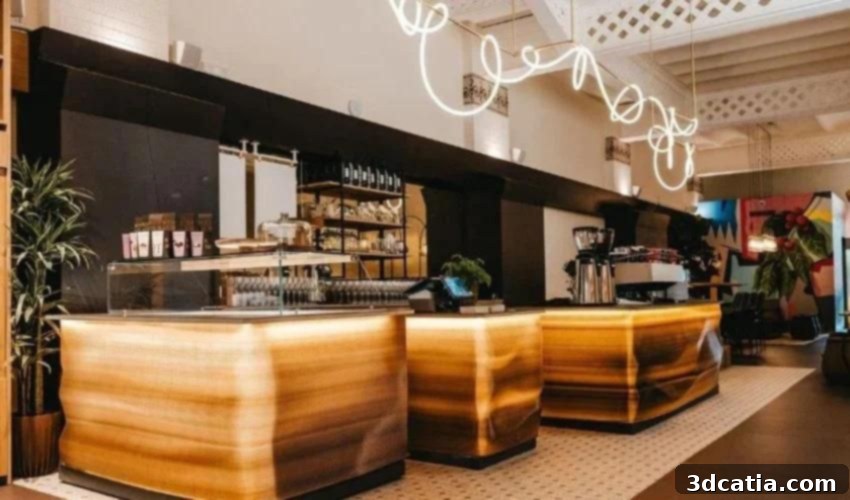
Brewing Innovation: How 3D Printing Transforms Coffee Waste into Sustainable Cafe Furniture
In an era defined by growing environmental consciousness and the urgent need for sustainable practices, global efforts to implement the circular economy have intensified dramatically. A fundamental pillar of this transformative model is circular design, which emphasizes creating products and systems that are inherently environmentally friendly and designed for a truly sustainable life cycle from conception to end-of-use. A compelling illustration of this forward-thinking approach is a pioneering project focused on redefining interior design through radical sustainability. The innovative Spanish company Lowpoly has proudly collaborated with the esteemed coffee roaster D-Origen to furnish a new cafe in Barcelona with extraordinary 3D printed furniture. These unique pieces, ingeniously crafted from discarded coffee waste, powerfully demonstrate the vast potential of advanced 3D printing technologies in sustainable design and material innovation.
The Pervasive Problem of Coffee Waste and a Groundbreaking Solution
Coffee is a global staple, enjoyed by billions daily, making it one of the most widely consumed beverages worldwide. However, the immense scale of coffee consumption generates an equally immense amount of spent coffee grounds. While these grounds are occasionally repurposed as plant fertilizer, for natural odor control, or in niche industrial applications like biomass production, these uses typically absorb only a fraction of the total waste produced. To grasp the sheer volume, one only needs to consider the countless coffee shops, cafes, and domestic brewing habits in any urban center. Tragically, a significant portion of this valuable organic material still ends up in landfills, where its decomposition contributes to the release of potent greenhouse gases, most notably methane, exacerbating climate change and putting unnecessary strain on landfill capacities.
Recognizing this significant environmental challenge, Lowpoly and D-Origen forged a remarkable partnership that addresses the issue head-on with a truly circular solution. Their innovative collaboration leverages the very coffee grounds generated by D-Origen’s own cafe to produce the furniture that adorns its interior. This ingenious closed-loop system embodies the core tenets of the circular economy, transforming a local waste stream into valuable, functional assets within the same ecosystem. At the heart of this innovation is Lowpoly’s proprietary material science. They developed an advanced composite that ingeniously combines discarded coffee grounds with recycled PLA (polylactic acid), a plant-based, biodegradable thermoplastic known for its eco-friendly properties and suitability for 3D printing.
Utilizing this pioneering bio-composite material, Lowpoly has 3D printed an entire collection of bespoke furniture pieces for the cafe. This includes elegantly designed bars, practical counters, ergonomic stools, and unique, captivating light fixtures. These custom-made creations are now integral features within D-Origen’s Casa Calvet café, a venue of particular historical and architectural significance. The cafe is nestled within a stunning modernist building, originally conceived by the legendary Catalan architect Antoni Gaudí. The integration of cutting-edge sustainable design within such an iconic and culturally rich historical setting creates a powerful dialogue between heritage and innovation, showcasing how modern solutions can beautifully coexist with timeless aesthetics.

The Synergy of AI, Advanced Design, and Biodegradable Materials
The distinctive aesthetic and functional brilliance of this coffee furniture are the culmination of the vision and expertise of a dedicated design team. Gianluca Pugliese, the founder of Lowpoly, collaborated with acclaimed designers Ilaria Marzano and Arturo Tedeschi to bring this concept to fruition. This creative trio leveraged the formidable capabilities of artificial intelligence and sophisticated digital design techniques. By employing advanced computational tools, they were able to meticulously develop and optimize their ideas, pushing the boundaries of what is traditionally possible in furniture design. AI-powered algorithms helped in exploring diverse forms, ensuring structural integrity, and maximizing material efficiency, while digital modeling allowed for precise customization and seamless integration within the specific architectural context of the cafe. The result is furniture that is not only visually appealing but also perfectly tailored to the unique dimensions and ambiance of the Casa Calvet building.
A cornerstone of this project’s profound environmental impact lies in its innovative material composition. The furniture’s unique and earthy shades, ranging from deep espresso browns to lighter latte hues, are entirely natural, stemming directly from the coffee grounds that constitute its primary ingredient. This intrinsic coloring eliminates the need for any artificial dyes or finishes, further minimizing the ecological footprint. Lowpoly’s proprietary material boasts an impressive composition: it is an astounding 98% organic, derived purely from repurposed coffee waste. The remaining percentage consists of recycled PLA, which serves as an essential binder, providing the necessary structural stability and enabling the material to be processed through large-scale 3D printing. This high organic content means the resulting 3D-printed furniture is completely petroleum-free, a critical distinction in reducing reliance on finite fossil resources. Furthermore, this characteristic ensures that at the very end of its long and useful life, the furniture is inherently biodegradable, preventing it from contributing to the pervasive issue of plastic pollution in landfills or natural environments.
Industrial-Scale 3D Printing: The Engine of Sustainable Furniture Manufacturing
Bringing these ambitious and complex designs from digital concept to tangible reality required state-of-the-art manufacturing capabilities. Lowpoly deployed its cutting-edge large-scale 3D printing technology, which stands at the forefront of sustainable additive manufacturing. The core of their production system involves sophisticated industrial robotic arms, meticulously configured and equipped with a specialized REV3RD extruder. This powerful and precise combination is engineered to efficiently process significant volumes of the innovative coffee-PLA composite material, enabling the rapid and cost-effective production of substantial furniture pieces. The impressive dexterity, reach, and accuracy of these robotic arms allow for the printing of components up to an astounding 3.50 meters in height, a crucial capability when fabricating functional and large-format furniture elements such as cafe counters, bars, and even large sculptural light installations.
Beyond mere technical efficiency and the capacity to handle large dimensions, the adoption of 3D printing offered unparalleled advantages in faithfully realizing the intricate and organic design ideas conceived by the Lowpoly team. Unlike conventional manufacturing methods, which often impose significant limitations on form complexity and material waste, additive manufacturing liberates designers to create fluid, non-standard shapes and bespoke geometries with remarkable ease. This inherent design freedom was absolutely instrumental in achieving the distinctive natural finish, flowing lines, and unique tactile textures that perfectly complement the existing architectural and aesthetic ethos of the Casa Calvet café. The layer-by-layer deposition process, fundamental to 3D printing, also contributes to unique surface characteristics, adding a subtle yet engaging tactile dimension that further enhances the user experience and beautifully connects the furniture to its natural, organic origins.
Lowpoly’s Expansive Vision: Pioneering Bio-Circular Design Beyond Coffee
The groundbreaking coffee furniture project, while impressive on its own, serves as a powerful testament to Lowpoly’s broader, ambitious commitment to pioneering new materials derived from a diverse range of organic waste streams, ingeniously blended with recycled plastics. Their innovative philosophy and practical approach extend far beyond just coffee grounds. As revealed by Gianluca Pugliese, the visionary founder of Lowpoly, in a recent insightful interview for the Venus Founders Podcast, the Lowpoly team is actively engaged in researching and utilizing an expansive array of agricultural and industrial organic byproducts. This includes waste generated from the processing of common produce such as oranges, grapes, bananas, and olives, transforming these often-discarded materials into valuable resources for next-generation products. By continually repurposing these diverse organic materials, Lowpoly is establishing a new paradigm for sustainable material science and eco-conscious manufacturing.
What makes Lowpoly’s strategy particularly impactful and exemplary is their comprehensive, integrated approach to material sourcing and circularity. They are not merely focused on transforming organic waste; they also diligently collect and process various types of plastics from their local environment, ensuring a consistent and robust supply of high-quality recycled content. This unwavering dedication to both upcycling organic byproducts and recapturing plastic waste from the ecosystem significantly amplifies their positive environmental impact. Through the consistent development of new and advanced bio-composites, Lowpoly is emphatically demonstrating that it is entirely feasible to create high-quality, durable, and aesthetically rich products without any reliance on virgin fossil resources. Their pioneering work offers a powerful blueprint and a compelling case study for other industries seeking to transition towards more sustainable, regenerative, and truly circular production models, showcasing how innovative creativity and cutting-edge technology can effectively intersect to solve some of the most pressing environmental challenges of our time.
The Future of Sustainable Interior Design and the Broader Circular Economy
This visionary project by Lowpoly and D-Origen is far more than just an impressive example of clever design and material innovation; it represents a significant and tangible stride forward in the practical implementation of the circular economy. It powerfully demonstrates how waste, conventionally viewed as an end-of-life material, can be reconceptualized and effectively become the starting point for entirely new, valuable, and desirable products. By strategically integrating advanced manufacturing techniques such as large-scale 3D printing with cutting-edge material science, industries can fundamentally pivot away from the detrimental linear “take-make-dispose” models towards truly regenerative and sustainable systems that mimic nature’s cycles.
The profound implications of this project extend well beyond the realm of bespoke furniture. Imagine entire commercial spaces, large-scale public installations, or even private residential interiors furnished with items meticulously crafted from locally sourced organic waste. This transformative model not only drastically reduces landfill burden, mitigates greenhouse gas emissions, and conserves finite natural resources, but also actively fosters local economies by creating economic value from otherwise discarded resources. It fundamentally challenges conventional notions of material worth and product longevity, actively compelling designers, manufacturers, and consumers alike to profoundly rethink their relationship with everyday objects and the systems that produce them.
As we collectively look towards a more sustainable future, the pioneering work of companies like Lowpoly unequivocally underscores the critical and indispensable role of innovation in achieving ambitious sustainability goals. Their groundbreaking efforts in bio-circular design, synergistically coupled with the remarkable precision, versatility, and efficiency of industrial 3D printing, offer a compelling and inspiring vision of a world where waste is systematically minimized, precious resources are meticulously optimized, and beautiful, highly functional products are born from seemingly unlikely and discarded origins. This project serves as a potent and inspiring call to action, actively encouraging the broader adoption of circular principles and advanced manufacturing across all industrial sectors globally.
What are your thoughts on this inspiring example of a sensible circular economy in action? We warmly invite you to share your valuable perspectives and insights! Let us know in a comment below, or join the ongoing conversation on our LinkedIn, Facebook, and Twitter pages. For those eager to stay abreast of the very latest advancements in 3D printing technology and sustainable innovation, don’t forget to sign up for our free weekly newsletter here to get breaking news directly to your inbox! You can also find all our compelling videos, interviews, and features on our dedicated YouTube channel.
*All Photo Credits: Lowpoly