
Revolutionizing 3D Printing: Unlocking Vibrant Structural Colors from a Single Ink with Nanoscale Precision
The landscape of additive manufacturing is continually evolving, pushing boundaries not only in the speed and efficiency of printing processes but, increasingly, in the intrinsic properties of the materials themselves. A groundbreaking development from researchers at the University of Illinois exemplifies this shift, showcasing how additive manufacturing technologies can be leveraged to produce an entire spectrum of colors from a singular ink. This marks a significant departure from traditional methods that rely on multiple pigments to achieve varied hues.
Published in the esteemed journal Science Advances, their research paper, “Tunable structural color of bottlebrush block copolymers through direct-write 3D printing from solution,” delves into the fascinating world of structural coloration. Unlike conventional pigments that absorb certain wavelengths of light and reflect others, structural colors are created by the interaction of light with nanoscale structures, known as photonic crystals. This innovative approach to material science within 3D printing is particularly compelling, as it highlights a new frontier for unlocking diverse applications by focusing on the development and manipulation of AM materials, rather than solely refining the printing mechanics. With the maturation of 3D printing technologies, the next significant revolution is unequivocally poised to emerge from material innovation.
Nature itself provides the most stunning examples of structural coloration, offering invaluable insights for scientific and technological advancement. As Lois Yoksoulian, the Physical Sciences Editor at the University of Illinois News Bureau, eloquently explains, some of the most vivid and enduring colors found in the natural world—from the iridescent sheen of a peacock feather to the shimmering wings of certain butterflies—are not due to pigments but to structural coloration. By meticulously studying the underlying phenomena responsible for these breathtaking natural displays, scientists are gaining crucial clues on how to replicate and even enhance such effects using cutting-edge technology. This phenomenon operates at the nanoscale level, far beyond the resolution of the human eye.
Yoksoulian elaborates on this captivating mechanism: “When light rays reflect off these periodically placed structures located in the wings and skins of some animals and within some minerals, they constructively interfere with each other to amplify certain wavelengths and suppress others.” This interference, occurring with incredible precision, dictates which colors we perceive. He further clarifies the conditions necessary for this effect: “When the structures are well ordered and small enough – about a thousand times smaller than a human hair, the rays produce a vivid burst of color.” This inherent property makes structural colors exceptionally durable and resistant to fading, offering a compelling alternative to traditional pigment-based coloring methods that can degrade over time or pose environmental concerns.
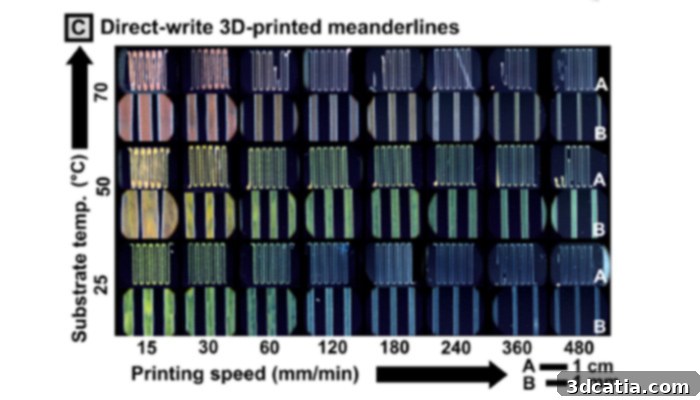
The speed and temperature of printing dictate the colors that we see
Translating this natural phenomenon into engineered materials, particularly within the polymer world, necessitates unparalleled nanoscale precision. Ying Diao, a distinguished chemical and biomolecular engineering professor at the University of Illinois at Urbana-Champaign, underscores this challenge: “Precise control of polymer synthesis and processing is needed to form the incredibly thin, ordered layers that produce the structural color as we see in nature.” The Illinois team’s innovation lies in their ability to precisely tune the self-assembly process of unique bottlebrush-shaped polymers during the 3D printing operation. These bottlebrush block copolymers, characterized by a backbone with numerous polymer side chains, offer a unique architecture that facilitates the formation of highly ordered nanoscale structures.
Through meticulous control, the researchers successfully printed photonic crystals with layer thicknesses that could be dynamically adjusted. This tunability allowed them to reflect different wavelengths across the entire visible light spectrum, all originating from a single, colorless ink. This method represents a significant leap forward, moving beyond simply depositing material to actively controlling its internal structure at the point of printing. However, working at the nanoscale invariably presents a formidable limitation: scalability. The extreme level of precision required for creating these intricate structures often prevents rapid, large-volume 3D printing, posing a hurdle for widespread industrial adoption.
To address the inherent challenge of precision at speed, the research team ingeniously modified a conventional consumer 3D printer. Their innovation involved fine-tuning critical printing parameters: the speed at which the nozzle moves and the temperature of the printing surface. Bijal Patel, a graduate student and the lead author of the study, elucidated the significance of this control: “Having control over the speed and temperature of ink deposition allows us to control the speed of assembly and the internal layer thickness at the nanoscale, which a normal 3D printer cannot do.” This direct control over the self-assembly process at the point of deposition is what fundamentally distinguishes their method. Patel further explained, “That dictates how light will reflect off of them and, therefore, the color we see.” By manipulating these parameters, they could precisely dictate the spacing and order of the photonic crystals, thereby generating specific colors without needing to switch inks or incorporate dyes.
While the scientific breakthrough is undeniable, the team is actively working on expanding the industrial relevance and scalability of this innovative process. The current methodology, given its reliance on fine-tuned nanoscale control, is not yet optimized for large-volume industrial production. However, the potential applications are vast and compelling, ranging from anti-counterfeiting measures and advanced display technologies to dynamic sensors, smart coatings, and even aesthetically versatile consumer products. Imagine a world where a single material could produce a rainbow of hues on demand, reducing waste, simplifying supply chains, and offering unprecedented design freedom.
This research reinforces the growing consensus that the next major revolution in additive manufacturing will indeed be driven by advancements in materials science. For too long, manufacturers and researchers have often been constrained more by the limited palette of available materials than by the capabilities of the 3D printing processes themselves. This work from the University of Illinois marks a pivotal moment, shifting the paradigm from simply creating complex shapes to actively engineering the material’s fundamental properties during fabrication. Bijal Patel succinctly summarized the profound implications: “This work highlights what is achievable as researchers begin to move past focusing on 3D printing as just a way to put down a bulk material in interesting shapes. Here, we are directly changing the physical properties of the material at the point of printing and unlocking new behavior.” This ability to manipulate materials at the nanoscale during printing opens doors to an entirely new class of smart, functional, and aesthetically rich 3D printed objects.
For those interested in delving deeper into the specifics of this fascinating research, more information can be found HERE. The implications of creating numerous colors from a single ink using advanced additive manufacturing technologies are immense. The crucial question remains: can this intricate nanoscale process be efficiently scaled up for industrial applications, potentially transforming industries from fashion to electronics? We invite you to share your thoughts and predictions in the comments section below, or join the conversation on our Facebook and Twitter pages! Stay informed about all the latest breakthroughs in 3D printing by signing up for our free weekly Newsletter, delivered straight to your inbox.